
Call now
977 01 4518759
Send Message
collegereaders123@gmail.com
Our Location
Putalisadak, Kathmandu
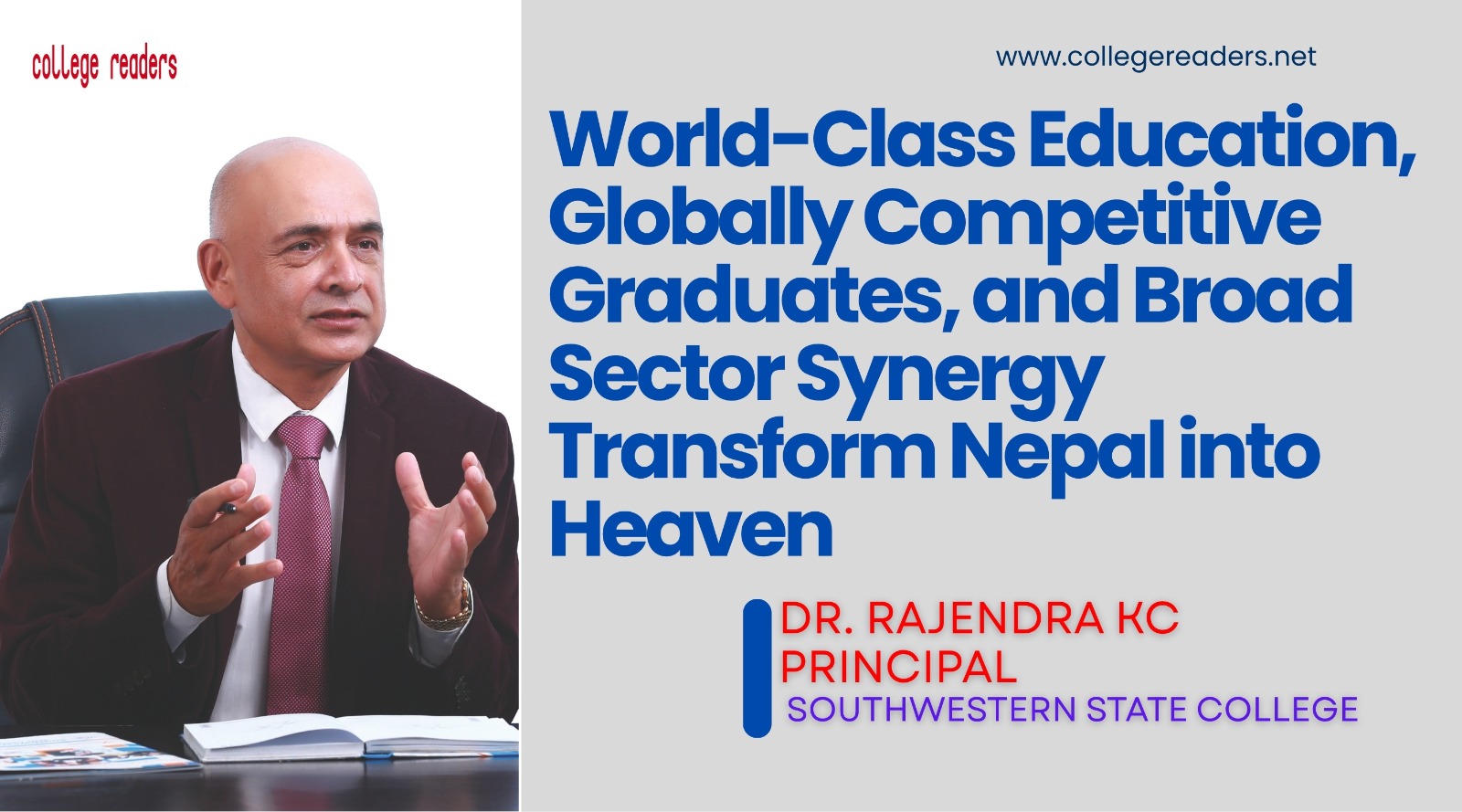
World-Class Education, Globally Competitive Graduates, and Broad Sector Synergy Transform Nepal into Heaven
- College Readers
- 18 May 2026
- Views
- Op-ed , Interviews
Dr. Rajendra KC, Founder Principal of Southwestern State College, stands as a distinguished educational visionary committed to revolutionizing Nepal's academic landscape through globally-relevant, locally-grounded education. With his doctoral expertise and entrepreneurial spirit, Dr. KC has dedicated his career to producing holistic graduates capable of competing internationally while contributing meaningfully to national development. In this exclusive rapid-fire conversation, he shares his profound insights on educational leadership, the critical balance between marks, skills, and character, common mistakes students make during Plus Two transitions, government policy gaps in private education, and his ambitious vision of transforming Nepal into a heaven-like country through transformative educational excellence and reform.
What inspired you toward education?
Education is lifelong commitment. Globally, after PhD completion, scholars naturally gravitate toward education because lifelong learning demands continuous research and development. Youth can deliver everything, and inspiration comes from rebuilding this country through education reform.
What drives you to build Nepal through education?
This country has Himalayas, hills, and Terai—immense resource base. We can reform Nepal by creating curriculum based on national interest and available resources. This conviction motivates everything I do.
How did you transition from teacher to principal?
It came automatically—nobody specifically guided me. When I became principal, I then guided my teachers toward institutional development. Leadership emerged through natural progression of dedicated work.
Biggest challenges in your professional journey?
Many challenges existed in our country—affiliation challenges, land acquisition challenges, building construction challenges, and banking challenges after construction. Our country's authorities lack indicated systems, and Nepal government provides minimal facilitation to educational institutions.
What support does the government provide?
Nepal government does only two things—provides scholarships and conducts limited oversight. Beyond intense struggle to obtain affiliations, currently everything remains essentially closed. No sectoral facilities exist from the state.
How do you remain happy despite struggles?
Happiness isn't readymade—it's a feeling you must cultivate. You can find it earlier, later, or sometimes never throughout life. Happiness is about management. Nobody supports you, but contributing to making Nepal heaven-like itself becomes happiness.
Describe Southwestern State College in one sentence.
Holistic student development—enabling minds, muscles, and complete personhood—producing global citizens whose certificates function universally, not merely as passports.
What does global citizen mean to you?
Our graduates shouldn't feel inferior in America, UK, European countries, or anywhere globally. Education's circle must remain unified worldwide—students should access international opportunities seamlessly while remaining grounded in Nepali identity.
How do you connect education with local sectors?
We connect education with army, corporate sector, and all sectors. Our goal transforms education from local to global, ensuring students engage meaningfully with diverse Nepali sectors while preparing for international engagement.
What's Southwestern's greatest strength?
Government provides identical curriculum to all institutions, but we exceed curriculum boundaries—conducting circuit visits, expo visits, taking students to various Nepali locations, and organizing international visits when possible.
What qualities should students develop?
When farming opportunity arises, they should become farmers. When electrical or technical work demands skills, they should become technicians. When administration calls, they should become administrators. Adaptability across sectors defines true education.
Beyond GPA 4.0, what matters?
GPA 4.0 alone isn't sufficient. We must connect all subjects with all sectors—creating methodology, technology, and systems that integrate knowledge across domains for practical application.
Common mistakes Plus Two students make?
First mistake: not understanding future value of science, management, or law—what does world recognize, what benefits each provides? Second mistake: copying friends' choices when those friends themselves may not succeed in chosen paths.
What should students analyze before choosing?
Students must conduct gap analysis—understand what country needs, what aligns with global demands, what's currently marketable worldwide. Without this awareness, common mistakes affect their entire futures negatively.
What change do you want in education?
State must integrate practical activities, cross-sector collaboration, and extracurricular connections into formal curriculum. This would simplify educational delivery nationwide while maintaining quality standards across all institutions.
How do you define educational leadership?
Our country mistakenly identifies leadership only with politics. Political leadership builds nations through governance; educational leadership builds nations through institutional excellence and academic advancement—both equally crucial.
What makes a great teacher?
Teachers manage 35-40 students with different desires, different schooling backgrounds. Bringing diverse students into unified frameworks requires exceptional intellect, global knowledge, leadership skills, and comprehensive capability.
Biggest challenge in digital age?
Today's students arrive with digital exposure but inconsistent foundational education. Managing this diversity while leveraging digital advantages presents both greatest challenge and significant opportunity.
Marks, skills, or character—which matters most?
All three operate parallel with intrinsic value. They're mutually complementary. Today, marks alone are insufficient—I emphasize being fast rather than first. But marks retain their own value.
Why character matters?
Character should never be lost. I emphasize character because it creates capable leaders, excellent bureaucrats, outstanding CEOs, effective corporate leaders, and trustworthy bankers across all sectors.
How are these three interconnected?
Marks, skills, and character are mutually complementary—all three necessary, all three teachable. We must intentionally cultivate each dimension to produce well-rounded graduates capable of multifaceted success.
Message for SEE graduates?
Visit Southwestern State College personally. Don't make decisions based solely on advertising or peer recommendations. Choose subjects aligned with genuine interests and capabilities, considering global relevance and national needs.
Advice for parents?
Support your children's authentic aspirations rather than imposing your preferences. Create environments where they can explore their interests while developing capabilities matching market demands and personal fulfillment.
Your vision for Nepal's future?
Transform Nepal into heaven-like country through educational excellence. Build institutions producing graduates competing globally while contributing locally. Connect every educational sector with every productive sector for sustainable national development.
Final thought for our readers?
Education isn't just curriculum completion—it's preparation for global citizenship grounded in local responsibility. Choose institutions building character, skills, and marks simultaneously. Remember: be fast, not just first, while maintaining strong character throughout your educational journey and beyond.
Popular Categories
Trending This Month






 Established in 2065 BS, COLLEGE READERS is a premier national-level educational magazine dedicated to serving the academic and informational needs of school and university students, teachers, educators, and concerned ones in Nepal. The magazine provides current and comprehensive information on various educational opportunities worldwide, aiming to guide school and college-level students in their academic and career journeys. It also highlights essential support services and service providers that play a crucial role in shaping students' career paths in today's competitive world.

- Our Location Putalisadak, Kathmandu
- Send Us Email collegereaders123@gmail.com
- Call Us Now 977 01 4518759
