
Call now
977 01 4518759
Send Message
collegereaders123@gmail.com
Our Location
Putalisadak, Kathmandu
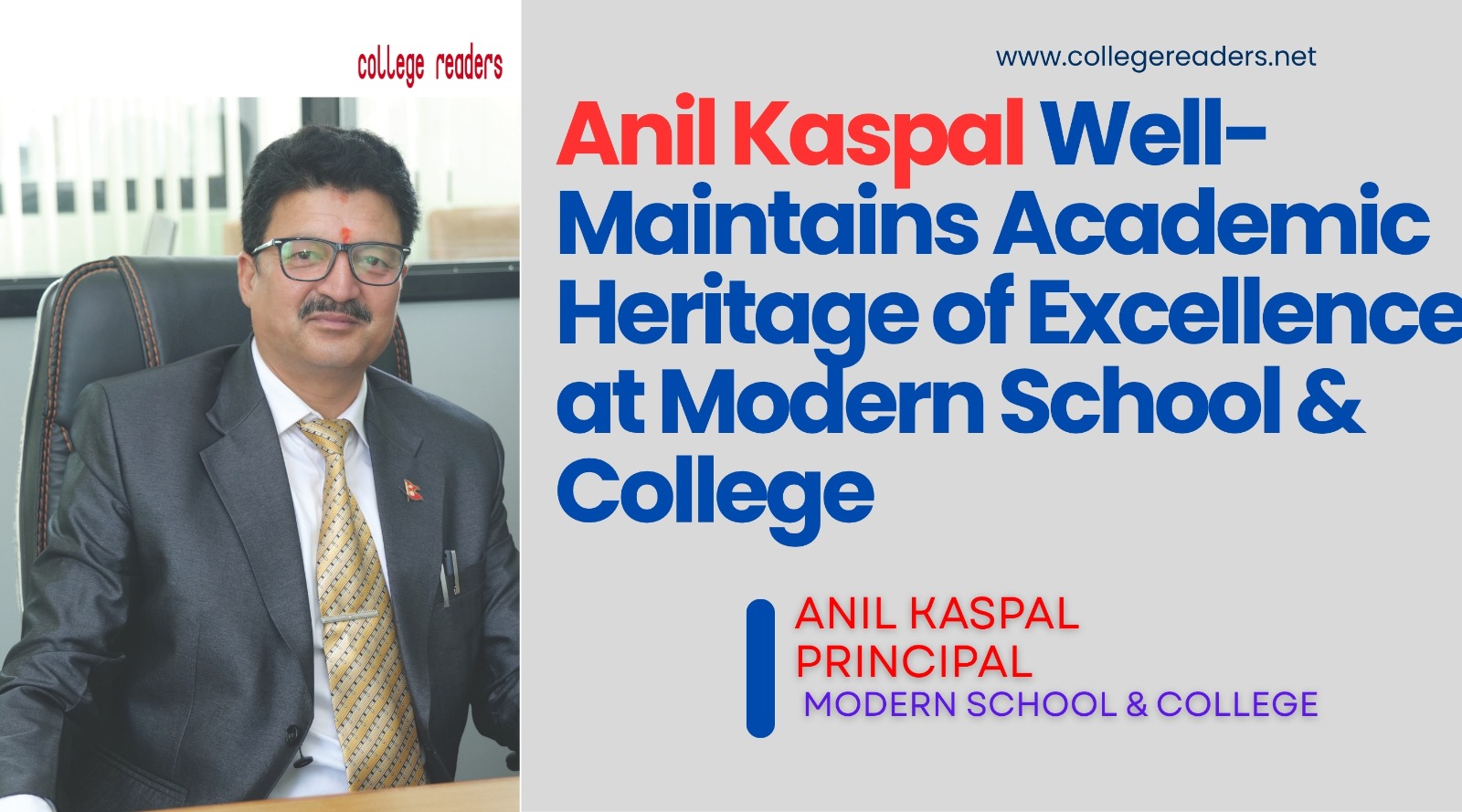
Well-Maintains Academic Heritage of Excellence at Modern School & College
- College Readers
- 18 May 2026
- Views
- Interviews , Op-ed
Anil Kaspal stands as a remarkable figure in Nepal's educational landscape, serving as the Principal of Modern School & College in Bhaktapur—an institution that has flourished for over three decades under his dedicated leadership. His story uniquely intertwines personal aspiration with paternal vision, creating a distinctive narrative of educational entrepreneurship rooted in family legacy and community service. As President of educational associations in Bhaktapur district and visionary leader of one of the region's most respected institutions, Kaspal embodies the transformation of educational possibilities in Nepal's heritage city.
Interestingly, Kaspal never initially envisioned himself entering the teaching profession. His early interests gravitated toward military or police service, complemented by athletic pursuits as a sportsman. However, his father's establishment of a school in 2050 BS fundamentally redirected his life trajectory. His father presented compelling reasoning that resonated deeply with Kaspal: regardless of career path, one ultimately needs sustainable livelihood, and if this school could be successfully established, sustained, and made durable, it would serve the family, community, and nation for generations. His father's wisdom proved particularly poignant given that he had retired from Nepal Bank Limited at the relatively young age of 48, prompting reflection on meaningful post-retirement engagement. This personal example—of needing to contemplate purposeful activity at a relatively young age—convinced Kaspal that educational entrepreneurship offered enduring value transcending traditional career considerations.
From the very first day, Kaspal embraced multifaceted institutional responsibilities. He simultaneously handled teaching, management oversight, supervision, and administrative duties. In their rural Bhaktapur Chitrapur location, recruiting students required personally visiting villages and meeting parents—activities that demanded considerable effort but built crucial community relationships. His natural creativity emerged as a distinctive teaching asset. Despite lacking formal teaching experience, Kaspal developed innovative approaches centered on imagination and student engagement. He composed educational songs leveraging his musical inclinations and writing abilities, transforming complex concepts into memorable, accessible lessons. Within just one to two months, he developed genuine passion for the teaching profession, finding profound happiness in this work that he never anticipated.
Kaspal acknowledges two primary inspirational sources shaping his career: his father's vision in establishing the school, and the students themselves who became his teachers in important ways. He emphasizes that teaching others required first becoming a learner himself—addressing gaps in his own knowledge through dedicated study and continuous improvement. This commitment to self-development alongside student instruction created an environment where personal growth and professional excellence reinforced each other continuously. He attributes his current position entirely to this dual relationship with his father's vision and students' inspiration.
Despite political instability that gripped Nepal after 2052 BS and the conflict that emerged following 2054 BS, Kaspal found himself increasingly absorbed in educational work. Days and nights blurred together as he juggled daytime teaching with nighttime administrative responsibilities—preparing examination questions, printing them using lithographic methods of that era. He briefly established a Montessori in Baneshwor, applying methodologies developed at Modern School, before national instability and expansion concerns prompted strategic recalibration.
Now in his 32nd year of institutional leadership, Kaspal takes immense pride in the institution's graduates. He estimates that approximately 99% of former students have successfully established themselves in various fields—whether as professionals, entrepreneurs, or in self-employment. The transformation he witnesses from humble rural beginnings to graduates serving across Nepal and internationally fills him with deep satisfaction. He particularly cherishes parental feedback expressing gratitude that ordinary villagers, farmers, and economically modest families could see their children achieve remarkable success through Modern School education.
Kaspal observes that Bhaktapur's educational landscape now ranks among Nepal's finest, with results consistently demonstrating excellence. The district hosts approximately 100 schools offering SEE examinations, 14 institutional Plus Two colleges, and 20-25 community colleges. Approximately 90% of these institutions deliver quality education at moderate fees—often significantly less than expensive Kathmandu alternatives while producing comparable or superior results, cultural values, and student conduct. He regrets, however, that despite Bhaktapur's robust educational infrastructure, many students still migrate to Kathmandu for higher studies, reflecting outdated perceptions rather than current realities.
His pedagogical philosophy emphasizes keeping students close to home through Class 12, which he considers crucial developmental years. He notes that students typically excel academically and behaviorally through Class 10, but performance often declines in Classes 11 and 12 when separated from family environments. Therefore, he advocates rising above institutional self-interest to support students completing their education in environments offering familial connections and community values.
Regarding quality education standards, Kaspal articulates a comprehensive vision extending beyond physical infrastructure. While Modern School has evolved from a small rented building in 2050 BS to ultra-modern facilities with smart boards and advanced technology by 2083 BS, he emphasizes that genuine quality education encompasses language, culture, traditions, society, and patriotic values. These foundational elements must originate at home and be complemented—not solely provided—by educational institutions. He defines quality education holistically, encompassing practical knowledge, communication, behavior, and the cultivation of authentic human beings. He warns that physical facilities can have both positive and negative impacts; resources must be deployed thoughtfully to support character development rather than undermine it.
Modern School cultivates this holistic development through numerous initiatives. Daily activities include welcoming students with namaskar greetings, conducting school morning assemblies (SMB) in both school and Plus Two sections, and using natural metaphors—the disciplined rising and setting of sun and moon—to teach students about constructive engagement with the world. The institution celebrates diverse cultural traditions through major annual programs reflecting various community backgrounds of enrolled students, ensuring all heritages receive appropriate recognition.
The institution's historic achievements validate Kaspal's educational philosophy. The first SLC batch graduating in 2060 BS produced Bhaktapur's first district-level distinction holders during Nepal's distinction system introduction—making Modern School the institution with most distinctions in Bhaktapur, with all students passing in First Division. By 2061 BS, students achieved national recognition: Narayan Prajapati ranked 7th, while Naveen Khadka ranked 9th nationally and later topped Nepal in Class 11 with 91%, setting national records.
The institution began with merely two students for the first month on Poush 1, growing to 98 students by Baisakh. Today, Modern School & College serves 3,500 students including Plus Two programs. Currently operating Plus Two in Dalikot and Bhaktapur Model English School locations, plus BBS bachelor's programs, the institution maintains 100-120 BBS students across four years. Kaspal acknowledges challenges including governmental neglect of BBS curriculum modernization and increasing student migration abroad, yet continues operating these programs to provide options as the country evolves.
For SEE graduates selecting Plus Two institutions, Kaspal provides thoughtful guidance. He emphasizes subject selection before college choice, encouraging students to identify genuine interests through consultation with teachers who know them well and parents who understand family circumstances. He advocates studying close to home, arguing that time savings benefit growing adolescents who should engage with family responsibilities, community activities, internships, sports, and extracurricular pursuits during this developmental period. He cautions against advertisement-driven decisions, peer pressure, or attraction to large buildings, urging investigation of actual results, teaching faculty quality, student culture, and extracurricular activities before commitment. Excellent institutions often don't engage in extensive promotional activities—instead, their authentic quality manifests through student achievements and community reputation.


Popular Categories
Trending This Month






 Established in 2065 BS, COLLEGE READERS is a premier national-level educational magazine dedicated to serving the academic and informational needs of school and university students, teachers, educators, and concerned ones in Nepal. The magazine provides current and comprehensive information on various educational opportunities worldwide, aiming to guide school and college-level students in their academic and career journeys. It also highlights essential support services and service providers that play a crucial role in shaping students' career paths in today's competitive world.

- Our Location Putalisadak, Kathmandu
- Send Us Email collegereaders123@gmail.com
- Call Us Now 977 01 4518759
