
Call now
977 01 4518759
Send Message
collegereaders123@gmail.com
Our Location
Putalisadak, Kathmandu
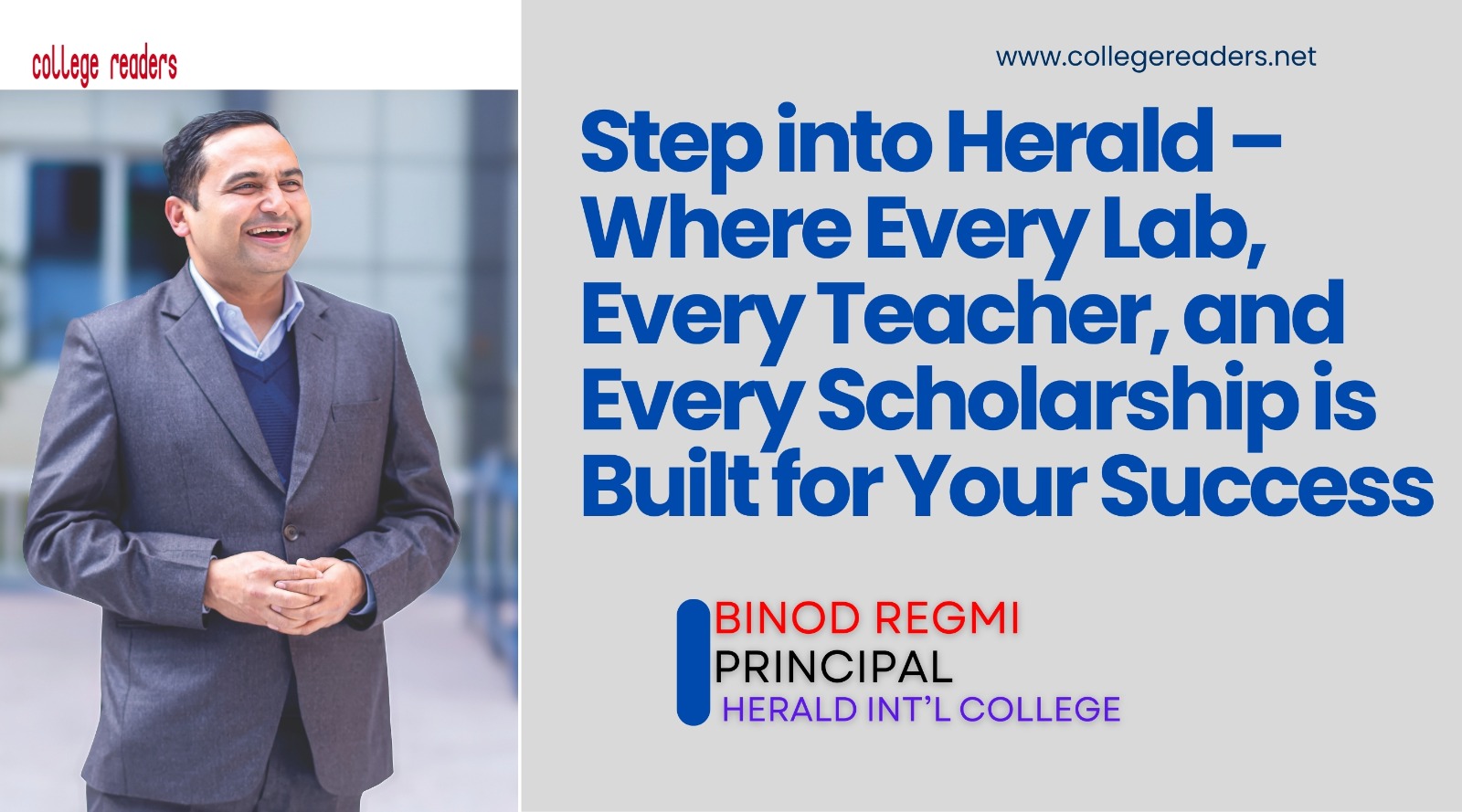
Step into Herald – Where Every Lab, Every Teacher, and Every Scholarship is Built for Your Success
- College Readers
- 18 May 2026
- Views
- Interviews , Op-ed
In this conversation with College Readers, Assoc. Prof. Binod Regmi, Principal of Herald School & College, sets out how an institution founded in 2063 BS now seeks to translate the country’s twentieth-century Plus Two curriculum into a twenty-first-century classroom. He maps the digital infrastructure his teachers and students now operate within, lays out Herald International College’s four NEB-certified streams and integrated facilities, and details a counselling-led pathway that ties Grade Eleven choices to long-term careers. International alliances with schools in China and Canada, structured scholarships, and a published list of twenty-first-century skills round out his vision. His closing message to parents and students alike: choose by passion, never under pressure.
In this digital era, how have you integrated technology into classroom teaching and learning at Herald?
We have fully embraced the digital era and built it into the daily rhythm of our classrooms rather than treating it as an add-on. Well-equipped laboratories and multimedia rooms now sit at the centre of our teaching, supporting interactive and engaging learning instead of passive delivery. Both our teachers and our students have undergone extensive training so that they can blend traditional pedagogical methods with modern technological tools — smart classrooms, curated online resources, and recognised e-learning platforms among them. The result is a learning environment that genuinely prepares our students for the realities of a rapidly evolving digital world and equips them with the practical skills that environment will increasingly demand of them. Our digital integration is also supported by continuous in-service training for our teachers, regular pedagogical reviews, and a willingness to update our toolkit as the technology itself moves.
What are the major features and attractions of your school for the Plus Two programmes at Herald International College?
Our Plus Two programmes have been shaped by nearly two decades of continuous operation since our founding in 2063 BS, and a few features genuinely distinguish our offering in the Kathmandu Valley. First, we run all four NEB-certified streams under one roof — Science, Management, Law, and Humanities — with structured options inside each, from Physical and Biological groups in Science to Computer Science, Hotel Management, and Business Studies in Management. Second, our infrastructure is purpose-built: Physics, Chemistry, and Biology laboratories, a computer lab, a library with quiet reading zones, and seminar and presentation rooms support hands-on practical work alongside theory, while GPS-tracked college buses and CCTV-covered campus zones keep daily life safe and predictable. Third, our experienced faculty are reinforced by industry-aware guest lecturers, and the NEB-certified curriculum covers more than thirty-one subjects through an interdisciplinary, project-based approach. Fourth, our academic rhythm is deliberate: a mandatory quality entrance test, regular internal assessments, terminal exams, pre-board trials, and structured parent-coordinator meetings after every terminal exam. Fifth, we publish merit-based and need-based scholarship rules at every intake, with clear provisions for differently-abled and deserving students. Together these form what we mean by Education for Excellence.
Plus Two education significantly determines a student’s future. What efforts are you making to help students realise their dreams?
We treat Plus Two as the bridge between school and university, and as the period in which most lifelong career trajectories are quietly set. Our students therefore receive personalised career counselling from the day they arrive, designed first to identify each student’s passion and then to align it with a realistic professional path. Our experienced faculty provide rigorous academic training in the chosen field, while skill-development workshops and structured internships translate classroom knowledge into practical capability over the two years. Real-world exposure is widened further by our institutional alliances with partner schools in China and Canada, which open doors that are rarely available to a single-campus institution and offer student-exchange opportunities, exposure visits, and a comparative window onto how peers elsewhere are preparing for the same global market. Scholarships and need-based financial aid sit alongside all of this, so that ambition is not silently filtered out by household income. Taken together, these are the levers by which we try to convert a dream stated at sixteen into a profession lived confidently at twenty-six.
SEE graduates often feel confused about which subjects to choose for further studies. What key factors should they consider when selecting a stream?
I would offer four anchors. The first is passion. Subjects that genuinely engage a student produce greater motivation, deeper satisfaction, and ultimately better results than streams chosen by reflex or by parental insistence. The second is alignment with long-term goals; SEE performance matters, but it is one input among several. Each stream should be tested honestly against the career paths it actually opens, the higher-education options it enables, and the working culture of the field it leads into. Researching the practical demands of each field — daily routines, entrance requirements, realistic earnings, and international mobility — sits at the heart of an honest stream choice. The third is candid self-assessment of the effort the student is willing to put in, because every stream rewards perseverance and quietly punishes drift. The fourth is informed conversation: teachers, counsellors, and working professionals can place academic enthusiasm against practical reality far more accurately than any college brochure ever can. Above all, students should keep flexibility in mind — careers evolve, and the right Plus Two choice should leave room for growth rather than narrow it prematurely.
Finally, what message would you like to convey to parents and students on selecting the institutional choice for Plus Two education?
First, congratulations to every student and family on completing the SEE, and my warmest wishes for a bright path ahead. As you choose a college, prioritise an institution that values your interests rather than one that quietly pressures you into a particular stream. Examine the academic reputation seriously, including the qualifications of the faculty and the depth of available resources. Look for a student-centric culture in which your development and well-being are central to the institution’s mission, not peripheral to its marketing. Seek out former students of the college; their experience after graduation is the most reliable guide you will ever find. Study the academic calendar and the student-development programmes to see whether twenty-first-century skills — critical thinking, confidence, communication, and collaboration — are genuinely taught or merely advertised. Assess the management and teaching team for the environment they actually create, day in and day out. With those filters honestly applied, the right choice becomes much clearer. We therefore encourage every family to take the time to visit, observe, listen, and verify what they hear. From all of us at Herald School & College, you are warmly welcomed to visit our Basundhara campus and enter the avenue of a quality life.


Popular Categories
Trending This Month






 Established in 2065 BS, COLLEGE READERS is a premier national-level educational magazine dedicated to serving the academic and informational needs of school and university students, teachers, educators, and concerned ones in Nepal. The magazine provides current and comprehensive information on various educational opportunities worldwide, aiming to guide school and college-level students in their academic and career journeys. It also highlights essential support services and service providers that play a crucial role in shaping students' career paths in today's competitive world.

- Our Location Putalisadak, Kathmandu
- Send Us Email collegereaders123@gmail.com
- Call Us Now 977 01 4518759
