
Call now
977 01 4518759
Send Message
collegereaders123@gmail.com
Our Location
Putalisadak, Kathmandu
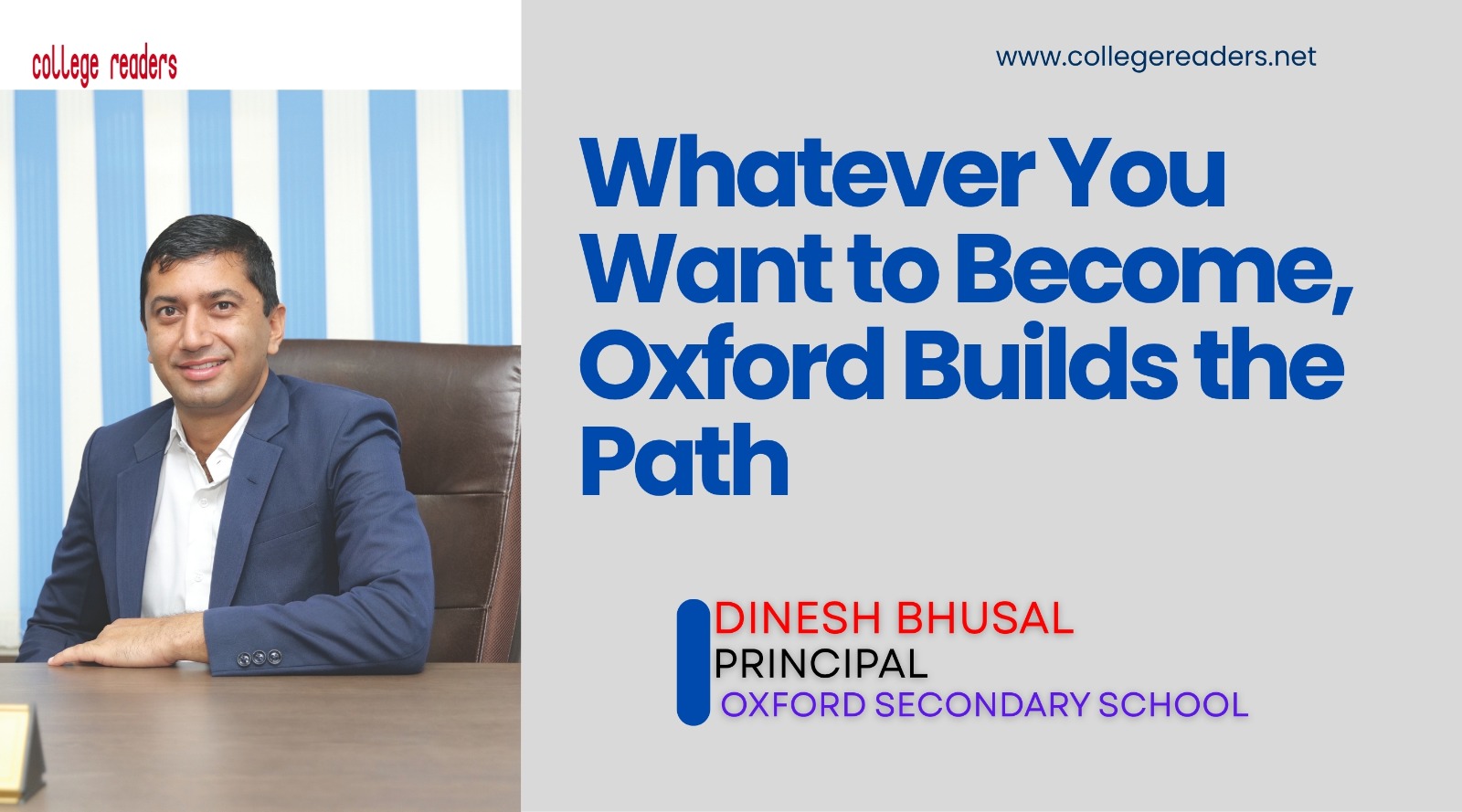
Whatever You Want to Become, Oxford Builds the Path
- College Readers
- 18 May 2026
- Views
- Op-ed , Interviews
Dinesh Bhusal, Principal of Oxford Secondary School, draws on the institution’s twenty-two-year record and a current enrolment of nearly 1,800 students to map the new shape of Plus Two education in the districts. He notes that the once-strong migration to Kathmandu has weakened sharply as mofussil colleges have caught up on faculty, results, and student-friendly environments. His sharpest contribution lies in subject selection: parental pressure has declined and student choice has correspondingly risen, he says, but interest alone is misleading without a matching capacity. Self-reflection, candid conversations with former teachers, and an honest assessment of one’s own academic character must precede every stream decision.
There is a clear sense that the old rush to Kathmandu for Plus Two has slowed. How do you read this shift?
It has certainly slowed, and we now see the evidence almost weekly. In earlier years a strong wave of students left for the capital after the SEE; today that number has fallen sharply. We even see students who initially enrolled in Kathmandu transferring back to local colleges within their first semester. Two reasons stand out. Students get to remain at home with their parents at a stage when family stability matters greatly, and mofussil colleges have themselves become genuinely competitive — in faculty, in infrastructure, and crucially in the results they are now producing year after year.
What has changed in mofussil colleges to make this possible?
Quite a lot, and the change has been steady rather than sudden. Teaching faculties have professionalised, physical infrastructure has improved, and extracurricular and skill-based provisions have moved from afterthoughts to standard offerings. Peer culture is another factor — when an entire batch chooses to stay locally rather than scatter, the academic environment thickens around them, and discipline becomes a shared habit rather than an individual struggle. The result is that today, when a family compares a mofussil college with one in the Valley, the decisive variable is no longer location but the specific match between the student and the institution they are considering.
When a guardian walks into a college for the first time, what should they actually examine?
Several things, in roughly this order. First, look at how student-friendly the environment is and what past results actually suggest. Second, ask what extracurricular activities and student-centred programmes the college runs, not merely what it advertises. Third, examine the physical infrastructure and the distance from home; a long daily commute drains both energy and study time. Then look closely at the teachers — not only at their qualifications but at how they understand and behave with children inside the classroom. Finally, ask how much project work and applied skill is integrated into regular teaching. Where possible, take feedback from former students; their reports are the most honest review any institution receives.
Subject selection is the next major decision. How should a student approach it?
I treat this as the most decisive single choice of the Plus Two journey, because the subject you select largely shapes the career direction you walk into. There is good news here: parental force has declined visibly in recent years, and students themselves are taking the lead in deciding. But that freedom brings its own danger. Many students declare a stream the way they declare a favourite team — by impulse, peer pull, or vague aspiration, and the consequences only surface a year later. My request is that they pause and ask themselves three questions: What am I genuinely capable of? Where does my interest lie? And do those two answers actually point in the same direction?
You often distinguish between interest and capacity. Why is that distinction so important?
Because they are constantly confused, and the cost of confusing them is high. A student may say with full conviction that she wants to study science and pursue medicine or nursing — and her interest may indeed be genuine. But interest is not the same as the academic character required to carry that interest forward. The discipline of Class Eleven science demands certain foundations, particularly in mathematics and lower-secondary science. If those foundations are missing, sincere interest can still end in a lost year or a forced subject change. I therefore ask students to perform two honest tests: examine their own academic record across the subjects they have actually studied, and consult the teachers who taught them earlier. Those teachers often know things about a student’s strengths and limits that the student has not yet noticed.
What specific support does Oxford offer once a student has chosen?
We work on two tracks simultaneously: the prescribed curriculum and additional preparation aligned to a student’s actual ambition. Students aiming at engineering or MBBS receive separate, structured entrance-preparation classes from early in Grade Eleven. Those drawn toward literature, sports, IT, or other skill-based fields find equivalent programmes built around them, with project-based and skill-based learning at the centre. Hotel Management, Computer Science, and Management students in particular learn through applied projects rather than lecture alone. Our underlying commitment is straightforward — to safeguard the rights and interests of every student, to recognise each student’s particular capacity, and to bring it fully into the open during the two years she spends with us.
A closing message for the SEE graduates currently weighing their options.
Two pieces of advice, then. First, do not let imagination alone carry you forward; success at this stage is built on sincere, daily effort. Below the age of twenty-five, your career is in its formative years, and what you put in now will define what you can ask of life later. Second, when you choose a college, study its faculty, speak to its current and former students, and visit in person rather than rely on word of mouth. If you choose with that level of seriousness, the institution will rise to meet you. From all of us at Oxford Secondary School, my warmest wishes for a bright and confident path ahead for every one of you.


Popular Categories
Trending This Month






 Established in 2065 BS, COLLEGE READERS is a premier national-level educational magazine dedicated to serving the academic and informational needs of school and university students, teachers, educators, and concerned ones in Nepal. The magazine provides current and comprehensive information on various educational opportunities worldwide, aiming to guide school and college-level students in their academic and career journeys. It also highlights essential support services and service providers that play a crucial role in shaping students' career paths in today's competitive world.

- Our Location Putalisadak, Kathmandu
- Send Us Email collegereaders123@gmail.com
- Call Us Now 977 01 4518759
