
Call now
977 01 4518759
Send Message
collegereaders123@gmail.com
Our Location
Putalisadak, Kathmandu
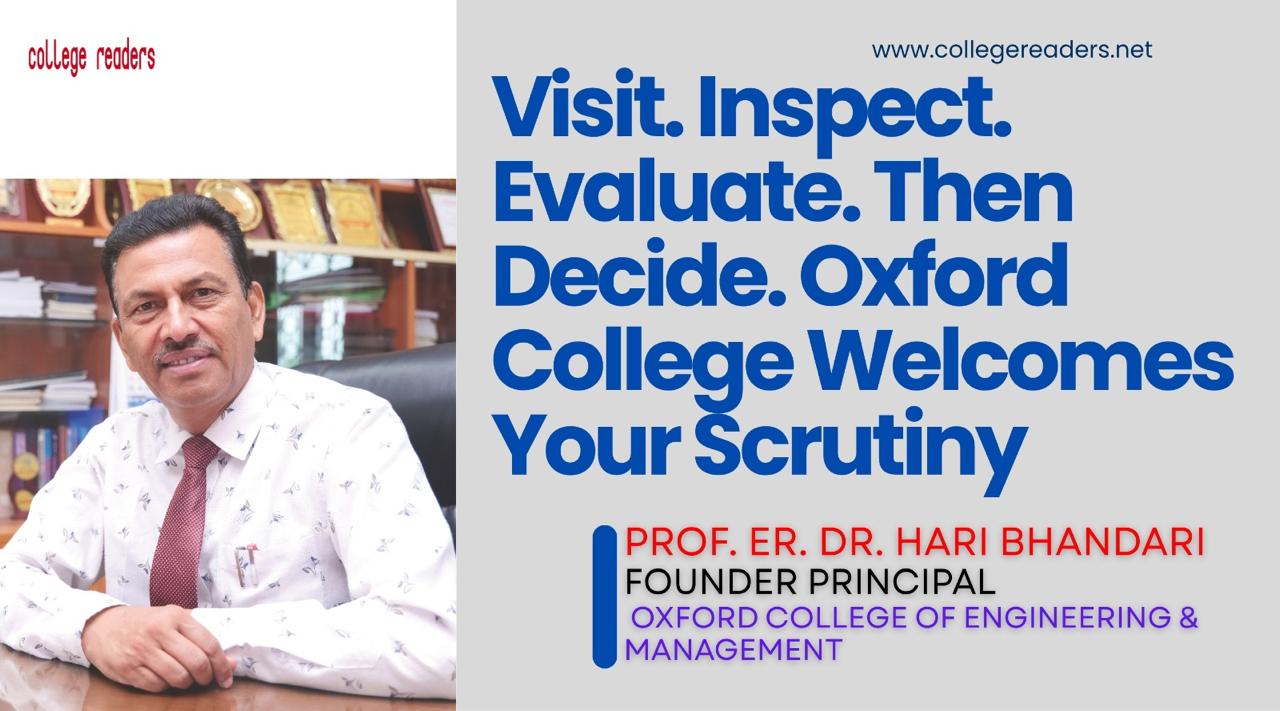
Visit. Inspect. Evaluate. Then Decide. Oxford College Welcomes Your Scrutiny
- College Readers
- 18 May 2026
- Views
- Interviews , Op-ed
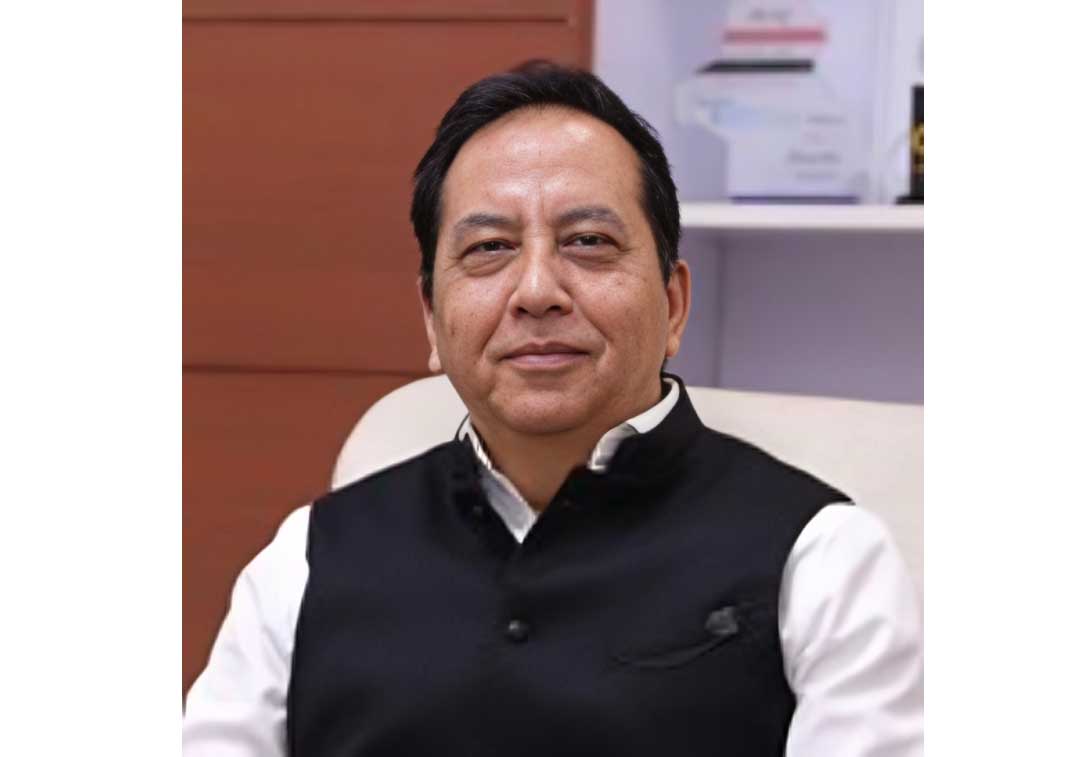
of Engineering & Management and Chairman of ten academic organisations, urges SEE graduates and their guardians to abandon hearsay and make Plus Two choices through careful, first-hand inspection. Drawing on four decades in education, he redefines quality not as price or prestige but as the successful fulfilment of a student’s particular requirement. He outlines a practical fifteen-point test for evaluating colleges, argues that subject selection must follow each student’s inner aptitude, and warns that any modern education lacking computer literacy is incomplete. His core appeal to families: visit, listen, and decide for yourself.
There was once a strong trend of Nepali students leaving the country for Plus Two. How has that changed?
The trend has clearly diminished, particularly in Kathmandu. In earlier years families felt compelled to send their children abroad because good local colleges simply did not exist; today the environment has changed considerably. We are also receiving sobering accounts of students who went overseas only to fall into addiction or directionless lives. The lesson is plain: many Nepali colleges now offer comparable quality, and going abroad is no longer the default mark of seriousness. I extend my advance congratulations to this year’s SEE graduates and urge them to evaluate domestic options with confidence before looking outward.
Should students therefore stay in their own districts, or move to the capital?
That decision must rest on the specific programme they wish to pursue. For most mainstream streams, mofussil colleges today are entirely adequate. If a particular programme is not available locally, students may consider the provincial capital or district headquarters before moving to Kathmandu. My request to candidates and guardians is simple: go yourself, observe the college carefully, talk to its staff, and ask honestly whether your child’s future will be safe there. Knowledge is acquired in four ways — through study, through hearing, through observation, and through lived experience. The first three should guide your choice; the fourth follows only after enrolment.
How would you define quality in education?
Quality is the successful fulfilment of your requirement. A Kathmandu school charging ten lakh a year may indeed offer excellent teaching, but if a family can afford only one lakh, that school is not quality for them. Quality must match capacity, ambition, and purpose. A truly quality institution also runs on disciplined management — by which I mean delivering maximum output through minimum resources, neatly and on time. Many colleges today have everything on paper yet falter precisely here. Walk into any institution and within minutes a discerning visitor can tell whether the management is real or merely advertised.
When parents visit a college, what should they actually look for?
I usually offer guardians a fifteen-point checklist. Begin with the quality of management, then the experience and approachability of the teachers, then the infrastructure — not just the building, but what is inside it. Examine the technology in use, the age and track record of the institution, and whether the college owns its premises or runs from rented quarters; an owned campus survives any change in ownership. Look for a working library and a credible online learning environment. Examine the personal attention each child is likely to receive, since impersonal classrooms rarely build confident learners. Most decisively, study the leadership — is the principal or chairman a visionary, strategic, and devoted person? Finally, weigh both the national and international brand. Apply these fifteen tests and the right choice becomes obvious.
How should a student choose between science, management, law, computer science, or other streams?
The first criterion is the student’s own inclination, which is rarely accidental. Nature, family upbringing, and early exposure together produce a particular aptitude — for argument, for numbers, for music, for design — and this should guide the choice of stream. A gifted singer forced into medicine, or a logical mind diverted from law, will struggle to flourish. The second criterion is local availability of a college that can serve that aptitude well. Where both align, the path forward is clear. Where they do not, students should be willing to travel for the right programme rather than settle for the wrong one nearby. Four decades of teaching have shown me that no subject is inherently difficult once a student has chosen it with genuine sincerity.
How important is computer literacy in today’s education?
Indispensable. Whichever stream you pursue — management, science, engineering, law, mass communication, agriculture, or nursing — computer science cannot be excluded. Even a PhD scholar in Nepali literature today must learn to work with computers, because every modern profession is tested on a screen. Equally, today’s children too often master their phones yet cannot buy a vegetable from the market or fetch a paracetamol when someone at home is unwell; a complete education marries digital fluency with everyday capability. I therefore advise students to choose colleges with strong computer facilities, and to treat technology not as a side subject but as the spine of their education. Study for yourself, not for parents or siblings. When motivation comes from within, your reading deepens, your discipline sharpens, and success follows almost automatically.
A closing message for SEE graduates and their guardians.
Do not be misled by hearsay. Read our website and brochures, visit the campus, listen to our team, and only then form your judgement. Quality education depends on four pillars — the student, the parents, the college, and the surrounding environment. Get those right and the rest follows. At Oxford College, I can say with pride that we have built the infrastructure, the brand, and the academic culture worthy of being called a destination institution. Yet the final decision must always belong to you. Whatever your child wishes to become — doctor, engineer, lawyer, communicator — guide them with care, and choose the college that earns your trust.

Popular Categories
Trending This Month






 Established in 2065 BS, COLLEGE READERS is a premier national-level educational magazine dedicated to serving the academic and informational needs of school and university students, teachers, educators, and concerned ones in Nepal. The magazine provides current and comprehensive information on various educational opportunities worldwide, aiming to guide school and college-level students in their academic and career journeys. It also highlights essential support services and service providers that play a crucial role in shaping students' career paths in today's competitive world.

- Our Location Putalisadak, Kathmandu
- Send Us Email collegereaders123@gmail.com
- Call Us Now 977 01 4518759
