
Call now
977 01 4518759
Send Message
collegereaders123@gmail.com
Our Location
Putalisadak, Kathmandu
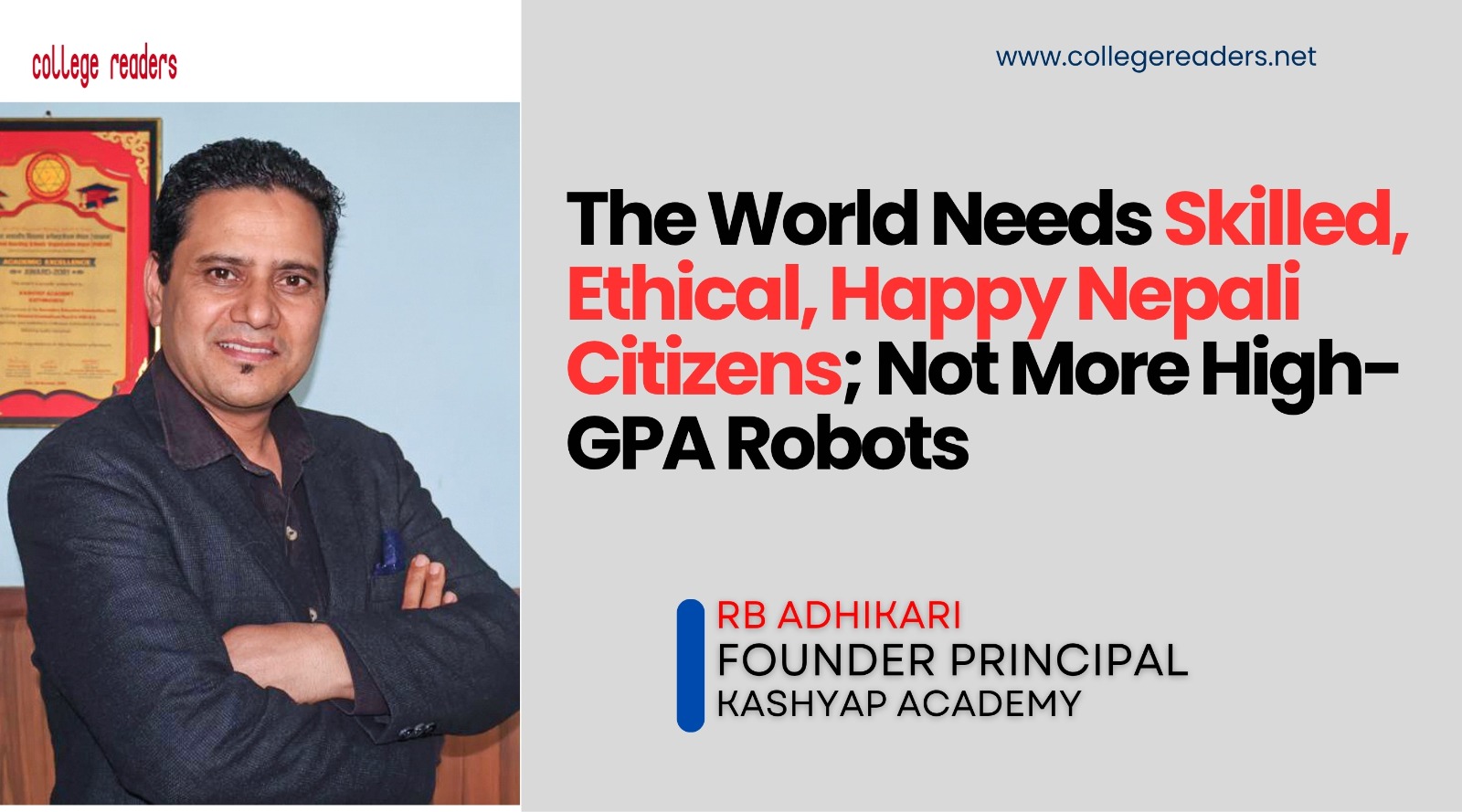
The World Needs Skilled, Ethical, Happy Nepali Citizens; Not More High-GPA Robots
- College Readers
- 19 May 2026
- Views
- Interviews , Op-ed
Nepal’s Plus Two education stands at a decisive turning point. Grades 11 and 12 are formally part of school education, yet our social psychology still treats them as college or pre-university education. This contradiction has created confusion among students, parents, institutions, and policymakers. If we want to make this level meaningful, disciplined, and future-oriented, we must first accept its real identity: Plus Two is school education, and students at this level are still minors who need guidance, structure, counselling, and opportunity.
The first major challenge is psychological. After SEE, many students feel they have entered complete freedom. Parents also begin to reduce their direct communication with schools, and institutions often promote Grades 11 and 12 as college life rather than continued schooling. This creates premature independence. Students detach from parental guidance, resist teacher-parent communication, and sometimes become attracted to distractions rather than discipline. The result is a gap between expectation and reality. Students dream big, parents expect even more, but the required effort, habits, and responsibility are often missing.
Therefore, Plus Two institutions must build a school-based culture with maturity-appropriate freedom. Running Grades 11 and 12 like disciplined school education does not reduce quality; it strengthens it. When students spend more meaningful time within an academic system, develop regular study habits, and remain connected with parents and teachers, quality improves. However, school psychology should not mean narrow learning. Institutions must provide better laboratories, libraries, sports facilities, clubs, counselling, career exposure, and creative spaces. Students need both discipline and opportunity.
Another urgent issue is the overemphasis on GPA, certificates, and outdated career dreams. GPA is important, but it is not the whole purpose of education. For decades, society has pushed students mainly toward medicine, engineering, and a few traditional professions. Those professions remain valuable, but today’s learners will compete in a society five to ten years ahead. They will need new technological skills, professional competencies, social intelligence, creativity, entrepreneurship, and adaptability. Preparing them only for board examinations is unfair to their future.
The 21st century demands technological readiness, but not technological addiction. Many students are highly energetic and intelligent, yet technology has also filled their minds with confusion, entertainment, distraction, and emotional disorder. Earlier, backwardness was often physical or material; today, a new kind of mental disorder is emerging from uncontrolled digital exposure. Schools must therefore teach students how to use technology professionally, ethically, and productively. Artificial intelligence, robotics, digital platforms, and online tools should not be introduced merely for fashion or attraction. They must help students create knowledge, solve problems, improve livelihoods, and serve humanity.
Human values must remain at the centre of all educational reform. Technology, capital, and modern tools are only means; they are not the final goal. The final goal is a meaningful life, responsible citizenship, humanity, happiness, and social contribution. If technology cannot strengthen character, family responsibility, social responsibility, and inner wellbeing, it may backfire. Plus Two education must therefore combine digital skills with personal and social skills. Students should learn empathy, discipline, cooperation, communication, critical thinking, civic responsibility, and respect for culture.
A future-ready education system should also recognize extracurricular and co-curricular activities as possible career pathways. A student who dances well, plays cricket, creates digital content, designs, debates, codes, leads clubs, or plays basketball may already possess a developing skill. Today, young athletes, artists, creators, entrepreneurs, and innovators can build careers very early. Schools should not make students merely “bookworms.” Academic content must remain strong, but ECA and CCA should be treated as serious platforms for personality development, confidence, teamwork, leadership, and employability.
Nepal’s curriculum is not fundamentally weak. It is average and contains many necessary themes. The bigger problem is slow updating and weak implementation. In technology-related areas, knowledge becomes outdated very quickly. A course considered latest today may become irrelevant within months or a year. Some studies suggest that a significant portion of today’s skills may become outdated by 2030. Therefore, curriculum revision must be faster, more research-based, and more connected with emerging labour markets, technology, entrepreneurship, and social change.
At the same time, we must not ignore Nepal’s native knowledge and Eastern philosophical foundation. Human values do not become obsolete like software. The qualities required for good human beings fifty or hundred years ago—honesty, compassion, discipline, respect, courage, and responsibility—will remain necessary fifty years later. Nepal has a rich cultural and intellectual heritage that can guide character formation, wellbeing, and social harmony. Our curriculum often gives more attention to modern and Western models while underusing local wisdom. A balanced education must connect global competence with native strength.
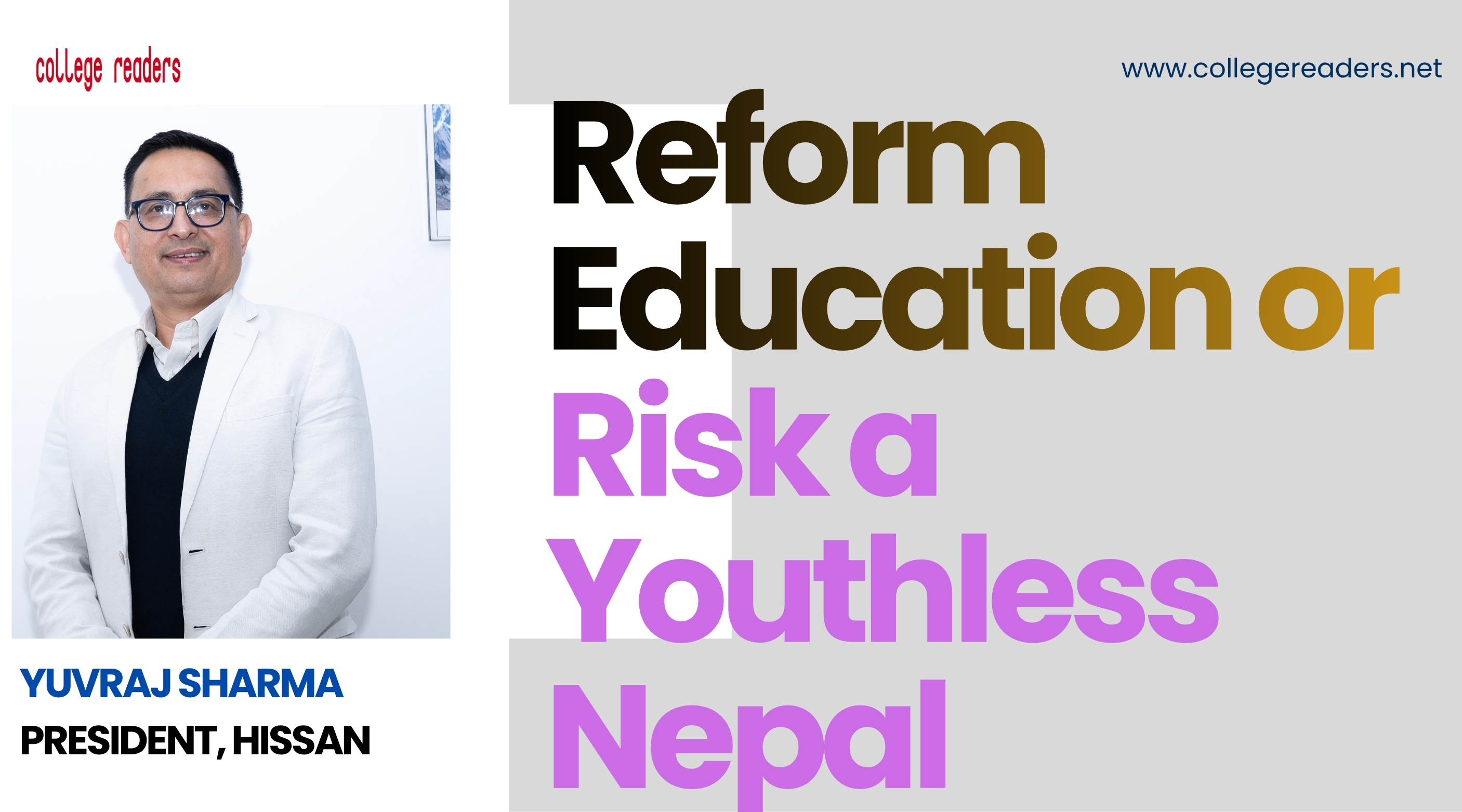
Institutional leadership has a decisive role in this transformation. Organizations such as HISSAN should not limit themselves to professional rights or negotiations with the government. They must contribute academically through research, policy dialogue, curriculum suggestions, teacher development, and innovative models. Academic councils, expert discussions, and partnerships with social scientists, educators, and industry leaders are essential. We must ask: what skills, values, knowledge, and attitudes will Nepali youth need ten years from now?
Private institutions also have space to add meaningful programs beyond the official curriculum. They can introduce modules on technology, entrepreneurship, financial literacy, communication, research, ethics, wellbeing, innovation, community service, and career exploration. At the same time, constructive partnership with the National Examination Board and government curriculum bodies is necessary. Education leads society, forecasts future needs, prepares skills, and shapes citizens. Therefore, academicians must accept both the challenge and the opportunity to set new trends.
The next decade of Plus Two education should be guided by a clear vision: disciplined schooling, professional technological skills, entrepreneurial thinking, strong human values, extracurricular career opportunities, and holistic personality development. We must produce not only high-GPA students, but skilled, ethical, happy, responsible, and innovative citizens. If we can balance knowledge, skills, character, and wellbeing, Nepal’s Plus Two education can truly serve the coming generation and help build a capable, humane, and future-ready society. This is the promise our schools must courageously fulfill together now.
Popular Categories
Trending This Month








 Established in 2065 BS, COLLEGE READERS is a premier national-level educational magazine dedicated to serving the academic and informational needs of school and university students, teachers, educators, and concerned ones in Nepal. The magazine provides current and comprehensive information on various educational opportunities worldwide, aiming to guide school and college-level students in their academic and career journeys. It also highlights essential support services and service providers that play a crucial role in shaping students' career paths in today's competitive world.

- Our Location Putalisadak, Kathmandu
- Send Us Email collegereaders123@gmail.com
- Call Us Now 977 01 4518759
