
Call now
977 01 4518759
Send Message
collegereaders123@gmail.com
Our Location
Putalisadak, Kathmandu
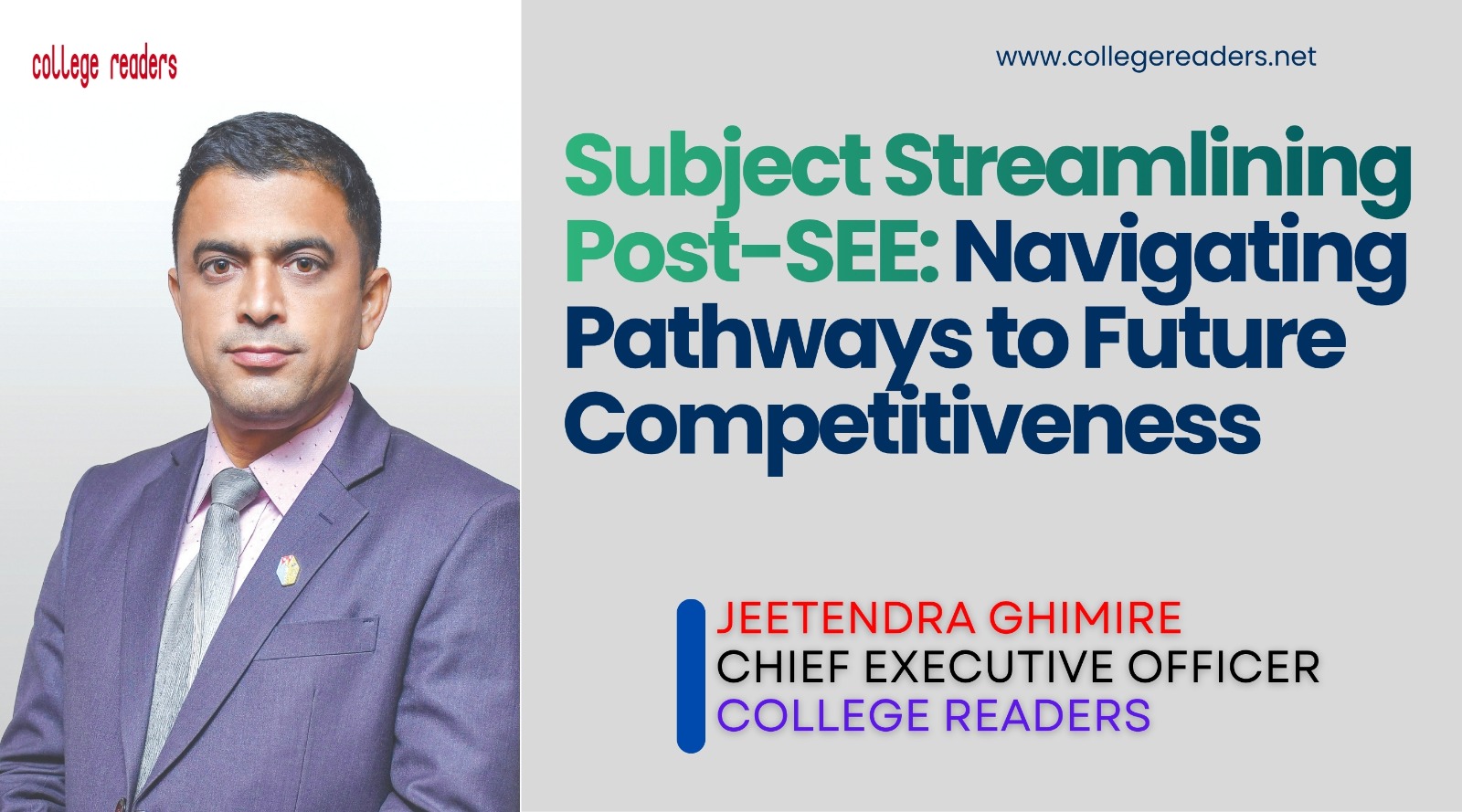
Subject Streamlining Post-SEE: Navigating Pathways to Future Competitiveness
- College Readers
- 19 May 2026
- Views
- Op-ed
Choosing a subject after SEE is not merely an academic formality; it is a decisive moment that can shape a student’s confidence, career direction and future identity. Every year, thousands of students enter Grade 11 carrying dreams, while parents enter the admission process with expectations, anxieties and social comparisons. The result is often confusion rather than clarity.
One common mistake in our society is to rank subjects as superior or inferior. Science is still viewed as the destination of excellent students, Management as the option for average students, and Humanities or Education as the choice for those with weaker grades. This mindset is deeply unfair. A subject does not become valuable because of social prestige; it becomes meaningful when it matches the learner’s interest, ability and life goal.
After SEE, many parents pressure children to follow a path chosen by family, relatives or neighbours. Some push Science because they believe it keeps all doors open. Others prefer Management because they see business opportunities. But a student forced into an unsuitable subject may lose motivation, perform poorly and develop frustration. Education should not begin with pressure; it should begin with understanding.
Grades 11 and 12 certainly create the foundation for higher studies, but they should not become a prison. Around the world, education is moving toward interdisciplinary learning. Students’ interests can change with exposure, experience and maturity. Therefore, universities, colleges and families must support flexible academic pathways instead of locking young learners into narrow choices too early.
The right decision requires careful preparation. Students and parents should collect reliable information from colleges, official sources and experienced educators. They should discuss subject combinations, university possibilities, technical alternatives, market demand and future careers. In Nepal, students now have several routes, including the +2 system under NEB, technical education through CTEVT, and international boards such as A-Level, IB and CBSE. Each path has value, but only when chosen with purpose.
Family discussion is important, yet the student’s voice must remain central. Parents may guide, warn and share experience, but they should not impose. Similarly, students should not choose a subject simply because friends are choosing it. Friendship may continue in many ways, but career direction is personal.
Technology and Artificial Intelligence are rapidly changing the job market. The future will reward creativity, adaptability, communication, critical thinking and technical competence. Therefore, subject selection should connect passion with practical possibilities.
The real question after SEE is not “Which subject is best?” It is “Which subject is best for this student?” When parents, teachers and students answer this honestly, Grade 11 becomes not a burden of confusion, but a confident beginning of purposeful education. Such wisdom can protect young minds from regret and unnecessary academic failure later.
Popular Categories
Trending This Month








 Established in 2065 BS, COLLEGE READERS is a premier national-level educational magazine dedicated to serving the academic and informational needs of school and university students, teachers, educators, and concerned ones in Nepal. The magazine provides current and comprehensive information on various educational opportunities worldwide, aiming to guide school and college-level students in their academic and career journeys. It also highlights essential support services and service providers that play a crucial role in shaping students' career paths in today's competitive world.

- Our Location Putalisadak, Kathmandu
- Send Us Email collegereaders123@gmail.com
- Call Us Now 977 01 4518759
