
Call now
977 01 4518759
Send Message
collegereaders123@gmail.com
Our Location
Putalisadak, Kathmandu
Reimagining Education in the Age of AI
- College Readers
- 05 Jun 2026
- Views
- Op-ed
By Surendra GC
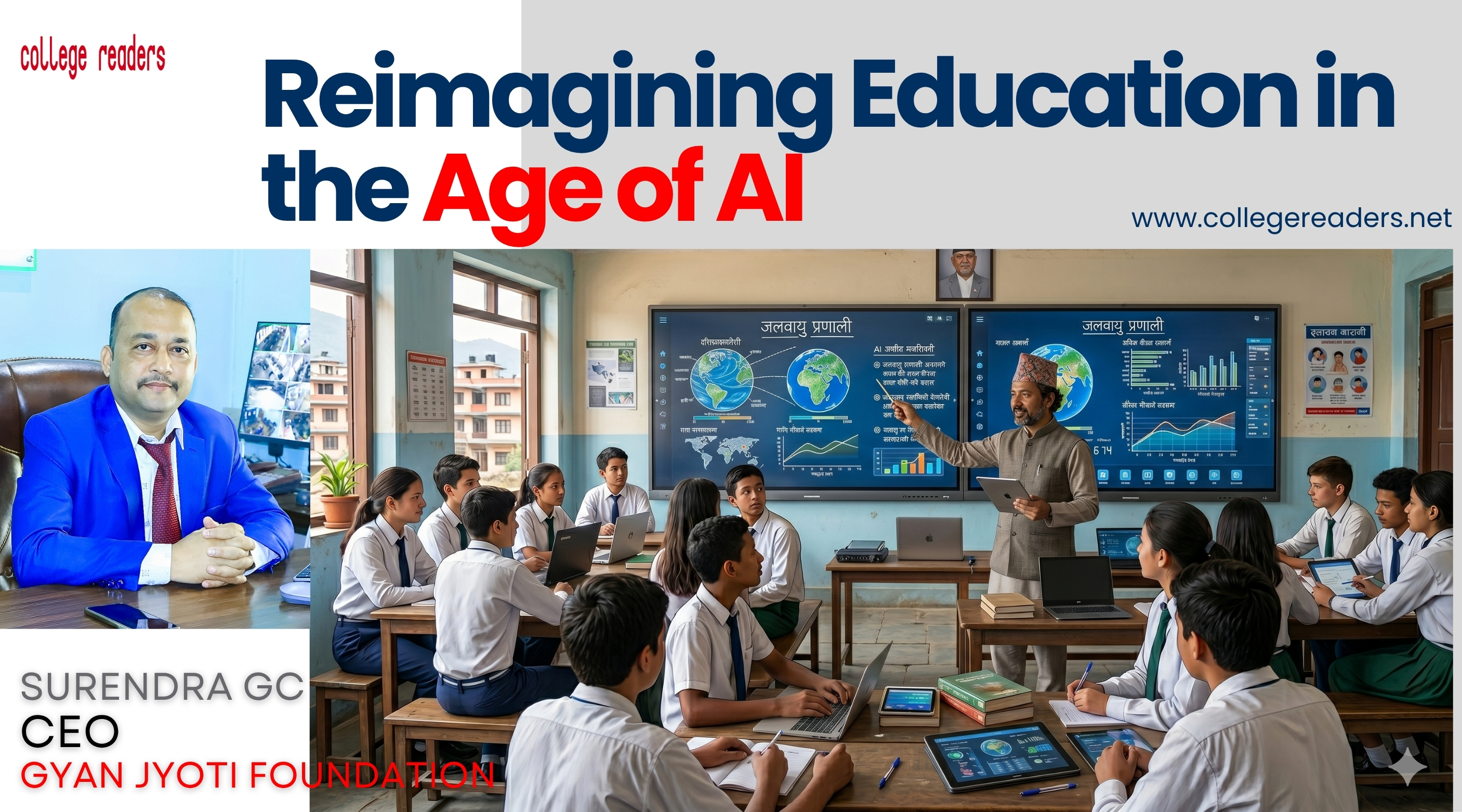
In the bustling educational hubs of Tulsipur and Ghorahi in Nepal's Dang District, a quiet revolution is unfolding. Students armed with smartphones are accessing sophisticated AI tools like ChatGPT and Gemini, while their professors grapple with age-old teaching methods designed for a pre-digital era. This collision of cutting-edge technology with traditional pedagogy has caught my attention and it will be the bourgeoning issue to understand AI's role in education—particularly in developing regions where digital infrastructure outpaces pedagogical adaptation.
The Digital Paradox in Nepal's Classrooms
Picture this: A student in rural Nepal can now access the same generative AI that Silicon Valley engineers use, yet their classroom assessment methods haven't changed since the typewriter era. This paradox lies at the heart of this article, which examines how AI is reshaping higher education in Nepal; where my focus is in Dang District, a region that exemplifies the broader challenges faced by mid-tier educational hubs across the developing world.
AI functions not merely as a convenience but as a 'second respiratory system'—a critical supplement to limited physical academic resources, as my unique position as both eduprenuer, researcher and practitioner gives me unprecedented insight into the ground realities of educational transformation.
Dang District, situated in Nepal's Lumbini Province, presents a fascinating microcosm of global educational challenges. While urban centers like Tulsipur and Ghorahi boast expanding digital infrastructure, many institutions still operate with limited connectivity and faculty who have received little to no training in AI-integrated pedagogy.
The Digital Paradox in Nepal’s Classrooms
Imagine a student in rural Nepal accessing the same generative artificial intelligence tools used by engineers in Silicon Valley, while sitting in a classroom where assessment methods remain largely unchanged from decades ago. This contradiction defines one of the most important educational debates of our time. Across Nepal, particularly in emerging academic hubs such as Dang District, artificial intelligence is reshaping the meaning of teaching, learning, and evaluation faster than institutions are prepared to respond.
Situated in Nepal’s Lumbini Province, Dang offers a revealing picture of the opportunities and challenges confronting higher education in developing societies. Urban centers such as Tulsipur and Ghorahi are witnessing steady improvements in digital infrastructure, smartphone penetration, and internet accessibility. Yet many colleges and institutions continue to operate with limited connectivity, inadequate digital resources, and faculty members who have received little training in AI-integrated pedagogy. As a result, a new educational paradox has emerged: students possess unprecedented access to information and intelligent digital tools, but classrooms often remain trapped within outdated teaching and examination systems.
In this rapidly changing environment, AI is no longer merely a technological convenience. For many students, especially those with limited access to libraries, research databases, or academic mentorship, AI functions almost like a “second respiratory system” for learning — supplementing the gaps left by insufficient physical educational resources. However, the rise of AI also raises urgent questions. Is it strengthening learning, or weakening it? Is it enhancing critical thinking, or encouraging intellectual dependency?
The debate around AI in education frequently swings between two extremes. Some portray it as a revolutionary force capable of democratizing knowledge and transforming classrooms. Others warn of plagiarism, declining creativity, and the erosion of academic integrity. A more balanced perspective is necessary — one that views AI neither as a miracle nor as a menace, but as a powerful educational partner whose impact depends on how institutions and learners choose to use it.
Educational theories provide valuable insights into this transformation. The ideas of Swiss psychologist Jean Piaget remain especially relevant. Piaget emphasized that meaningful learning occurs when learners actively construct knowledge through engagement, experimentation, and reflection. In an AI-driven classroom, the danger is not simply that students use technology, but that they may bypass the intellectual struggle necessary for genuine understanding. When AI generates essays, summaries, or solutions instantly, students may receive polished outputs without participating in the cognitive process that produces learning.
At the same time, AI also creates opportunities for deeper educational engagement when used wisely. Russian psychologist Lev Vygotsky’s concept of the Zone of Proximal Development — the space between what a learner can do independently and what they can achieve with support — can be reimagined for the digital era. In this “Digital ZPD,” AI acts not as a replacement for thought but as a scaffold that guides reasoning, prompts inquiry, and expands intellectual capacity. Instead of merely supplying answers, AI can encourage students to ask better questions, compare perspectives, and refine arguments.
Equally important is the human-centered AI framework proposed by Ben Shneiderman, which insists that technology must amplify human creativity, responsibility, and judgment rather than replace them. This principle holds particular significance in Nepal’s educational context, where cultural understanding, ethical reasoning, and human relationships remain central to meaningful education. Technology should strengthen these qualities, not diminish them.
One of the most effective ways to understand AI’s educational role is through the metaphor of a wholesale market. AI can be imagined as a massive marketplace overflowing with raw informational ingredients. Students, meanwhile, are like chefs whose responsibility is to select, clean, refine, and transform these ingredients into something meaningful and original. Genuine learning lies not in simply collecting information, but in the intellectual process of synthesis, interpretation, and contextualization.
This metaphor resonates deeply within Nepali society, where culinary traditions are shaped by skill, patience, and cultural wisdom. Just as a skilled cook can create unique dishes from common ingredients, students must learn to transform AI-generated information through critical thinking, creativity, and contextual understanding. The real challenge for education, therefore, is determining whether students are becoming thoughtful creators of knowledge or merely passive distributors of machine-generated content.
Nowhere is this challenge more visible than in assessment practices. Traditional written examinations — still dominant in most institutions — are increasingly vulnerable in an age where AI can generate assignments, essays, and even research responses within seconds. Yet focusing solely on AI detection software risks reducing education to a technological cat-and-mouse game. The more important task is to redesign assessment itself.
In an AI-enhanced world, the most valuable academic abilities are no longer memorization or repetitive reproduction of information. Instead, critical evaluation, oral articulation, problem-solving, ethical reasoning, and contextual application become the true indicators of learning. Educational institutions in Dang and across Nepal could benefit significantly from assessment models that emphasize viva examinations, presentations, project-based learning, collaborative inquiry, and process-oriented evaluation.
Ironically, this transformation may also democratize educational quality. In institutions with large class sizes and limited teaching resources, process-based and interactive learning methods can shift the emphasis from quantity of written output to quality of understanding. Students who may struggle with conventional examinations could demonstrate competence through discussion, creativity, and practical application.
Another urgent necessity is the development of AI literacy and ethical awareness within educational curricula. Rather than attempting to ban or suppress AI use, institutions should equip students with the skills to use these tools responsibly and intelligently. AI literacy must include understanding the strengths and limitations of AI systems, identifying misinformation and bias, maintaining academic integrity, and critically evaluating machine-generated content.
Importantly, such reforms must remain grounded in practical realities. Educational transformation cannot depend solely on expensive technologies or idealized models imported from wealthier countries. District-level institutions like those in Dang require adaptable frameworks that work within existing resource limitations while still preparing students for an increasingly digital future.
The lessons emerging from Nepal’s classrooms carry broader global significance. Around the world, educational systems are struggling to adapt as technological advancement outpaces pedagogical reform. Developing regions face this challenge most intensely because infrastructure, teacher training, and policy frameworks often evolve more slowly than access to digital tools.
Yet Nepal’s experience also offers hope. It demonstrates that meaningful educational innovation does not require abandoning human values in favor of technology. Instead, it requires thoughtful integration — combining digital opportunities with ethical reflection, cultural understanding, and sound educational principles.
The path forward demands coordinated action from institutions, educators, policymakers, and students themselves. Provincial ministries and district education offices must support AI-informed policies, teacher training programs, and updated assessment systems. Educational leaders must move beyond fear-based narratives and embrace evidence-based adaptation. Teachers must evolve from information providers into learning facilitators and mentors. Most importantly, students must learn to see AI not as a shortcut around thinking, but as a tool that enhances thoughtful inquiry.
As artificial intelligence continues to transform societies across the globe, education stands at a defining crossroads. The future does not lie in resisting technological change, nor in surrendering unquestioningly to it. The future lies in balance — preserving the human essence of education while embracing the opportunities that digital innovation provides.
For Nepal, and particularly for districts like Dang, this moment represents more than a technological transition. It is an opportunity to redefine the purpose of education itself. If approached wisely, AI can help create learners who are not passive consumers of information but thoughtful architects of knowledge, capable of creativity, ethical judgment, and critical reflection.
The students navigating Nepal’s AI-enhanced classrooms today are doing more than preparing for their personal futures. They are participating in a larger global experiment that will shape the future of education for generations to come.
Surendra GC is the CEO of Gyan Jyoti Foundation, Dang. The views, opinions, and ideas expressed in this article are solely those of Mr. GC and do not necessarily reflect the views of any other individual or organization.
Popular Categories
Trending This Month









 Established in 2065 BS, COLLEGE READERS is a premier national-level educational magazine dedicated to serving the academic and informational needs of school and university students, teachers, educators, and concerned ones in Nepal. The magazine provides current and comprehensive information on various educational opportunities worldwide, aiming to guide school and college-level students in their academic and career journeys. It also highlights essential support services and service providers that play a crucial role in shaping students' career paths in today's competitive world.

- Our Location Putalisadak, Kathmandu
- Send Us Email collegereaders123@gmail.com
- Call Us Now 977 01 4518759
