
Call now
977 01 4518759
Send Message
collegereaders123@gmail.com
Our Location
Putalisadak, Kathmandu
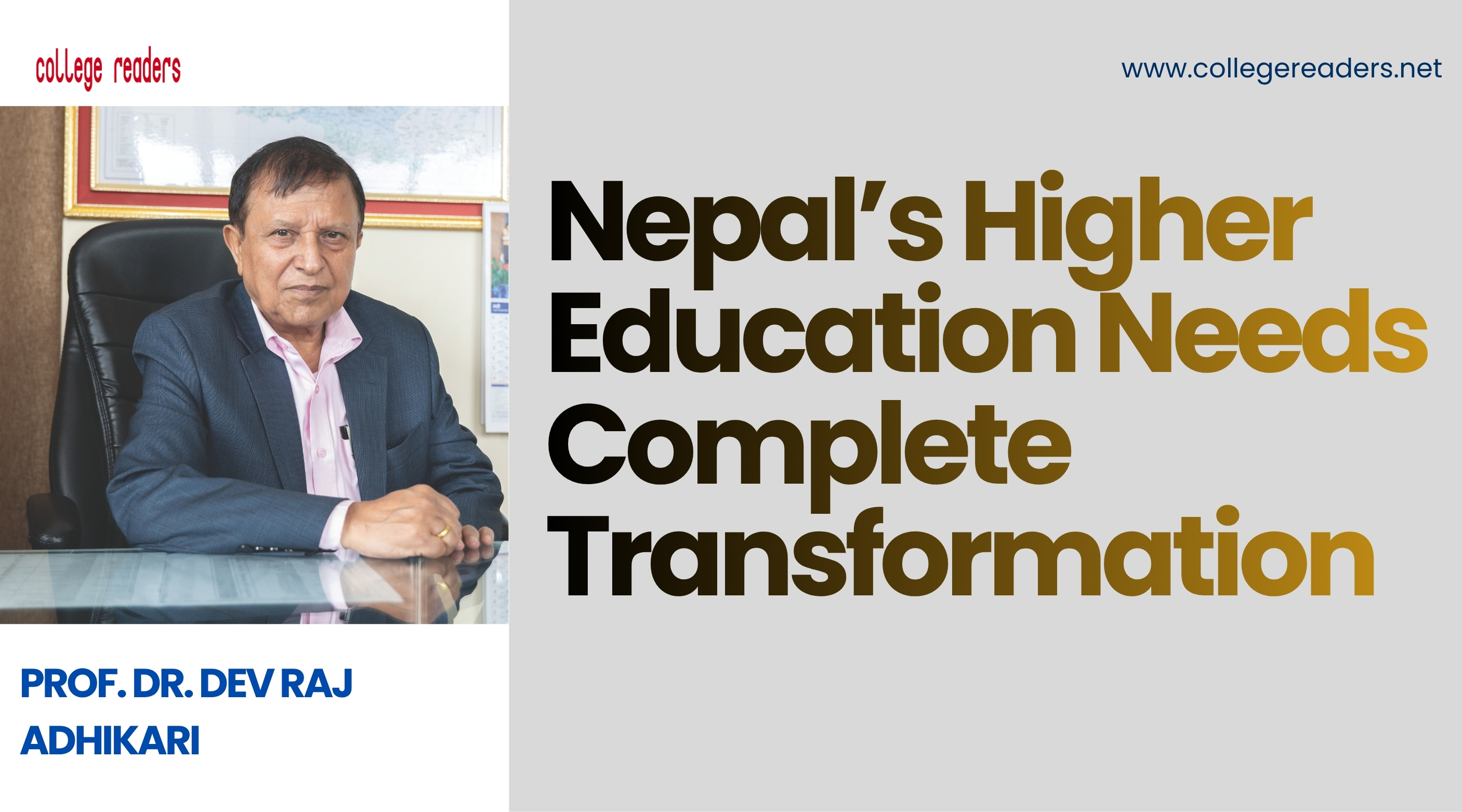
Nepal’s Higher Education Needs Complete Transformation
- College Readers
- 13 Jul 2026
- Views
- Interviews
In this interview, Prof. Dr. Dev Raj Adhikari, examines the condition and future direction of higher education in Nepal. He argues that universities must move beyond traditional governance, ensure consistent academic quality, introduce market-relevant curricula, follow reliable academic calendars, and restore student confidence. He also highlights the need for specialized universities, merit-based faculty recruitment, stronger monitoring of constituent, community and private colleges, and practical learning-while-earning opportunities. While acknowledging the growing attraction of foreign education, he remains optimistic that decisive reforms can make Nepal’s universities competitive, credible and capable of retaining students at home.
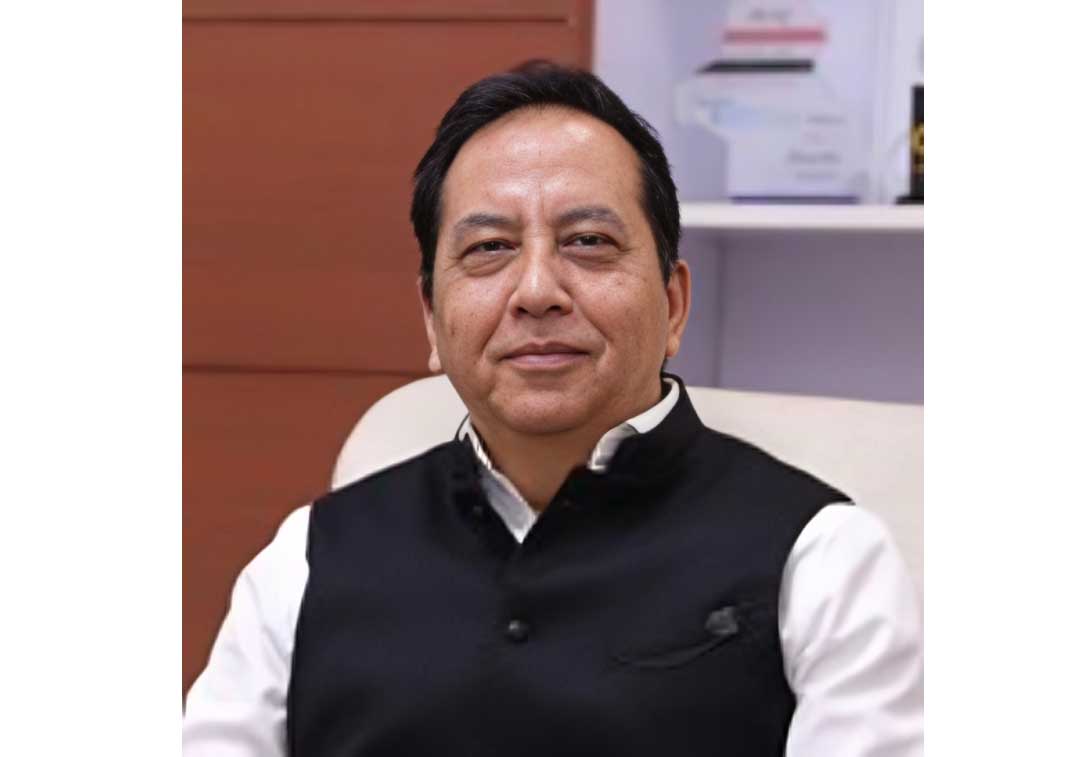
Prof. Dr. Dev Raj Adhikari, former Chairperson of the University Grants Commission, has extensive experience in Nepal’s higher education sector, including leadership roles at Tribhuvan University and the UGC. In an interview with College Readers, he discussed the present condition of higher education, the responsibilities of newly appointed university leaders, the growing migration of students, academic quality, institutional governance and the reforms required to make Nepal an attractive destination for higher studies.
College Readers: Based on your long experience at Tribhuvan University and the University Grants Commission, how do you assess the present condition of higher education in Nepal?
Prof. Dr. Dev Raj Adhikari: Higher education must now be developed by understanding the aspirations of young people. The expectations, ambitions and priorities of today’s students are different from those of previous generations. Universities must recognize this changing context and redesign their academic systems accordingly.
We cannot take higher education significantly forward through the traditional approach. Nepal’s universities will find it difficult to achieve meaningful progress or make a major academic leap if they continue operating through outdated structures, curricula and governance practices. The system must respond to the expectations of students as well as changes taking place in society, technology and the employment market.
College Readers: Should we be pessimistic about Nepal’s higher education system, or do you still see opportunities for progress?
Prof. Dr. Adhikari: We should remain optimistic. Higher education has the responsibility and capacity to create major opportunities for the country and its people. Universities can contribute to human-resource development, innovation, social transformation and national prosperity.
However, optimism must be accompanied by serious reform. We cannot expect better results by repeating the same practices. If institutions adopt new thinking, improve quality and respond to students’ aspirations, Nepal’s higher education system can move forward positively.
“Universities cannot make a significant leap by continuing with traditional governance, outdated curricula and uncertain academic schedules.”
College Readers: What is the greatest challenge currently facing higher education in Nepal?
Prof. Dr. Adhikari: The most serious challenge is the lack of consistency in academic quality. Nepal has universities, constituent campuses, community campuses and private affiliated colleges, but the standard of education is not uniform across these institutions.
Uniform quality does not mean that every university must teach the same subjects or follow an identical academic identity. It means that every institution must meet acceptable standards in teaching, assessment, infrastructure, faculty competence, governance and student support.
Regardless of where students study, they should receive education of a dependable standard. Establishing this confidence across the system is one of Nepal’s most important higher education challenges.
College Readers: Several universities have recently received new vice-chancellors. What should be their immediate priorities?
Prof. Dr. Adhikari: The newly appointed vice-chancellors have inherited numerous longstanding problems. Universities face delayed examinations, unpredictable results, outdated programs, weak governance, declining student confidence and the continued movement of young people abroad.
The number of students leaving Nepal for education has not decreased. In many cases, it has continued to rise. University leaders must therefore introduce policies based on new thinking. Their reforms should address accumulated institutional problems while making Nepali universities more attractive to students.
They should introduce emerging disciplines, revise existing curricula and develop programs that respond to contemporary social and economic needs. Academic courses must be connected to employment opportunities, entrepreneurship, research and professional development.
Vice-chancellors must not merely administer existing structures. They should provide academic leadership, establish clear priorities and create a convincing vision for the future of their universities.
“Quality must be consistent across constituent, community and private affiliated colleges, although institutions may offer different subjects and specialized programs.”
College Readers: Nepal’s higher education is provided through university constituent campuses, community campuses and private affiliated colleges. Why have these three sectors not developed within a coordinated system?
Prof. Dr. Adhikari: These three sectors can move forward together only when there is consistency in quality. Universities must monitor all campuses under their authority fairly and regularly.
Constituent campuses should not receive favourable treatment merely because they are directly operated by universities. Similarly, community and private affiliated colleges should not be viewed only as institutions that receive affiliations. Universities have a responsibility to ensure that every campus follows academic standards and provides appropriate learning conditions.
Monitoring should examine faculty qualifications, teaching practices, infrastructure, student performance, research, examination systems and institutional governance. When standards are applied consistently, the different categories of campuses can contribute collectively to national higher education.
College Readers: What measures should universities adopt to reduce the number of students leaving Nepal?
Prof. Dr. Adhikari: Universities must first create confidence. Students and parents need certainty about the quality, duration and outcome of an academic program.
Newly established universities should develop clear areas of specialization instead of duplicating programs already offered by older institutions. They should identify disciplines in which they can build distinctive academic strengths, appoint competent faculty members and demonstrate how their programs will contribute to society.
Quality is indispensable, regardless of the subject being taught. Universities must also conduct examinations and publish results according to a reliable schedule.
The national academic calendar was developed to establish predictability. A university should be able to tell students when admissions will open, when classes will begin, when examinations will be held and when final results will be published.
At present, students enrolling in a four-year bachelor’s program are sometimes uncertain whether they will complete their degree within four years. Such uncertainty weakens confidence and encourages them to explore foreign alternatives.
When universities follow their calendars, provide relevant education and deliver results on time, parents and students will develop greater trust in Nepal’s higher education institutions.
College Readers: New universities are being established, but many continue to offer the same traditional programs. How should universities approach curriculum development and affiliation?
Prof. Dr. Adhikari: Universities should not simply distribute their existing programs among an increasing number of affiliated colleges. That approach will not take the higher education system towards innovation.
Affiliation-granting universities should encourage colleges to propose programs in fields that are not adequately available in Nepal. When a college develops a new course and seeks affiliation, the university should carefully evaluate its academic merit, social value and market relevance.
The university should examine whether the proposed program responds to changing circumstances, serves the interests of students and society, and prepares graduates for emerging opportunities.
A relevant and well-designed program should receive support. However, endlessly expanding the same courses without considering student demand or employment prospects will create duplication, confusion and unhealthy competition among institutions.
“Market-relevant curricula, timely examinations and learning-while-earning opportunities are essential to rebuild confidence and retain students in Nepal.”
College Readers: Many students are attracted abroad by the possibility of earning while studying. How practical is a learning-while-earning model in Nepal?
Prof. Dr. Adhikari: Employment is a broader national issue, and the government has a central responsibility to create an enabling environment. A learning-while-earning system requires cooperation among the government, educational institutions, industries and businesses.
The government can introduce policies allowing students to work for a limited number of hours each week while continuing their education. For example, students could work for eight or ten hours weekly and receive remuneration that helps cover part of their tuition and living expenses.
Educational institutions could introduce flexible or alternative class arrangements for working students. However, such a system cannot develop effectively without the expansion of industries, enterprises and other employment-generating sectors.
A previous government attempted to introduce a similar concept, but it did not succeed as expected. The idea should not be abandoned. It must be redesigned according to Nepal’s economic capacity and implemented through proper coordination.
Even limited opportunities to earn while studying could help students become more independent and reduce the pressure to leave Nepal.
College Readers: You have said that education requires transformation rather than ordinary change. Should that transformation begin from the school level to the university level?
Prof. Dr. Adhikari: Reform is required from school education to university education. Schools have many areas that need improvement, and universities face equally serious challenges.
At the university level, incremental adjustment will not be enough. We need complete transformation in governance, curriculum, faculty recruitment, assessment and institutional accountability.
Universities cannot reach a new destination through the governance practices of the past. Decision-making processes must become more efficient, transparent and academically focused. Leadership positions should carry clear responsibilities, and institutions must be evaluated according to their performance.
Transformation also means preparing students for a rapidly changing world rather than merely enabling them to pass examinations and receive certificates.
College Readers: Despite campaigns promoting “Study in Nepal,” many students remain unconvinced that they can receive globally competitive education within the country. Why have universities been unable to communicate that assurance?
Prof. Dr. Adhikari: Giving an absolute guarantee is difficult because students have different priorities. One of the main attractions of foreign education is the perception that students can study and earn at the same time.
Some Nepali students have successfully combined education with employment abroad. Their experiences encourage friends, relatives and other young people to follow them. However, not everyone receives the same opportunities.
We also hear about students who struggle financially, fail to obtain the expected employment or return to Nepal without completing their studies. These experiences are not always discussed as prominently as the success stories.
Nevertheless, pointing to difficulties abroad will not be enough to retain students. Nepal must improve its own institutions. Students will not remain here merely because they are advised to do so.
They need strong academic programs and clear evidence that their qualifications will make them competitive in the labour market. A curriculum should demonstrate the knowledge, skills and professional opportunities students can gain after completing the course.
College Readers: Are Nepal’s colleges and universities capable of providing globally relevant and competitive programs?
Prof. Dr. Adhikari: If an institution lacks capable teachers or academic leaders, it must identify and recruit competent professionals. If the existing recruitment process cannot bring qualified people into universities, the recruitment system itself must be changed.
Transformation cannot be achieved by compromising on faculty competence, academic leadership or institutional quality. Universities should review how teachers and administrators are selected, evaluated and promoted.
We must approach the entire system from a new perspective. Institutions should be prepared to revise outdated procedures when those procedures prevent them from appointing capable people or introducing necessary reforms.
College Readers: How important is the role of government in transforming higher education?
Prof. Dr. Adhikari: Universities have major responsibilities, but the government must also create supportive policies. Higher education is directly connected to national development, employment, innovation and social progress.
The government should support quality enhancement, strengthen regulatory mechanisms and facilitate links among universities, industries and employers. It should also encourage universities to develop specialized identities rather than allowing unnecessary duplication.
Policy intervention is particularly important for developing learning-while-earning opportunities, improving research investment and ensuring that institutions follow academic standards. At the same time, universities need sufficient autonomy to make timely academic and administrative decisions.
Government intervention should support quality and accountability rather than create unnecessary political or administrative obstacles.
College Readers: What message would you like to give students who have completed Grade 12 and are considering higher education in Nepal?
Prof. Dr. Adhikari: I would tell students that Nepal’s higher education system has already reached a certain level of development. Many curricula taught in Nepali institutions are not inferior to those offered by foreign universities.
Students should first clarify their own objectives. Going abroad simply because friends have gone, because society expects it or because parents are under social pressure may not always be the right decision.
They should carefully examine the quality of the institution, the relevance of the program, its costs, possible career outcomes and their personal readiness before making a choice.
Nepal offers credible academic programs, and students can build successful careers after studying here. However, universities and the government must not become complacent. They must continue improving teaching, infrastructure, academic schedules, student services and employment connections.
Students should make informed decisions rather than following a trend. At the same time, Nepal’s institutions must earn their confidence by providing education that is relevant, timely, competitive and trustworthy.

Popular Categories
Trending This Month








 Established in 2065 BS, COLLEGE READERS is a premier national-level educational magazine dedicated to serving the academic and informational needs of school and university students, teachers, educators, and concerned ones in Nepal. The magazine provides current and comprehensive information on various educational opportunities worldwide, aiming to guide school and college-level students in their academic and career journeys. It also highlights essential support services and service providers that play a crucial role in shaping students' career paths in today's competitive world.

- Our Location Putalisadak, Kathmandu
- Send Us Email collegereaders123@gmail.com
- Call Us Now 977 01 4518759
