
Call now
977 01 4518759
Send Message
collegereaders123@gmail.com
Our Location
Putalisadak, Kathmandu
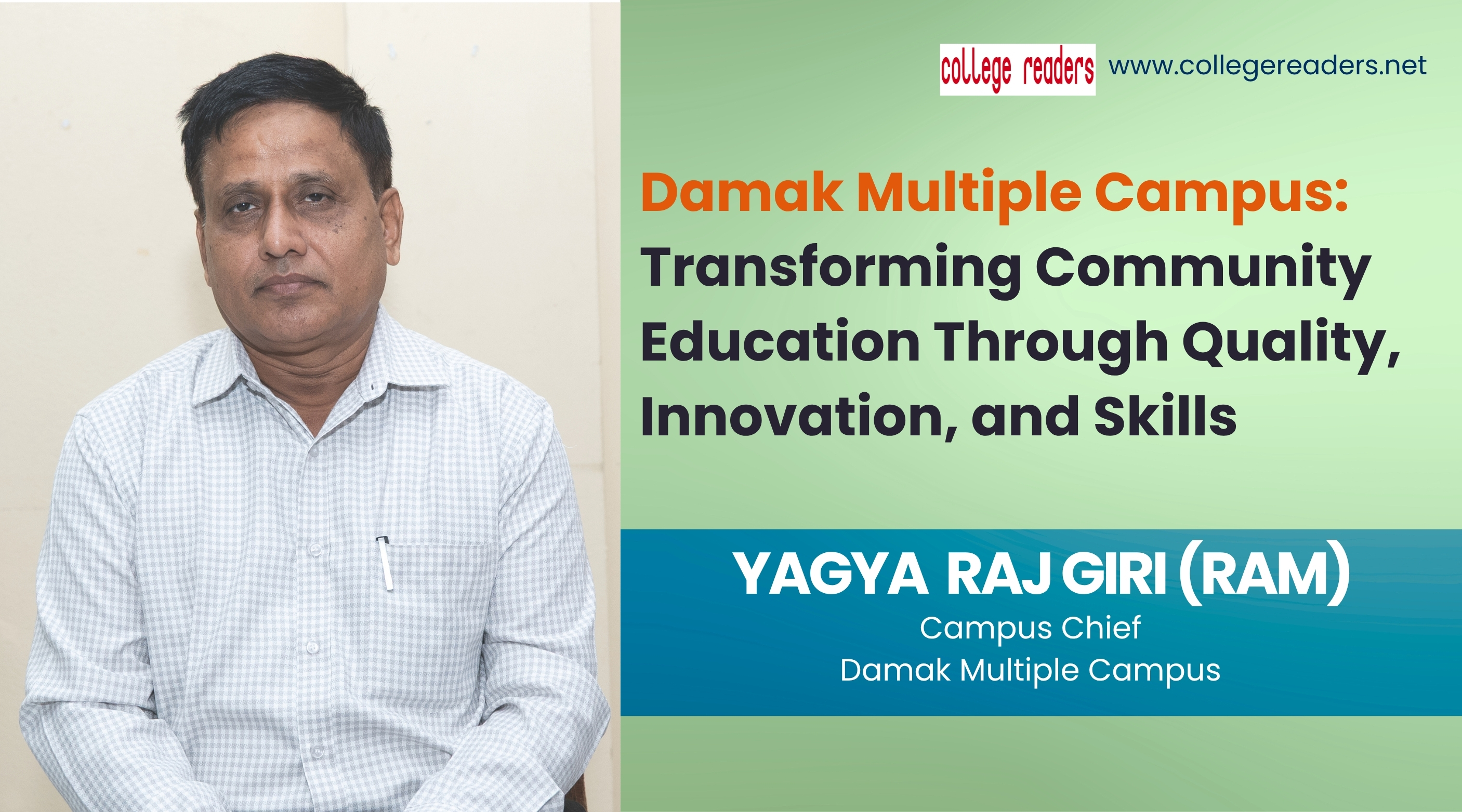
Damak Multiple Campus: Transforming Community Education Through Quality, Innovation, and Skills
- College Readers
- 03 Aug 2026
- Views
- Op-ed
The journey of Damak Multiple Campus is a story of continuous improvement and institutional excellence. Having successfully completed two cycles of Quality Assurance and Accreditation (QAA), the campus is currently progressing through its third cycle of reaccreditation. The ongoing Pre-Review Team (PRT) process reflects the institution's determination to maintain and further strengthen its academic standards.
For decades, Damak Multiple Campus has served as an educational center for students from rural and underserved communities. The institution has consistently worked to ensure that geographical limitations and economic challenges do not deprive deserving students of quality higher education. This commitment to inclusiveness remains one of the campus's greatest strengths.
Today, the campus has developed modern classrooms equipped with advanced facilities and learning resources. However, infrastructure alone does not define educational quality. Recognizing this reality, Damak Multiple Campus has adopted an innovative academic policy that invites retired professors, researchers, and PhD holders from Tribhuvan University and other universities to conduct specialized classes and share their expertise with students.
The experience of these distinguished scholars enriches the learning environment and exposes students to new perspectives, research methodologies, and practical knowledge. By institutionalizing this practice, the campus has created a bridge between academic theory and professional experience.
The true strength of Damak Multiple Campus lies not only in its infrastructure but in its commitment to bringing the country's finest academicians, researchers, and professionals into the classroom to enrich the learning experience of its students.
The impact of this approach is evident in the achievements of its graduates. Since its establishment, Damak Multiple Campus has produced more than 30,000 graduates, many of whom have gone on to become influential figures in Nepal's political, administrative, academic, and professional sectors. The institution proudly counts among its alumni members of parliament, ministers, government secretaries, professors, and educational leaders.
Perhaps the most remarkable achievement of the campus is the fact that a large number of schools and colleges in the surrounding region are staffed by its graduates. Teachers, lecturers, administrators, and education professionals who once sat in the classrooms of Damak Multiple Campus are now shaping the future of education across eastern Nepal. This legacy is a testament to the institution's enduring contribution to national development.
In recent years, Damak Multiple Campus has also recognized the growing importance of connecting education with employment. While formal job-placement initiatives are still in their early stages, the campus has already begun implementing programs that prepare students for the labor market and provide guidance on professional development.
One of the most important challenges facing Nepal today is the increasing trend of students leaving the country immediately after completing higher secondary education. In response, the campus has embraced the concept of "earning while learning" and has restructured its academic programs to accommodate students who wish to balance education with employment.
Most undergraduate and master's-level programs that were previously conducted during the day have now been shifted to the morning schedule. Classes begin as early as 5:30 a.m. and conclude by around 8:30 a.m., allowing students to pursue employment opportunities or professional training during the rest of the day. Commerce and master's programs have already adopted this system, while programs in arts and education are gradually being adjusted to follow the same model.
This flexible academic structure has attracted a growing number of students, particularly working professionals and individuals pursuing higher education alongside their careers.
Beyond scheduling reforms, Damak Multiple Campus has introduced a number of innovative non-credit courses designed to strengthen students' practical skills. One of the most promising initiatives is the academy-industry program, a three-month training course that combines academic learning with entrepreneurship and business development.
The program brings together students and local entrepreneurs in a collaborative learning environment. Fifteen students from the campus and fifteen individuals already involved in business participate in the course, which is conducted in the campus's computer laboratories. Classes are held three days a week, while participants continue their professional or academic activities during the remaining days.
The objective of the program is to provide practical training in entrepreneurship, business promotion, and professional development. Industry experts and experienced professionals are invited to share their knowledge and mentor participants, helping them understand the realities of business management and innovation.
Academic qualifications alone are no longer sufficient in today's competitive world; students must graduate with practical skills, entrepreneurial thinking, and the confidence to create opportunities for themselves and others.
Although the academy-industry initiative has not yet received widespread public attention, it has the potential to become one of Nepal's most innovative models of non-credit education. The campus believes that such programs can play a crucial role in reducing unemployment and encouraging young people to explore entrepreneurial opportunities within Nepal.
In addition to entrepreneurship training, Damak Multiple Campus has introduced several other skill-oriented programs. Bachelor of Education (B.Ed.) students are encouraged to participate in Montessori training programs, which significantly enhance their employability in schools and educational institutions. Computer training, professional development workshops, and short-term certification courses have also become integral components of the campus's educational strategy.
The philosophy behind these initiatives is simple: higher education should not merely provide students with degrees; it should equip them with the practical skills and competencies necessary to succeed in the workplace and contribute meaningfully to society.
At a time when foreign migration among young Nepalis is increasing, Damak Multiple Campus continues to emphasize the importance of acquiring knowledge and skills before seeking opportunities abroad. According to the campus leadership, completing Grade 12 marks only the end of basic education, not the completion of one's academic journey.
Students who aspire to study or work abroad should first acquire professional skills, practical experience, and academic qualifications. Completing at least a diploma-level course—or, preferably, a bachelor's degree—can significantly improve their chances of success in foreign countries. Skills not only increase employability but also help individuals adapt to new social and professional environments.
At the same time, the campus encourages students to explore opportunities within Nepal and contribute to the country's development. Nepal possesses enormous potential, and the responsibility of educational institutions is to prepare young people to recognize and utilize those opportunities.
The experience of Damak Multiple Campus demonstrates that community campuses can play a transformative role in national development. Through quality education, innovative teaching practices, research, and skill-oriented programs, the institution has shown that higher education can become a powerful instrument for social change. As Nepal's education system continues to evolve, Damak Multiple Campus stands as an example of how academic excellence and practical learning can go hand in hand to shape the leaders of tomorrow.

Popular Categories
Trending This Month








 Established in 2065 BS, COLLEGE READERS is a premier national-level educational magazine dedicated to serving the academic and informational needs of school and university students, teachers, educators, and concerned ones in Nepal. The magazine provides current and comprehensive information on various educational opportunities worldwide, aiming to guide school and college-level students in their academic and career journeys. It also highlights essential support services and service providers that play a crucial role in shaping students' career paths in today's competitive world.

- Our Location Putalisadak, Kathmandu
- Send Us Email collegereaders123@gmail.com
- Call Us Now 977 01 4518759
