
Call now
977 01 4518759
Send Message
collegereaders123@gmail.com
Our Location
Putalisadak, Kathmandu
Laboratory Builds Excellence from Every Student’s Potential
- College Readers
- 19 May 2026
- Views
- Interviews , Op-ed
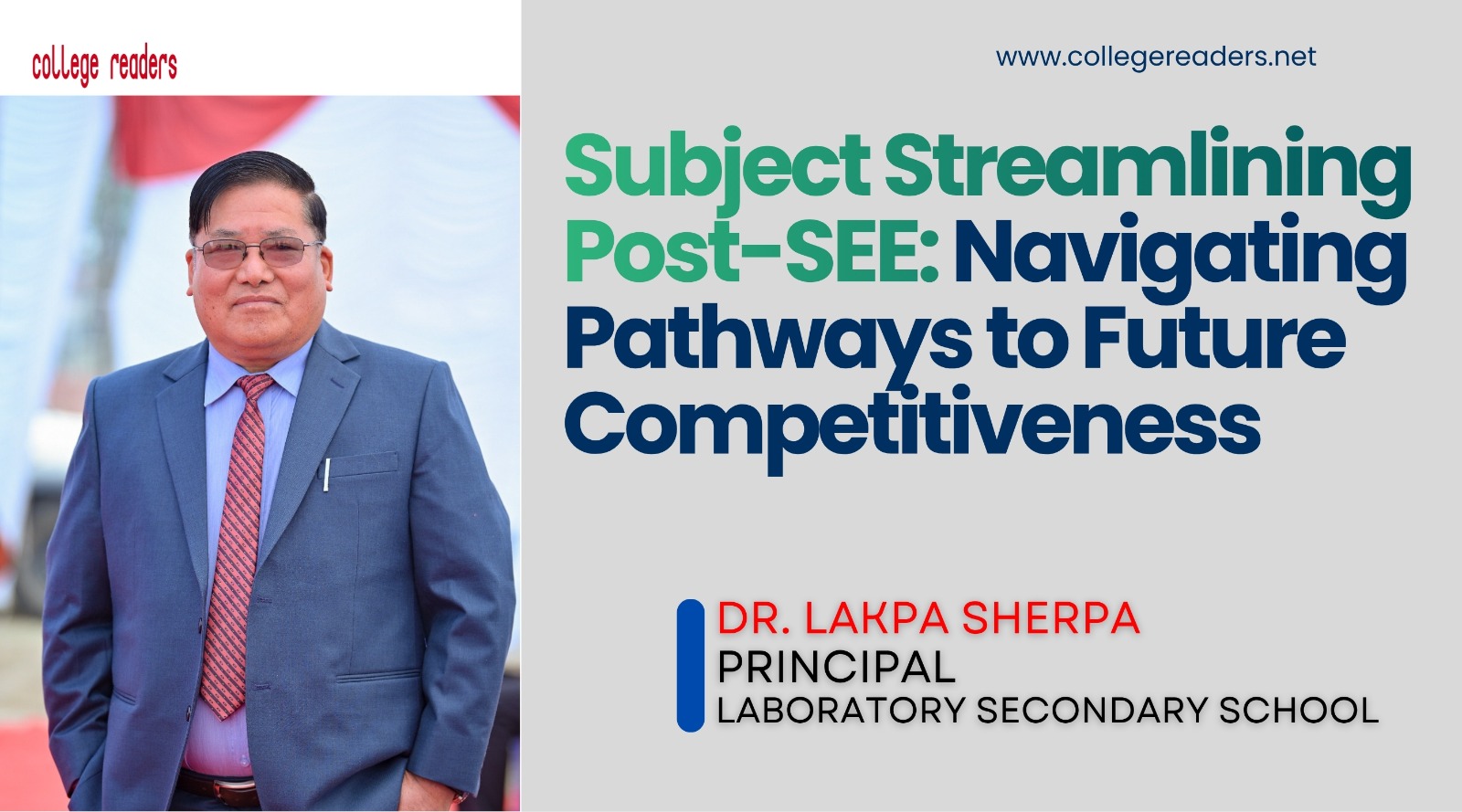
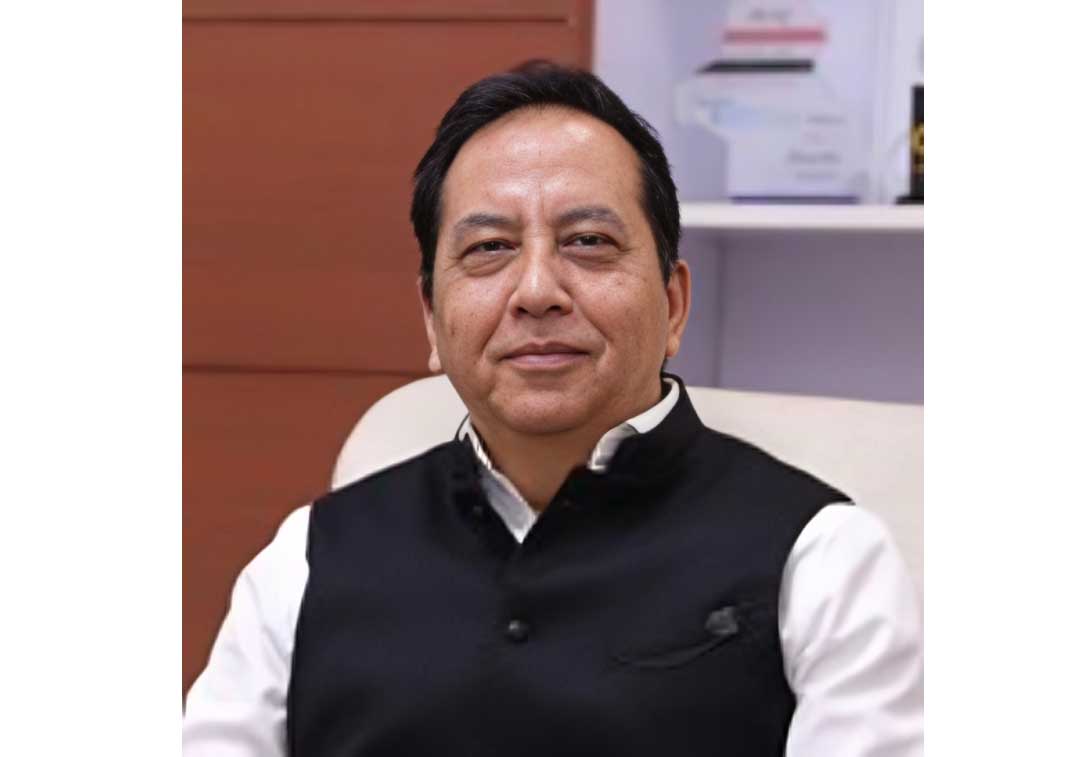
Dr. Lakpa Sherpa, Principal of Laboratory Secondary School, one of Nepal’s leading academic institutions, believes Plus Two education must remain rooted in disciplined school culture while preparing students for higher studies and life. In this interview with College Readers, he discusses the school’s outstanding SEE performance, interest-based subject selection, and the need for parents to judge institutions through results, pedagogy, infrastructure, safety, teacher quality, and student care. He stresses that Grade XI and XII students still need close guidance, emotional support, and a learning environment that protects them from confusion while developing confidence, skills, character, responsibility, and future readiness for success in Nepal’s rapidly changing educational and professional landscape today.
Laboratory Secondary School has achieved impressive SEE results. How do you evaluate this success?
We are pleased with this year’s SEE performance. Laboratory Secondary School has maintained a strong academic record for more than two decades, and our 21st batch has continued that tradition. All 120 students passed the SEE examination. Among them, 65 students secured between 3.6 and 4 GPA, while 55 students obtained between 3.2 and 3.6 GPA. This achievement reflects students’ hard work, teachers’ dedication, systematic planning, and a supportive school environment. For us, results matter, but the academic culture that produces those results matters even more.
SEE results were published earlier this year, and the national pass percentage increased. How do you view this trend?
A rise in the pass percentage is encouraging, but evaluation must remain careful and fair. In our case, some students scored 3.96 GPA and narrowly missed 4 GPA. With more time and detailed checking, perhaps they could have reached that mark. This is not a complaint; it is an academic concern. Timely publication is good, but answer-sheet evaluation should be student-sensitive and accurate. Across Nepal, many students may have benefited, while some may have missed deserved recognition. Therefore, speed should not weaken the quality of evaluation.
Many SEE graduates are confused while choosing subjects for Grade XI. What is your advice?
Subject selection should be based on interest, ability, and future direction. Many students still choose subjects under parental pressure. Parents may want their children to become doctors, engineers, or professionals in a particular field, but every child has different strengths. Howard Gardner’s theory of multiple intelligences reminds us that children may be talented in mathematics, language, visual creativity, physical skills, or other areas. A student strong in numbers may enjoy science or engineering, while a student strong in language may do better in literature, communication, or related fields. The best subject is the one that matches the learner’s talent and passion.
What should parents and students consider while selecting a Plus Two institution?
They should not choose a school only through advertisements or popularity. They must study its academic history, consistency of results, teaching methodology, teacher strength, management, discipline, infrastructure, safety, and student support system. A good institution identifies students’ strengths and weaknesses and grooms them accordingly. At Laboratory, we try to make above-average students excellent, average students stronger, and weaker students more confident through continuous support. Parents should observe practical learning, laboratories, counseling, food, transport, security, child-friendly teaching, and parent-school communication. A school is not merely a building; it is a learning community.
How has Laboratory Secondary School applied these standards in practice?
Laboratory is a full-fledged modern school with a strong academic environment. Our classrooms have smart boards, quality furniture, and internet facilities. We provide computer access on a one-to-one basis. Our science stream is supported by separate, well-equipped laboratories for physics, chemistry, biology, and mathematics. We also promote robotics, innovation, and technology-based learning. Beyond academics, students participate in chess, football, volleyball, basketball, music, singing, handwriting, and other activities. We do not showcase facilities only for attraction; we involve students meaningfully so they can become skilled, confident, and responsible citizens.
Grade XI and XII are part of school education, yet many students treat them as college life. How do you see this mindset?
This mindset comes from the old system, when Grade XI and XII were known as PCL or college level. Today, they are school-level grades, and that is appropriate. Students aged around 15 to 17 still need guidance, supervision, discipline, and emotional support. When they suddenly enter a very free environment, some struggle to adjust. Some students leave a familiar school for a new atmosphere, but later realize that structure, care, and personal attention were valuable. Freedom without maturity can disturb learning achievement and may even lead some students toward wrong habits.

Popular Categories
Trending This Month








 Established in 2065 BS, COLLEGE READERS is a premier national-level educational magazine dedicated to serving the academic and informational needs of school and university students, teachers, educators, and concerned ones in Nepal. The magazine provides current and comprehensive information on various educational opportunities worldwide, aiming to guide school and college-level students in their academic and career journeys. It also highlights essential support services and service providers that play a crucial role in shaping students' career paths in today's competitive world.

- Our Location Putalisadak, Kathmandu
- Send Us Email collegereaders123@gmail.com
- Call Us Now 977 01 4518759
