
Call now
977 01 4518759
Send Message
collegereaders123@gmail.com
Our Location
Putalisadak, Kathmandu
Taxing Education: Who Really Pays the 3%?
- College Readers
- 05 Jun 2026
- Views
- Op-ed
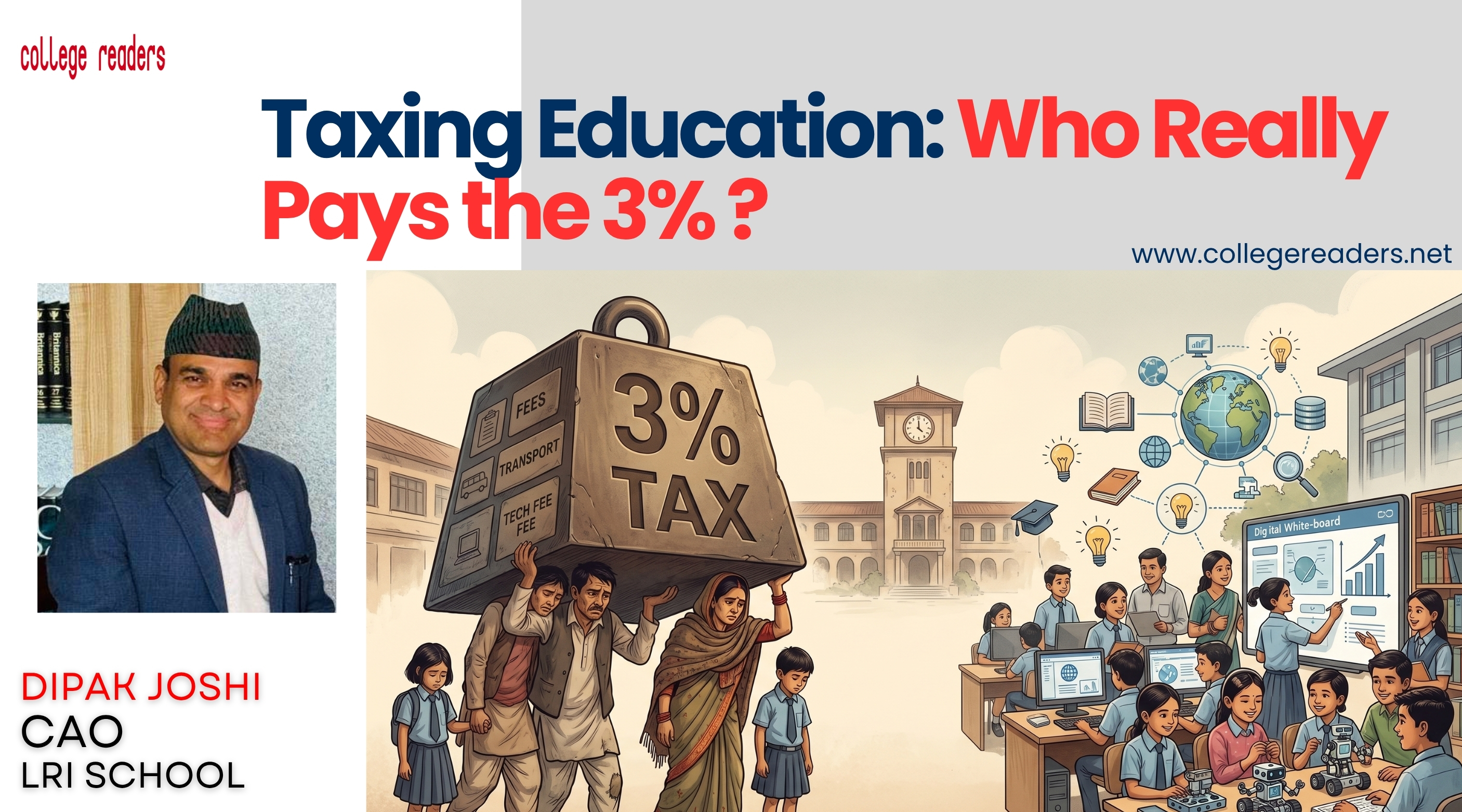
Improving public education is not just important; it is unavoidable. But is it practical for the state to treat private education as an “enemy” when millions of students, thousands of jobs, and countless families are connected to it? And when a tax is imposed on school fees, who ultimately pays the price—the institution or the parents?
The budget for Fiscal Year 2083/84 has placed education among its priorities. Programmes related to artificial intelligence, educational technology, teacher capacity development, open universities, expansion of medical education, and paid internships have created some fresh hope for the sector. The government’s commitment to improving the quality of public education is certainly welcome, because providing free and quality education to every citizen is a constitutional responsibility of the state.
However, some budgetary provisions and existing education policies demand serious discussion. In particular, the 3% tax imposed on fees charged by private schools and colleges, the lack of clarity in fee determination, and the state’s overall attitude toward private education have become matters of public concern.
There is no doubt that public schools must be strengthened. Government schools must become capable, competitive, technology-friendly, and quality-driven. But another reality cannot be ignored: millions of students are currently studying in private schools. Thousands of teachers, staff members, and their families depend on the private education sector for their livelihood. For more than three decades, private schools have played a significant role in reducing the educational burden of the state.
Against this background, the government’s decision to impose a 3% tax on the fees collected by private schools and colleges appears problematic. In practice, this tax will not be paid by the schools alone. Eventually, it will be passed on to parents in the form of an additional financial burden.
At a time when many families are already struggling with rising prices, declining income, and limited resources, parents are still trying to provide private education to their children. Many of them cut down on personal needs and household expenses just to manage school fees. Adding another 3% tax to education costs directly increases pressure on these families.
Education is not a luxury item. It is a fundamental right. The state’s focus should be on making education accessible, affordable, and high-quality—not on raising revenue from school fees. Therefore, the 3% tax on education fees should be reconsidered and removed.
Private schools, meanwhile, are caught between two pressures. On one side, they face frequently changing government policies, rules, and decisions. On the other, they face continuous pressure and dissatisfaction from parents. But this debate should not place all responsibility on the government or schools alone. Parents, too, need to reflect honestly on their choices.
In Nepal, many parents choose private schools after looking at physical infrastructure, English-medium teaching, extracurricular activities, use of technology, transportation facilities, canteen services, sports, and other amenities. During admission, they usually accept the fee structure, monthly expenses, additional charges, and the school’s policies. Yet later, dissatisfaction is often expressed only over the issue of fees.
This does not mean that parents’ complaints are wrong. Their concerns are valid and must be heard. But before choosing a school, parents should realistically assess their financial capacity, the services the school provides, and the actual cost of those services. Every parent should ask a clear question: “Can I afford this school’s fees in the long run?”
If a school provides advanced facilities, qualified teachers, modern technology, and diverse extracurricular programmes, some cost is naturally involved. Therefore, the debate on fees should not be driven by emotion alone. It must be based on facts, transparency, and fairness.
The government, however, has also failed to manage the issue of private school fees in a clear and scientific manner. Even today, it continues to refer to the fee structure set in 2078 BS. But the economic situation of 2078 and today is not the same. Since then, salaries of teachers and staff, house rent, transportation, technology, electricity, stationery, and general operating costs have increased significantly.
In such a situation, fee determination must be updated according to time and reality. It should be based on the services provided by schools, local economic conditions, inflation, and actual operating costs. Unfortunately, neither the federal government appears serious enough, nor have local governments been sufficiently active in this matter. As a result, unnecessary disputes among schools, parents, and regulatory bodies are repeated every year.
What we need today is not a campaign to portray private schools as enemies. Nor should the genuine concerns of parents be ignored. What we need is a partnership based on trust among the government, schools, and parents.
The government must prioritise the improvement of public schools. At the same time, it should also recognise private schools as partners in the education sector. Parents should be clear about their financial capacity and the services they expect from a school. Schools, for their part, must maintain full transparency in fee determination and expenditure details.
Ultimately, our common goal is the same: our children should receive quality education. To achieve this, the education sector needs dialogue, not blame; partnership, not punishment; and policies that make education more accessible, not taxes that make it more expensive.
Since education is a fundamental right, the 3% tax on education fees should be removed. A scientific fee-determination system should be implemented. Most importantly, an environment must be created where both public and private education sectors can move forward together for the benefit of students, parents, and the nation.
Dipak Joshi who is the Chief Administrative Officer (CAO) of LRI School, has composed this article. The ideas and opinions solely belong to Mr. Joshi.
Popular Categories
Trending This Month







 Established in 2065 BS, COLLEGE READERS is a premier national-level educational magazine dedicated to serving the academic and informational needs of school and university students, teachers, educators, and concerned ones in Nepal. The magazine provides current and comprehensive information on various educational opportunities worldwide, aiming to guide school and college-level students in their academic and career journeys. It also highlights essential support services and service providers that play a crucial role in shaping students' career paths in today's competitive world.

- Our Location Putalisadak, Kathmandu
- Send Us Email collegereaders123@gmail.com
- Call Us Now 977 01 4518759
