
Call now
977 01 4518759
Send Message
collegereaders123@gmail.com
Our Location
Putalisadak, Kathmandu
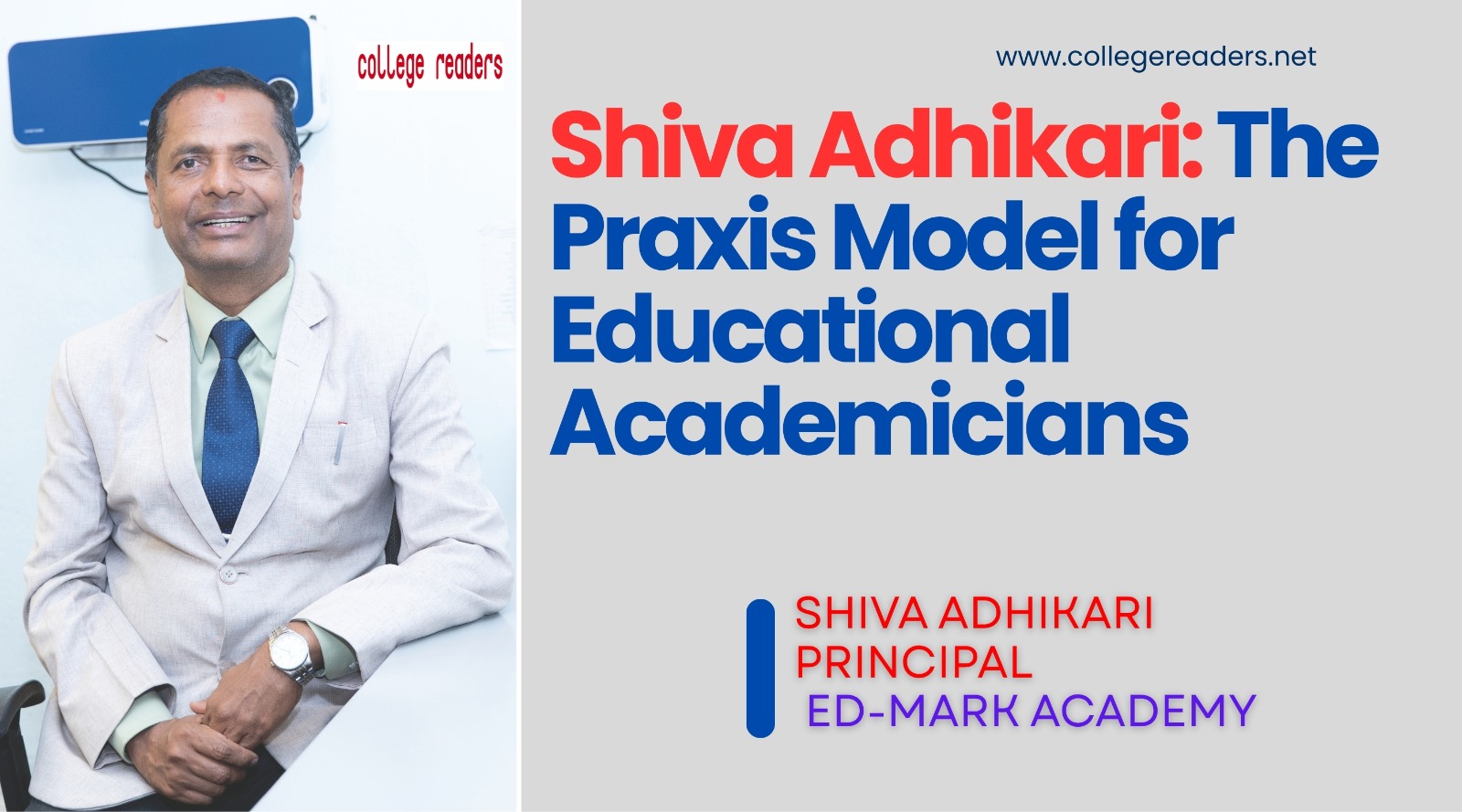
The Praxis Model for Educational Academicians
- College Readers
- 18 May 2026
- Views
- Op-ed , Interviews
Shiva Adhikari exemplifies extraordinary entrepreneurial vision in Nepal's education sector, simultaneously founding and leading multiple educational institutions across urban and rural landscapes. As Founder Principal of Edmark College in Kalanki, Founder Principal of Wisdom English Academy in Kalanki, Founder Chairperson of Success Academy in Baireni (Ward No. 6, Galchhi Rural Municipality, Dhading), Founder Chairperson of Safal College, Founder Chairperson of Dhading Multiple Campus in Masina (Ward No. 4, Galchhi, Dhading), and Treasurer of Ishan Center, Adhikari represents a unique model of educational leadership that bridges Nepal's urban-rural divide while maintaining quality standards across diverse institutional contexts.
Adhikari's journey into education began immediately after completing his SLC examination in 2042 BS from Adarsha Secondary School in Gajuri, Dhading. During that era, SLC examinations occurred in Magh (January-February) with results announced in Saun (July-August). On the nineteenth of Bhadra in 2043 BS, Adhikari entered Kathmandu, marking the beginning of a transformative educational career. By 2044 BS, while still pursuing his own education, he established and registered Success Career Institute, operating tuition classes that would become the foundation of his institutional empire. This dual identity—simultaneously student and educator—characterized his early years and shaped his understanding that effective teaching requires continuous learning.
For approximately fourteen years, from 2044 BS to 2058 BS, Adhikari dedicated himself exclusively to operating tuition institutes, refining his pedagogical approaches and understanding student needs across diverse academic levels. This extended period in supplementary education provided crucial insights into systemic gaps within Nepal's formal education system—knowledge that would later inform his institutional innovations. Following this foundational phase, he collaborated with colleagues to operate what is now known as Nepal Aaya (formerly Amar Jyoti Secondary School) until 2062 BS. On the second of Magh in 2062 BS, his formal association with Edmark and Wisdom began, marking his transition from tuition instructor to comprehensive institutional leadership.
Adhikari's leadership philosophy centers on continuous learning and adaptation. He describes his journey as "learning while teaching, teaching while learning"—a reciprocal process where professional development never ceases. Recognizing that stagnation threatens educational quality, he actively seeks training opportunities and learns from professional educators encountered throughout his career. His institutions have formalized this commitment through collaboration with Kathmandu University, which for the past two years has provided professional training for teaching staff through university professors. Significantly, Adhikari personally participates in these training sessions alongside his teachers, embodying the learning culture he advocates. This humble approach—where the principal learns alongside staff—creates organizational cultures valuing growth over hierarchy.
Currently, Adhikari's combined institutions serve approximately 5,000 students across Dhading and Kathmandu locations. His approach to fee determination reflects sophisticated market understanding combined with genuine commitment to accessibility. Rather than maximizing revenue, he conducts thorough market research examining parents' payment capacity and ensuring fees align with the economic realities of families who trust his institutions. This methodology has proven remarkably successful. During a recent needs assessment conducted by Kathmandu University's professional team, approximately one hundred parents were interviewed separately from students and teachers. Strikingly, not a single parent mentioned fees as problematic—a statistic Adhikari considers "surprising" given typical parental concerns about educational costs. The university team spent separate days with parents, students, and teachers before submitting comprehensive reports analyzing satisfaction levels across all stakeholder groups.
The needs assessment revealed valuable insights across constituencies. Students requested increased emphasis on extracurricular activities—feedback Adhikari received positively as constructive criticism rather than failure acknowledgment. Parents expressed general satisfaction with minimal improvement suggestions. Teachers, some of whom have taught for twenty-two years within Adhikari's institutions, showed contentment with working conditions, particularly noting that salaries increase according to changing circumstances and time periods. The overwhelmingly positive feedback from all three groups provided Adhikari tremendous energy and encouragement, validating his institutional approaches while identifying specific enhancement opportunities.
Adhikari's educational philosophy rests on a "three-pillar" framework dividing responsibility equally among institutional stakeholders. He allocates thirty-three percent responsibility to the institution itself, thirty-three percent to students (emphasizing that students must establish clear personal goals), and thirty-three percent to parents. This balanced model recognizes that quality education requires coordinated effort rather than depending solely on institutional excellence. Additionally, he emphasizes sanskar (cultural values and character formation) as foundational to quality education, estimating that approximately eighty percent of such character development occurs through community and family environment. He argues that disciplined, culturally grounded students can more effectively receive quality education aligned with their interests and aptitudes.
To operationalize stakeholder engagement, Adhikari implements an innovative "Parents Response Test" (PRT) every three months. During these sessions, parents visit institutions to complete questionnaires—both structured and open-ended—providing feedback on the previous quarter's performance and suggesting improvements. Institutions also share planned initiatives, soliciting parental input before implementation. This systematic engagement has generated numerous innovative ideas and improvements that Adhikari might not have conceived independently. The PRT represents best practice in participatory educational management, ensuring parents function as active partners rather than passive consumers.
Adhikari offers trenchant critique of Nepal's current educational system, identifying fundamental structural problems requiring systemic reform. He argues Nepal's education remains excessively "bookish," failing to accommodate diverse student interests and aptitudes. His vision includes establishing specialized institutions from approximately Class 8 onward—sports schools for athletically inclined students, music schools for musically talented youth, administrative schools for future managers, medical schools providing early foundation for aspiring doctors, and engineering schools preparing future engineers. This specialization would replace the current one-size-fits-all model that ignores individual inclinations while forcing students into rigid academic tracks. He criticizes how the system fails to generate new ideas from children, instead constraining them through excessive academic pressure disconnected from genuine interests.
Adhikari believes the system's fundamental weakness lies in treating all students identically regardless of aptitude or aspiration, with subject selection driven by examination scores rather than genuine interest. High scorers feel compelled toward science streams while lower scorers default to humanities—a practice Adhikari considers fundamentally misguided. He expresses hope that Nepal's young Prime Minister and Education Minister will implement comprehensive educational reforms addressing these systemic inadequacies.
For students selecting colleges, Adhikari provides clear, practical guidance reflecting hard-won experience. First, students must choose subjects according to personal interest rather than parental preference, rejecting the prevailing mentality that high scores mandate science while low scores relegate students to humanities. Second, students should abandon assumptions that expensive colleges automatically deliver superior education or that distant institutions inherently outperform nearby options. Third—and crucially—students should investigate college operators' backgrounds. He distinguishes sharply between business-minded operators who prioritize profit over quality and academically-oriented operators who understand pedagogical principles and student psychology.
Business operators may charge premium fees without delivering corresponding educational value, whereas educators-turned-administrators better comprehend how to structure learning environments matching students' developmental needs.
At admission, Adhikari's institutions conduct counseling sessions involving both students and parents, exploring motivations and expectations before enrollment. This ensures alignment between institutional offerings and family aspirations, reducing later dissatisfaction or transfers. However, he acknowledges that even his institutions operate within Nepal's outdated curriculum framework requiring comprehensive revision—not just through Class 10 but extending through Classes 11 and 12.
Shiva Adhikari represents educational leadership transcending typical administrative roles. By founding multiple institutions spanning urban and rural contexts while maintaining direct involvement in pedagogical development, stakeholder engagement, and systemic critique, he demonstrates that educational excellence requires visionary thinking, humble continuous learning, genuine stakeholder partnership, and courageous advocacy for fundamental reform. His career—from teenage tuition instructor to multi-institutional founder—proves that transformative educational leadership emerges not from credentials alone but from sustained commitment to student success, willingness to challenge prevailing assumptions, and courage to implement innovative practices even within constraining systemic frameworks.


Popular Categories
Trending This Month






 Established in 2065 BS, COLLEGE READERS is a premier national-level educational magazine dedicated to serving the academic and informational needs of school and university students, teachers, educators, and concerned ones in Nepal. The magazine provides current and comprehensive information on various educational opportunities worldwide, aiming to guide school and college-level students in their academic and career journeys. It also highlights essential support services and service providers that play a crucial role in shaping students' career paths in today's competitive world.

- Our Location Putalisadak, Kathmandu
- Send Us Email collegereaders123@gmail.com
- Call Us Now 977 01 4518759
