
Call now
977 01 4518759
Send Message
collegereaders123@gmail.com
Our Location
Putalisadak, Kathmandu
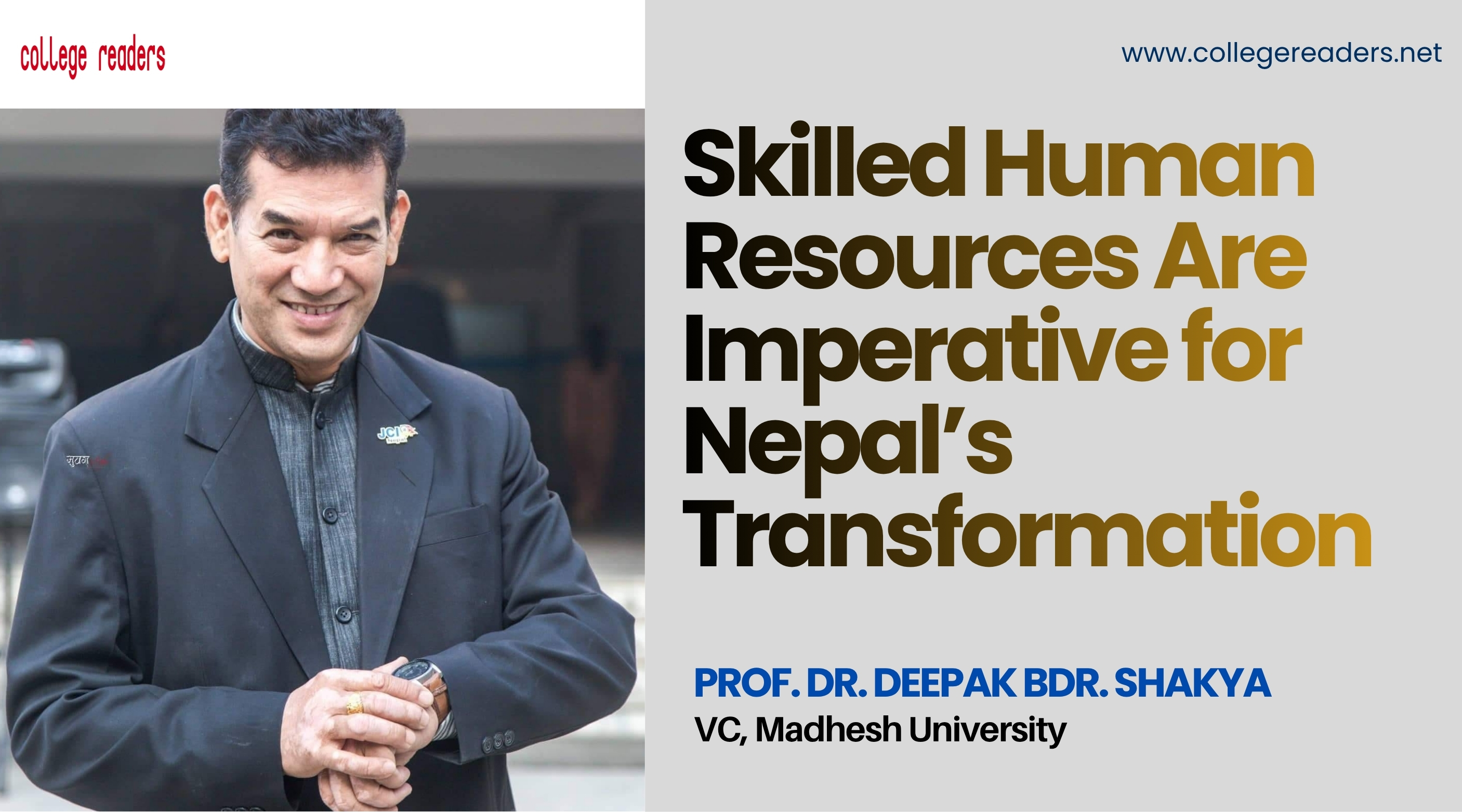
Skilled Human Resources Are Imperative for Nepal’s Transformation
- College Readers
- 05 Jul 2026
- Views
- Interviews
.jpg)
College Readers: You have spent a long time in Nepal’s higher education sector. How do you assess the present condition of higher education in Nepal?
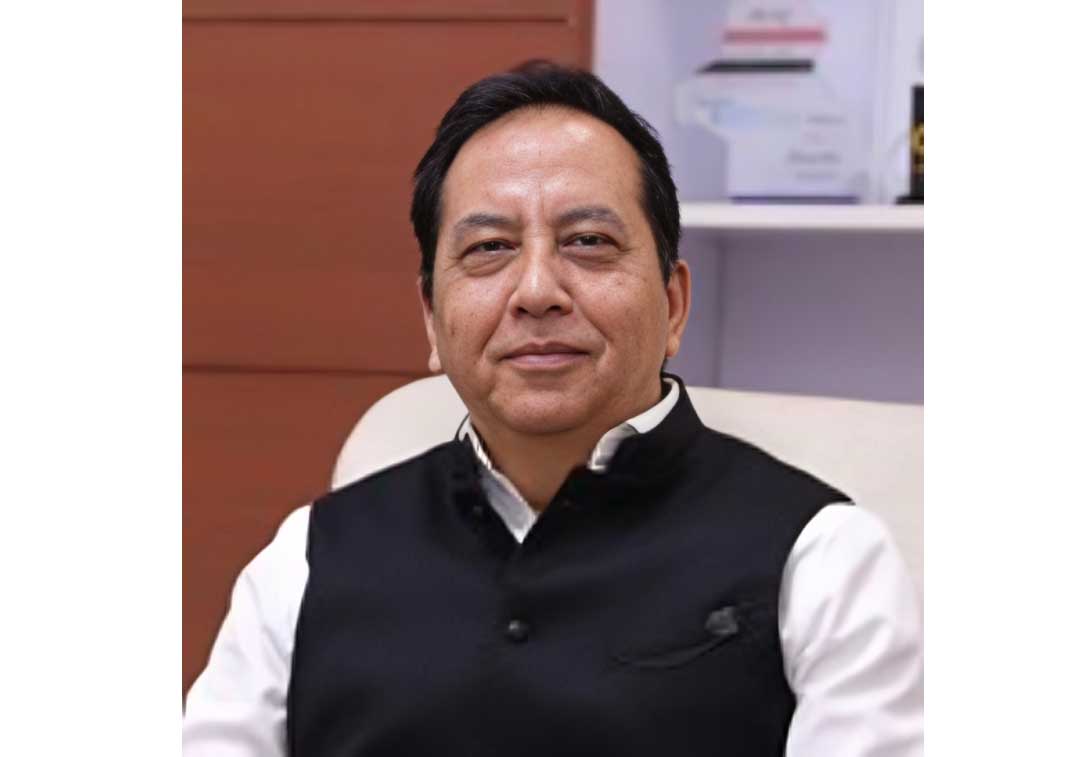
Prof. Dr. Shakya: My fundamental understanding is that no country can develop economically, socially, politically or institutionally without skilled human resources. Higher education is the main system responsible for producing such human resources. Colleges and universities therefore have a very important role, and within them, teachers and professors have an even more decisive responsibility.
Nepal is one of the most beautiful countries in the world and is rich in natural resources. Yet, we have not been able to capitalize on those resources properly. The main reason is that we have not given enough attention to producing the kind of skilled manpower needed to mobilize our resources. Our higher education system has remained largely conventional and city-centred. Many colleges are still running the same traditional courses, and students often study what is available rather than what is needed by the country and the market.
If we truly want to produce competent human resources, universities and colleges must be transformed according to time, national demand and global changes. That is the area where I believe reform is urgently needed.
College Readers: Why has Nepal not been able to connect higher education with the production of capable and competent human capital?
Prof. Dr. Shakya: The first problem is the absence of a clear national vision. We have been making plans and projects for decades, but we have not developed a strong roadmap that clearly identifies what kind of manpower the country needs, how much manpower is required, in which sectors, and where institutions should be developed.
Secondly, the world has already moved from a nationalized mindset to a globalized reality. When we talk about skilled manpower, we should not think only about Nepal’s internal needs. We must also think about what kinds of human resources are needed globally. Nepal should prepare manpower that can serve both national and international markets.
For example, people often say that Nepal’s education is weak. But Nepali nurses, doctors, engineers, IT graduates and hotel management students are already working in different parts of the world. If they were not competent, they would not be accepted internationally. This shows that Nepal has potential, but we have failed to brand, coordinate and systematize our education properly.
Nepal’s higher education must be directly connected with national development, skilled human-resource production and global competitiveness.
College Readers: What kind of roadmap does Nepal need for higher education?
Prof. Dr. Shakya: Nepal must first identify its priority sectors. We talk about agriculture, tourism, hydropower, culture, natural resources, IT, administration, education and health. But have we calculated how many skilled people are needed in each of these sectors? Have we decided which university should produce what kind of manpower? Have we designed courses accordingly? This is where the gap lies.
For example, if Nepal wants to export IT products, then we need thousands of IT engineers and professionals. If we want to expand hydropower, we need engineers, technicians, managers and skilled workers for hydropower projects. If we want to promote tourism, we need manpower for educational tourism, medical tourism, natural tourism, sports tourism and cultural tourism. If we want quality education, we need well-trained teachers. But which university is specializing in these areas? This question must be answered.
A roadmap must link education with national development. It should clarify which university will specialize in which sector, how colleges will support that vision, and how school education will prepare students from the beginning.
College Readers: You have often said that opening universities is not enough. What do you mean by that?
Prof. Dr. Shakya: Nepal has seen a race to open universities. Earlier, there was only Tribhuvan University. Now we have several universities, including provincial universities. I am not against opening new universities. In fact, even more universities can operate if they have clear specialization and purpose.
But if every university simply runs the same BBA, BBS, MBA, BIT or IT programmes, then one large university would have been enough. The purpose of creating new universities should not be duplication. It should be specialization, decentralization and innovation.
Federalism means decentralizing resources, opportunities and decision-making. Universities should also follow that spirit. One university may specialize in tourism, another in agriculture, another in IT, another in teacher development, another in engineering or natural resources. They should coordinate with each other instead of competing by offering the same courses everywhere.
Universities should not merely duplicate popular programmes; each institution should specialize according to national, provincial and sectoral needs.
College Readers: How important is coordination among government, universities, colleges and schools?
Prof. Dr. Shakya: Coordination is extremely important. At present, schools seem to be moving in one direction, colleges in another, universities in another and the government in another. Because of this lack of coordination, we have not been able to achieve the quality and relevance that higher education requires.
The government must prepare a clear policy and say: this is the kind of manpower the country needs; universities should produce this kind of manpower; colleges should support this vision; and schools should prepare students from the foundation level. Without such coordination, universities will continue to function without clear direction.
Even teacher preparation should begin with a proper academic pathway. A student who wants to become a doctor knows that after Grade 10 he or she should study science, choose biology and then prepare for MBBS. But what about a student who wants to become a teacher? What should that student study from Grade 10 or Plus Two? Where is the clear academic pathway for teacher development? These are serious gaps.
College Readers: You have emphasized teacher development. Why is it so important?
Prof. Dr. Shakya: Teaching must be placed at the centre of development. A good teacher is the foundation of a good education system. If teachers are competent, motivated and research-oriented, they can produce competent students. Therefore, teachers must be respected, paid properly and encouraged to conduct research.
If we invest in other sectors but fail to develop teachers and the teaching system, our effort will be like pouring water into sand. Education is the root of every development. Agriculture, tourism, medicine, IT, administration, hydropower and all other sectors depend on education. Unless we strengthen teachers and teaching ideology, development in other areas will not be sustainable.
College Readers: You also speak about education as an export sector. How can Nepal export education?
Prof. Dr. Shakya: Many countries have made education an export industry. The United Kingdom, Australia and the United States attract students from around the world, educate them and send skilled manpower globally. Bangladesh has also developed medical education as an export sector by attracting international students.
Nepal can also do this. We have good teachers, a favourable climate, natural beauty, cultural richness and comparatively affordable education. Students from other countries can come to Nepal to study medicine, engineering, IT, tourism, culture and other subjects. If they study here and return to their countries, Nepal is exporting education.
But for this, we need quality assurance, branding, proper policy and coordination. We often say that education in Nepal is not good. This negative mindset must change. If Nepali graduates are accepted abroad, it proves that our education has strength. We must improve where necessary and promote what we already have.
College Readers: How do you view the concept of “learning and earning” in Nepal?
Prof. Dr. Shakya: “Learning and earning” has become a popular slogan, but it cannot be achieved only by saying it. Students can earn while learning only when they have practical skills, a work-positive mindset and an academic system that supports flexibility.
Today, many students are studying at the bachelor’s level, but they are mostly limited to theoretical content. When they go to work, they often lack practical skills. Small skills can make a big difference. A student entering the hotel sector needs hotel-related skills. A student working in accounts needs VAT and accounting knowledge. A student entering marketing needs digital marketing skills. A student interested in agriculture needs basic technical knowledge related to land, production and management.
Universities should introduce micro-certifications and short-term skill courses of two or three months. Students could study in the morning or evening and work during the day. In this way, they would learn, earn, gain experience and become more employable.
“Learning and earning” is possible in Nepal only when students receive practical skills, micro-certifications and a work-positive mindset.
College Readers: Is mindset also a barrier to learning and earning?
Prof. Dr. Shakya: Yes, mindset is a major barrier. In foreign countries, Nepali students do many kinds of work. They work in hotels, old-age homes, cleaning services, driving, mechanics and other areas. They do not feel ashamed because no work is considered small there.
But in Nepal, even if a student’s own father has a small shop, the student may feel ashamed to sit there. Many students think that work must be prestigious or office-based. Parents also discourage children from working, saying that work will disturb their studies. This mindset must change. Students should understand that work gives experience, discipline, confidence and career direction.
At the same time, universities must provide the skills required for work. A student cannot become a manager immediately. But if a BBA student has digital marketing skills, for example, he or she can work online for companies even while staying in Nepal. This is the kind of practical approach we need.
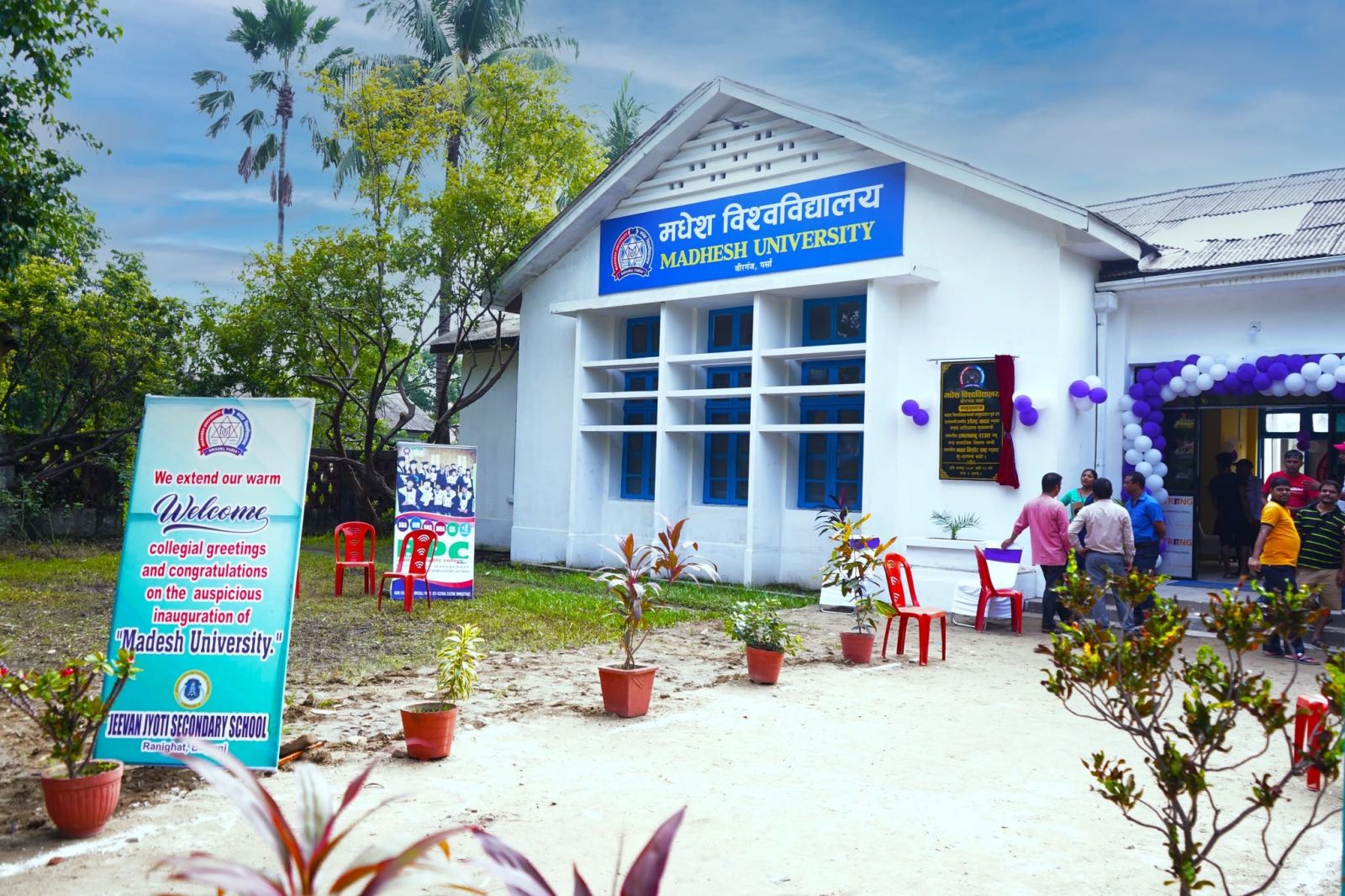
Madhesh University is trying to develop a new provincial university model based on research, federalism, teacher development and the ground realities of Madhesh Province.
College Readers: What is Madhesh University doing differently in this regard?
Prof. Dr. Shakya: When Madhesh University was established, I did not want to begin by simply running conventional courses. First, we conducted research. Since we started from Madhesh, we studied all eight districts and consulted experts. Based on that, we prepared a 10-year strategic plan.
Through that study, we identified several gaps. One major gap was teacher development and education development. Therefore, we are working to develop courses related to teacher development. Another important area is federalism. Since federalism has a deep connection with Madhesh, and since Nepal is still struggling to understand and implement federalism effectively, we have developed courses related to federalism.
Our aim is to make Madhesh University a need-based institution. We want to connect our academic programmes with the realities of Madhesh Province—agriculture, industry, border economy, social transformation, governance, education and local development.
College Readers: How do you define the role of a provincial university like Madhesh University?
Prof. Dr. Shakya: A provincial university must be directly connected with the soil, society, economy and needs of its province. A central university has a broader national and international role. But a provincial university should focus on the development needs of its province.
Madhesh Province has its own realities. It can become an agricultural hub. It has industries. It has border-related challenges and opportunities. It has specific social and educational needs. Madhesh University should produce manpower that can address these realities.
A provincial university should not simply duplicate the courses of a central university. Its purpose should be to stand on ground reality and produce human resources required for provincial development. That is the model we are trying to develop.
College Readers: What challenges do provincial universities face in Nepal?
Prof. Dr. Shakya: The biggest challenge is the lack of clear coordination between the central and provincial governments. Laws may be made, but implementation remains unclear. Provincial universities need resources, land, autonomy, policy support and guidance. But there is still a gap between central and provincial thinking.
For example, Madhesh University has been established for four years, but it has not yet received land. If proper coordination had been done and land had been provided, we could already have developed new faculties and research-based programmes. A university needs space, resources and policy clarity to grow.
The advantage of a university is that it can design its own courses according to need and produce manpower accordingly. But if it is not given proper support, it cannot fulfil its purpose. Therefore, the government must understand why a university is opened and what kind of manpower it is expected to produce.
College Readers: Finally, what message would you like to give to policymakers, universities and society?
Prof. Dr. Shakya: My message is that education must be placed at the centre of national development. If we want to develop agriculture, tourism, medicine, IT, hydropower, administration or any other sector, we must begin with education. Education is the root, the tool and the foundation of development.
We need a clear national roadmap, strong coordination, specialized universities, competent teachers, practical courses and a positive mindset toward work. Nepal has resources, teachers, students, natural beauty and global opportunities. What we lack is proper coordination, policy clarity and implementation.
This is the right time for transformation. The country is seeking change, new leadership is emerging, and Nepal’s global possibilities are expanding. If we manage education properly, we can produce skilled manpower for Nepal and also contribute to the world. That should be the mission of our higher education system.

Popular Categories
Trending This Month








 Established in 2065 BS, COLLEGE READERS is a premier national-level educational magazine dedicated to serving the academic and informational needs of school and university students, teachers, educators, and concerned ones in Nepal. The magazine provides current and comprehensive information on various educational opportunities worldwide, aiming to guide school and college-level students in their academic and career journeys. It also highlights essential support services and service providers that play a crucial role in shaping students' career paths in today's competitive world.

- Our Location Putalisadak, Kathmandu
- Send Us Email collegereaders123@gmail.com
- Call Us Now 977 01 4518759
