
Call now
977 01 4518759
Send Message
collegereaders123@gmail.com
Our Location
Putalisadak, Kathmandu
Seven New Vice-Chancellors Take Charge: Nepal’s Universities Stand at the Crossroads of Reform
- College Readers
- 04 Jul 2026
- Views
- Study in Nepal
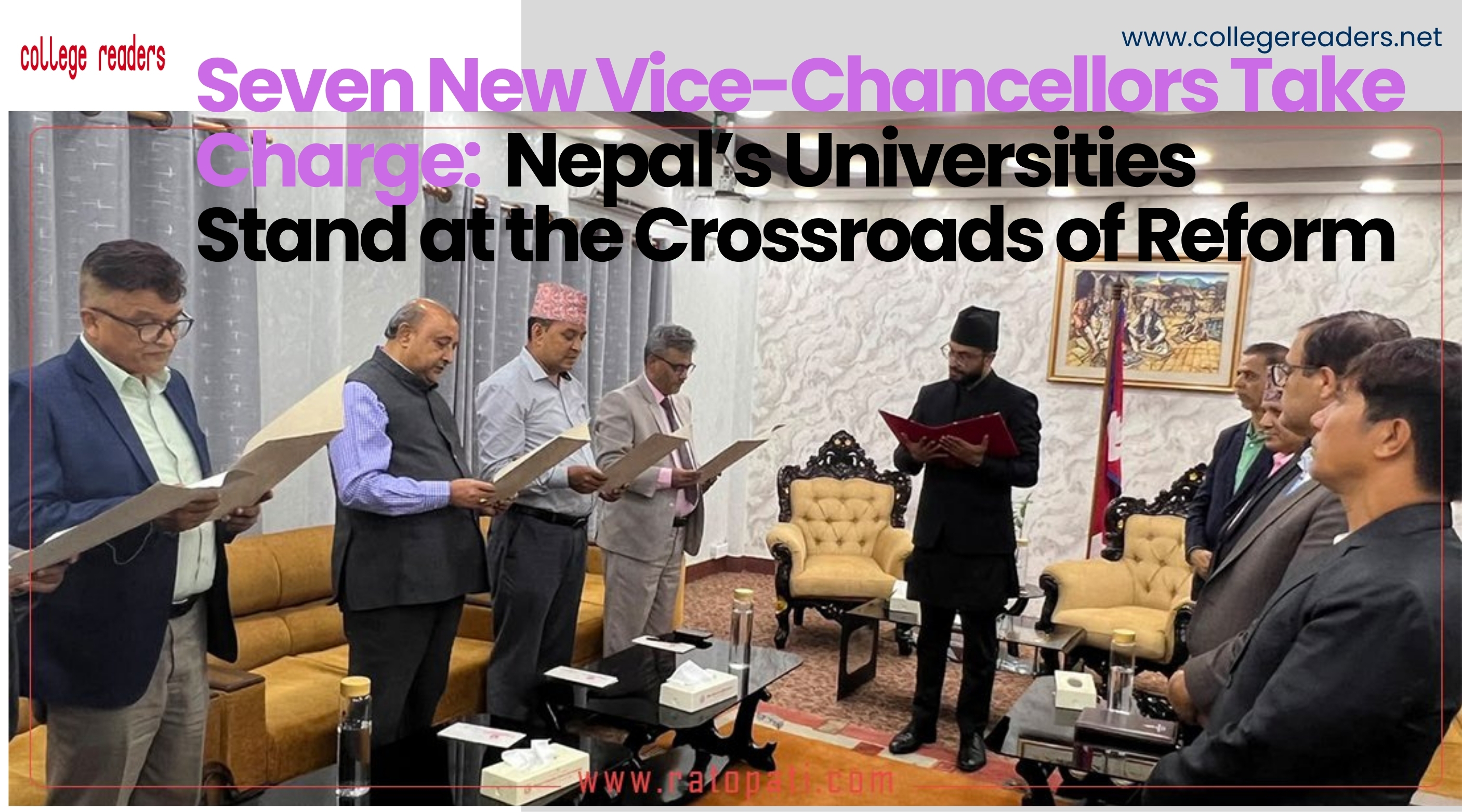
Kathmandu, 4 July 2026 — Nepal’s higher education sector has entered a new phase as seven newly appointed Vice-Chancellors of public universities took the oath of office and secrecy on Friday. Minister for Education and Sports and University Pro-Chancellor Sasmit Pokharel administered the oath to the new university leaders at the ministry, shortly after Prime Minister and University Chancellor Balendra Shah appointed them on the recommendation of the University Vice-Chancellor Selection and Recommendation Committee.
The new appointments include Prof. Dr. Bhola Thapa as Vice-Chancellor of Tribhuvan University, Kisan Datta Bhatta at Far-Western University, Rajan Suwal at Mid-West University, Rishi Ram Kattel at Agriculture and Forestry University, Shyam Narayan Labh at Rajarshi Janak University, Devendra Adhikari at Pokhara University, and Sujan Babu Marahatta at Purbanchal University.
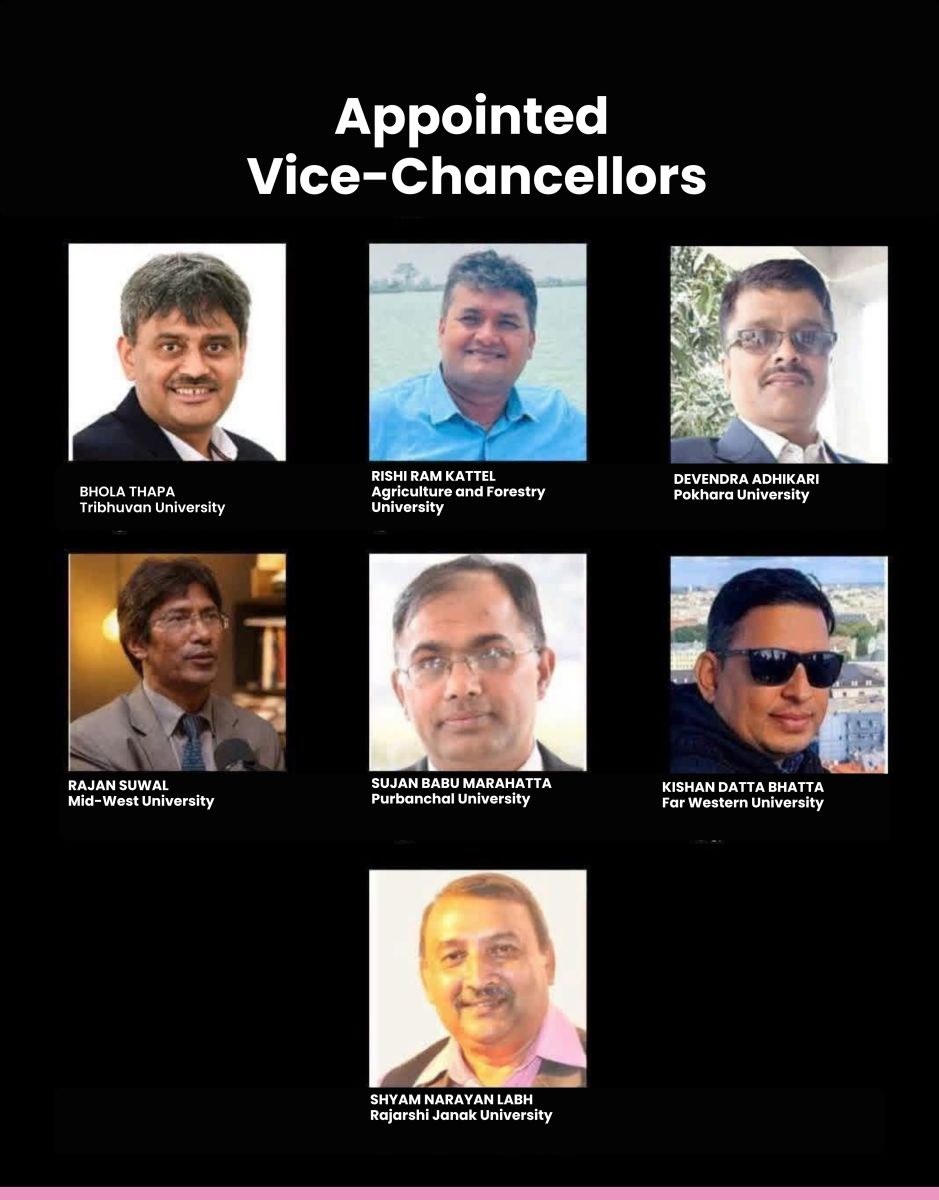
The oath ceremony was not merely a formal administrative event. It carried a wider message: Nepal’s universities are expected to move beyond routine management and enter a period of reform, credibility-building, academic competitiveness, and institutional transformation. Minister Pokharel directed the new Vice-Chancellors to work in a fair, independent, professional, and transparent manner. He also instructed them to ensure transparent implementation of the mandatory 10 percent scholarship provision in universities and possible constituent campuses, and to remove union and trade-union banners from university and campus premises.
The government has presented these appointments as the result of an open and competitive process. According to available reports, the selection system included applications, shortlisting, academic evaluation, vision papers, interviews, and final recommendation before the Chancellor made the appointments. This is significant because university leadership in Nepal has long been criticized for political bargaining, delayed decision-making, weak accountability, and institutional instability.
Among the seven appointments, the selection of Prof. Dr. Bhola Thapa as Vice-Chancellor of Tribhuvan University has drawn special attention. Tribhuvan University is Nepal’s oldest and largest university, established in 1959, and its Vice-Chancellor is responsible for leading an institution with 64 constituent campuses and around 950 affiliated colleges across the country.
Prof. Dr. Thapa is not new to university leadership. He is a distinguished academic, researcher, engineer, and administrator with a long record at Kathmandu University. He completed his Bachelor of Engineering in Mechanical Engineering from Punjab Engineering College under the Colombo Plan Scholarship, earned his Master of Engineering from Birla Institute of Technology and Science, Pilani, and received his PhD in Sand Erosion in Hydraulic Machinery from the Norwegian University of Science and Technology in 2004.
He joined Kathmandu University as a lecturer in 1994 and rose through academic ranks to become professor in 2008. He served as Dean of the School of Engineering from 2008 to 2016, Registrar from 2013 to 2018, and Vice-Chancellor of Kathmandu University from January 2021 to January 2025. His leadership experience, engineering background, exposure to international academic systems, and research work on hydropower turbine erosion place him among Nepal’s technically grounded academic leaders.
His appointment at Tribhuvan University comes at a crucial time. TU is not merely a university; it is a national academic system. It influences school graduates, public service aspirants, professional education, research culture, and the future of Nepal’s human resources. However, the institution has faced repeated challenges: irregular academic calendars, delayed examinations and results, political pressure, weak research output, outdated curricula, poor digital systems, and inconsistent quality among affiliated colleges.
Prof. Dr. Thapa’s biggest opportunity is to prove that Nepal’s largest university can become modern, research-oriented, technology-driven, and globally connected without losing its public character. His background at Kathmandu University may help him bring a culture of academic discipline, institutional planning, engineering-style problem solving, and quality assurance to TU. As KU’s School of Engineering became Nepal’s first QAA-certified engineering institution during his leadership period, expectations are high that he can strengthen quality benchmarks at TU as well.
To make Tribhuvan University unique and quality-oriented, Prof. Dr. Thapa will need to focus on five urgent priorities. First, the academic calendar must become predictable. Students should know when classes begin, when examinations are held, and when results are published. Second, TU must modernize its examination, registration, transcript, and equivalence systems through a strong digital platform. Third, curricula must be revised in line with today’s job market, artificial intelligence, entrepreneurship, climate change, engineering innovation, public policy, health, and social transformation. Fourth, research must be connected to national needs, including hydropower, agriculture, urban planning, public health, education reform, disaster management, and technology development. Fifth, affiliation and quality monitoring must be transparent so that TU’s name is not weakened by poorly managed affiliated colleges.
The threats before him are equally serious. Tribhuvan University is far larger and more politically complex than Kathmandu University. TU’s decision-making structure is layered, its campuses are spread across the country, and its affiliated colleges have different levels of capacity. Any reform effort may face resistance from political groups, trade unions, student unions, bureaucratic culture, and interest groups benefiting from the existing system. The instruction to remove union and trade-union banners may itself test how strongly university leaders can maintain academic space without creating confrontation.
Another challenge is public expectation. Students and parents want faster services, credible exams, skilled graduates, and degrees that can compete in Nepal and abroad. Faculty members expect dignity, research support, fair promotion, and institutional autonomy. The government expects visible reform. Employers expect employable graduates. International universities expect serious academic partners. Balancing all these expectations will require not only academic vision but also political maturity, administrative courage, and communication skills.
The other newly appointed Vice-Chancellors also face similar responsibilities in their respective universities. Far-Western University and Mid-West University must strengthen regional access to quality higher education. Agriculture and Forestry University must link education with food security, climate-smart agriculture, forestry, and rural economy. Rajarshi Janak University has the opportunity to become a strong academic center in Madhesh. Pokhara University needs to improve governance, research, and program relevance. Purbanchal University must rebuild confidence through stronger academic regulation and institutional credibility.
The wider opportunity for all seven Vice-Chancellors is historic. If they work collectively, Nepal can move from politically driven university management to performance-based academic leadership. They can introduce common standards in academic calendars, research ethics, digital governance, scholarship transparency, faculty development, and student support. They can also create inter-university collaboration rather than unhealthy competition.
The previous trend of Nepal’s university leadership shows that appointment alone does not guarantee reform. Many Vice-Chancellors entered office with promises but were later weakened by political pressure, lack of resources, administrative resistance, or their own inability to take bold decisions. The new leadership team will therefore be judged not by speeches but by measurable outcomes: timely examinations, transparent scholarships, improved services, stronger research, international collaboration, quality assurance, and reduced political interference.
The oath taken by the seven Vice-Chancellors is therefore more than a constitutional formality. It is a public promise. Nepal’s students, teachers, parents, researchers, and policymakers are now watching whether this new generation of university leadership can protect the dignity of higher education and build universities capable of meeting the demands of the twenty-first century.

Popular Categories
Trending This Month








 Established in 2065 BS, COLLEGE READERS is a premier national-level educational magazine dedicated to serving the academic and informational needs of school and university students, teachers, educators, and concerned ones in Nepal. The magazine provides current and comprehensive information on various educational opportunities worldwide, aiming to guide school and college-level students in their academic and career journeys. It also highlights essential support services and service providers that play a crucial role in shaping students' career paths in today's competitive world.

- Our Location Putalisadak, Kathmandu
- Send Us Email collegereaders123@gmail.com
- Call Us Now 977 01 4518759
