
Call now
977 01 4518759
Send Message
collegereaders123@gmail.com
Our Location
Putalisadak, Kathmandu
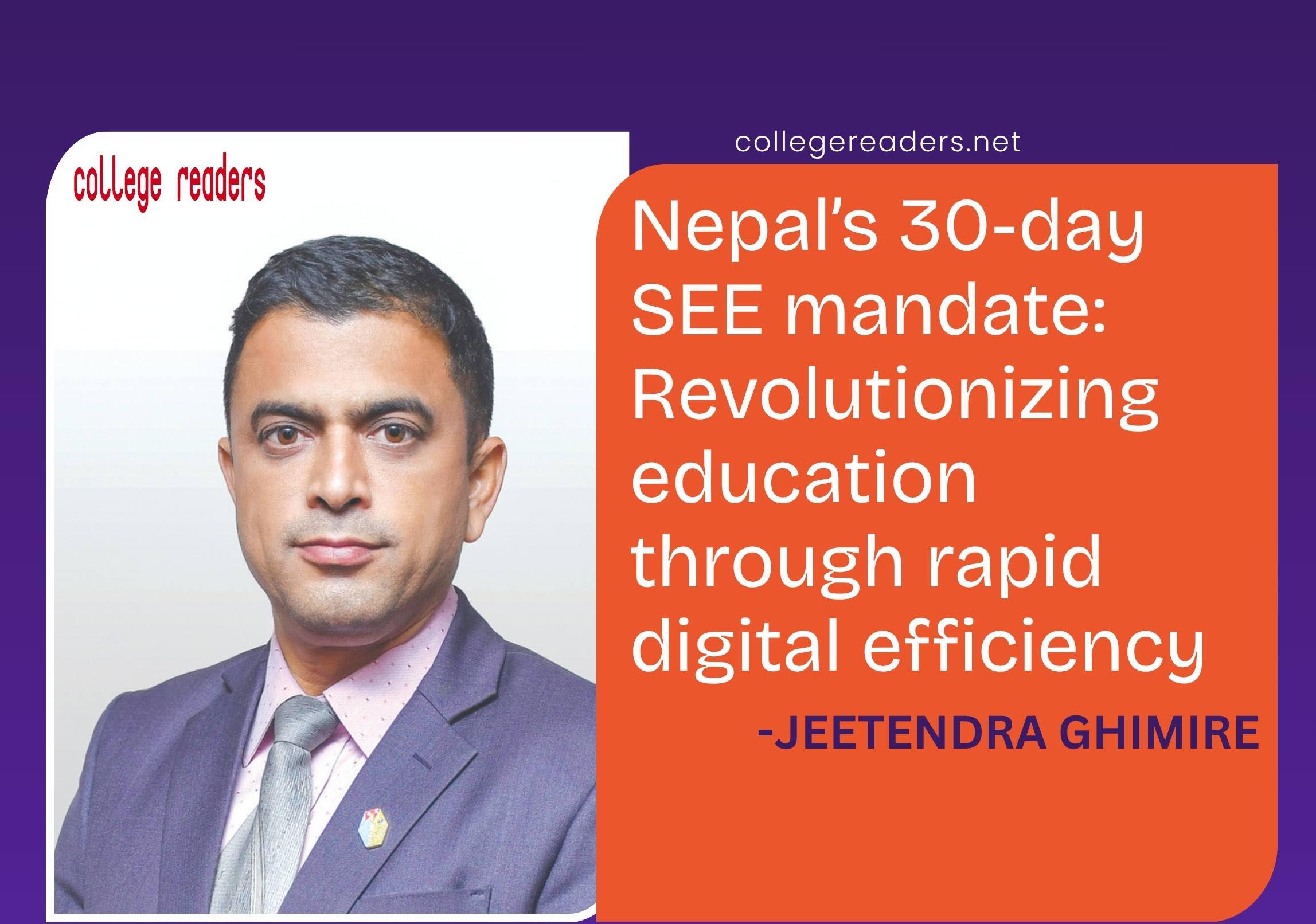
SEE in 30 Days: Speed, Standards, and a System in Transition
- College Readers
- 16 Apr 2026
- Views
- Op-ed , Study in Nepal
Jeetendra Ghimire | CEO | College Readers
The Government of Nepal’s latest directive to publish the Secondary Education Examination (SEE) results within just one month marks a decisive break from decades of administrative sluggishness. Long known as the “Iron Gate,” the SEE has historically been followed by an agonizing three-month waiting period that left more than half a million students suspended in uncertainty. This shift toward “superfast” processing is both bold and necessary—but it raises a critical question: can Nepal’s education system deliver speed without compromising fairness and quality?
At the heart of this reform lies a decentralized evaluation mechanism. By enabling answer scripts to be checked immediately at examination centers or district hubs, the National Examination Board (NEB) eliminates delays caused by transportation and centralized processing. Complementing this is the introduction of digital entry systems, where marks are uploaded directly into a central database via tablets. In theory, this architecture is efficient, transparent, and time-saving. However, its success depends heavily on infrastructure readiness—particularly stable electricity and internet access in geographically remote regions.
Yet, speed must not eclipse credibility. The integrity of SEE results is foundational to a student’s academic trajectory. Recognizing this, the directive incorporates strict monitoring protocols, including teacher verification systems and examiner rotation to prevent bias. Scripts are assigned to teachers outside their own institutions, while re-evaluation audits aim to ensure accountability. If rigorously enforced, these measures can actually strengthen fairness by reducing the prolonged exposure to manipulation that often accompanies delayed systems.
The benefits of this reform are wide-ranging and deeply impactful. For students and guardians, the reduction in waiting time alleviates immense psychological stress and allows timely decision-making regarding higher education or vocational pursuits. Academic institutions, particularly higher secondary schools, gain the advantage of a synchronized calendar. An earlier start ensures that the mandated 180 instructional days are completed without rushing, thereby enhancing learning outcomes.
Moreover, this reform carries implications far beyond secondary education. Most of Nepal’s universities have long struggled with delayed results, often taking six to nine months. This “result paralysis” disrupts academic progression and delays entry into the workforce. The SEE model, if successfully implemented, offers a scalable blueprint. Decentralized checking, digital data entry, and strict oversight can be replicated to align Nepal’s higher education timelines with global standards.
Ultimately, the SEE 30-day result directive signals a shift toward what may be called a “fourth-generation” reform mindset—one that values efficiency, accountability, and technological integration. It challenges the long-held notion that public systems must inherently be slow. More importantly, it reframes time as a fundamental right of students, not a bureaucratic afterthought.
The success of this initiative, however, will depend not merely on policy but on execution. If implemented with precision and integrity, this reform could redefine Nepal’s educational landscape—transforming not just how quickly results are published, but how effectively the system serves its learners.

Popular Categories
Trending This Month








 Established in 2065 BS, COLLEGE READERS is a premier national-level educational magazine dedicated to serving the academic and informational needs of school and university students, teachers, educators, and concerned ones in Nepal. The magazine provides current and comprehensive information on various educational opportunities worldwide, aiming to guide school and college-level students in their academic and career journeys. It also highlights essential support services and service providers that play a crucial role in shaping students' career paths in today's competitive world.

- Our Location Putalisadak, Kathmandu
- Send Us Email collegereaders123@gmail.com
- Call Us Now 977 01 4518759
