
Call now
977 01 4518759
Send Message
collegereaders123@gmail.com
Our Location
Putalisadak, Kathmandu
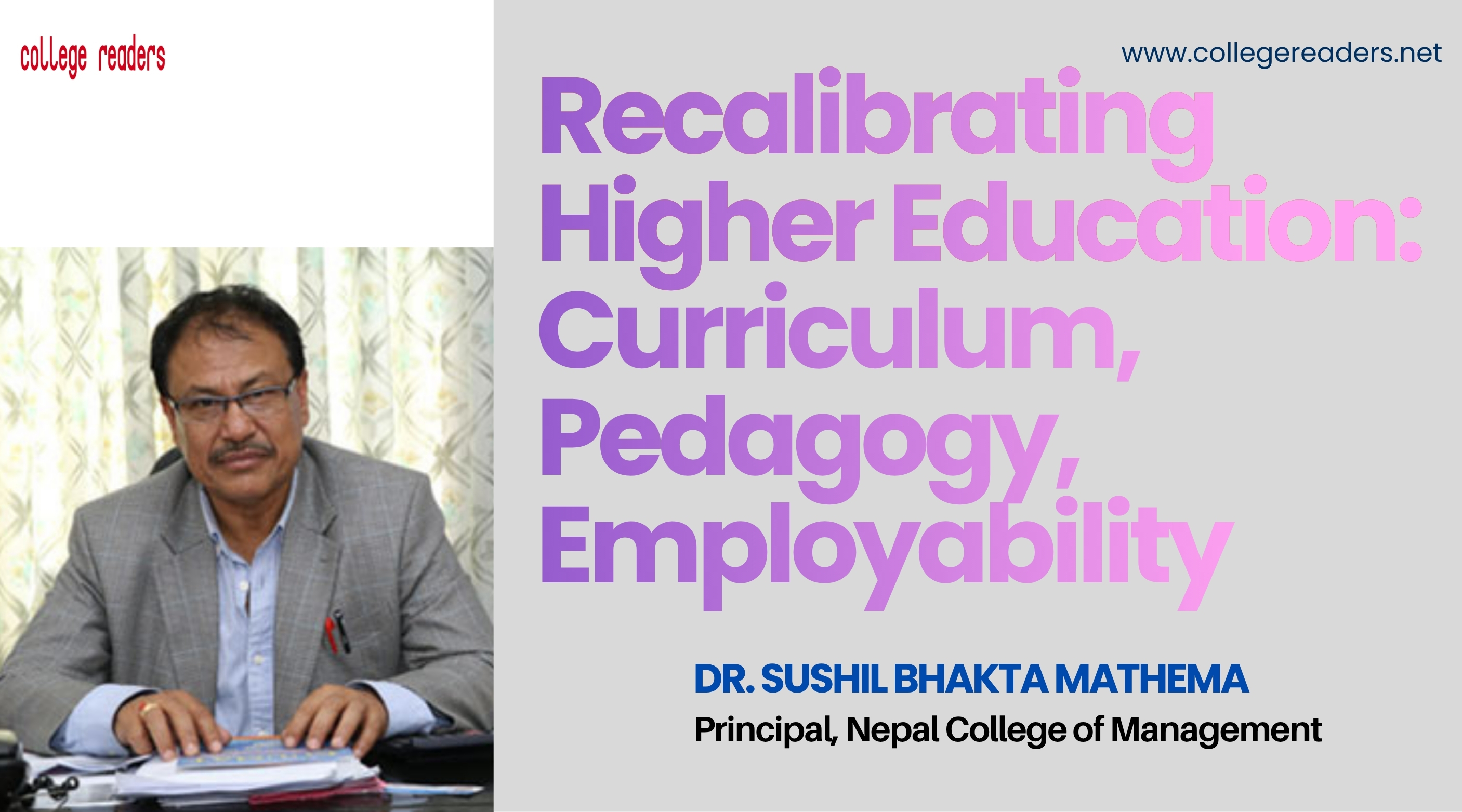
Recalibrating Higher Education: Curriculum, Pedagogy, Employability
- College Readers
- 07 Jul 2026
- Views
- Interviews
The trend of students going abroad immediately after Plus Two is not only an educational issue; it is a social issue. In management education, this trend is more visible because many students do not see a clear employment future after graduation. The syllabus of many programmes has remained almost the same for the last twenty to twenty-five years. Education has become too theoretical, while practical learning remains weak. Students are asked to memorize, reproduce answers and pass examinations, but they are not always trained to apply knowledge in real business situations. This gap weakens confidence and professional readiness.
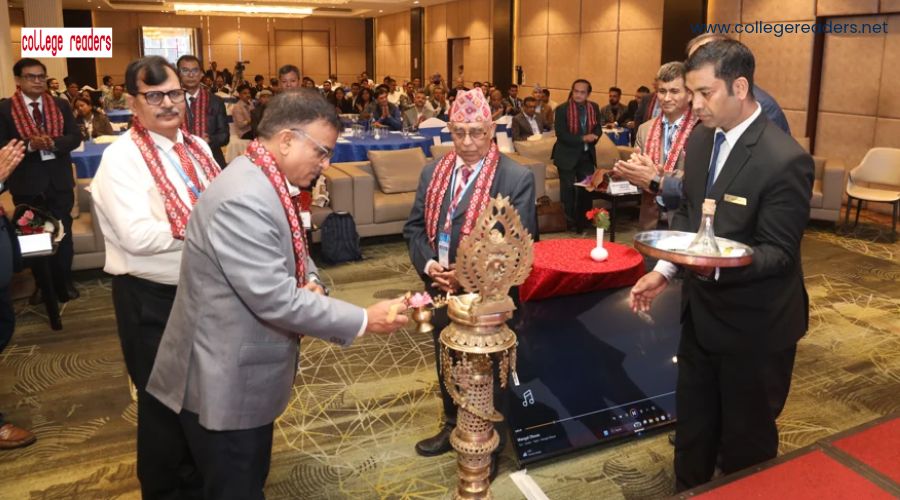
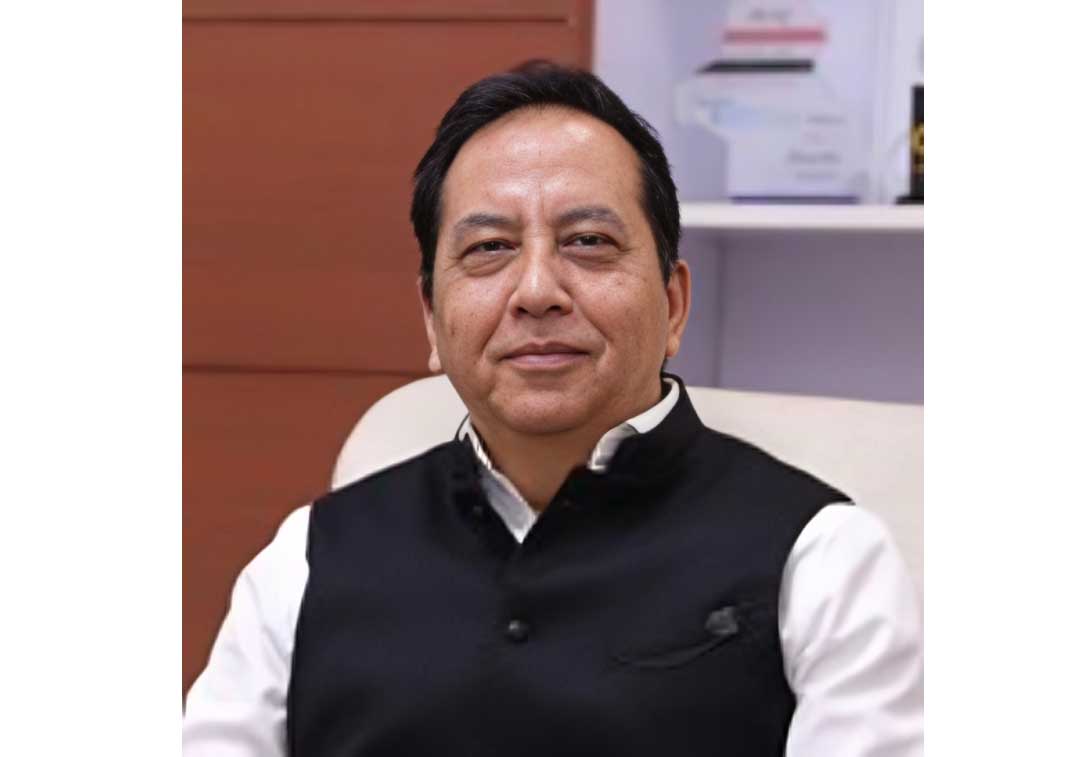
.jpeg)
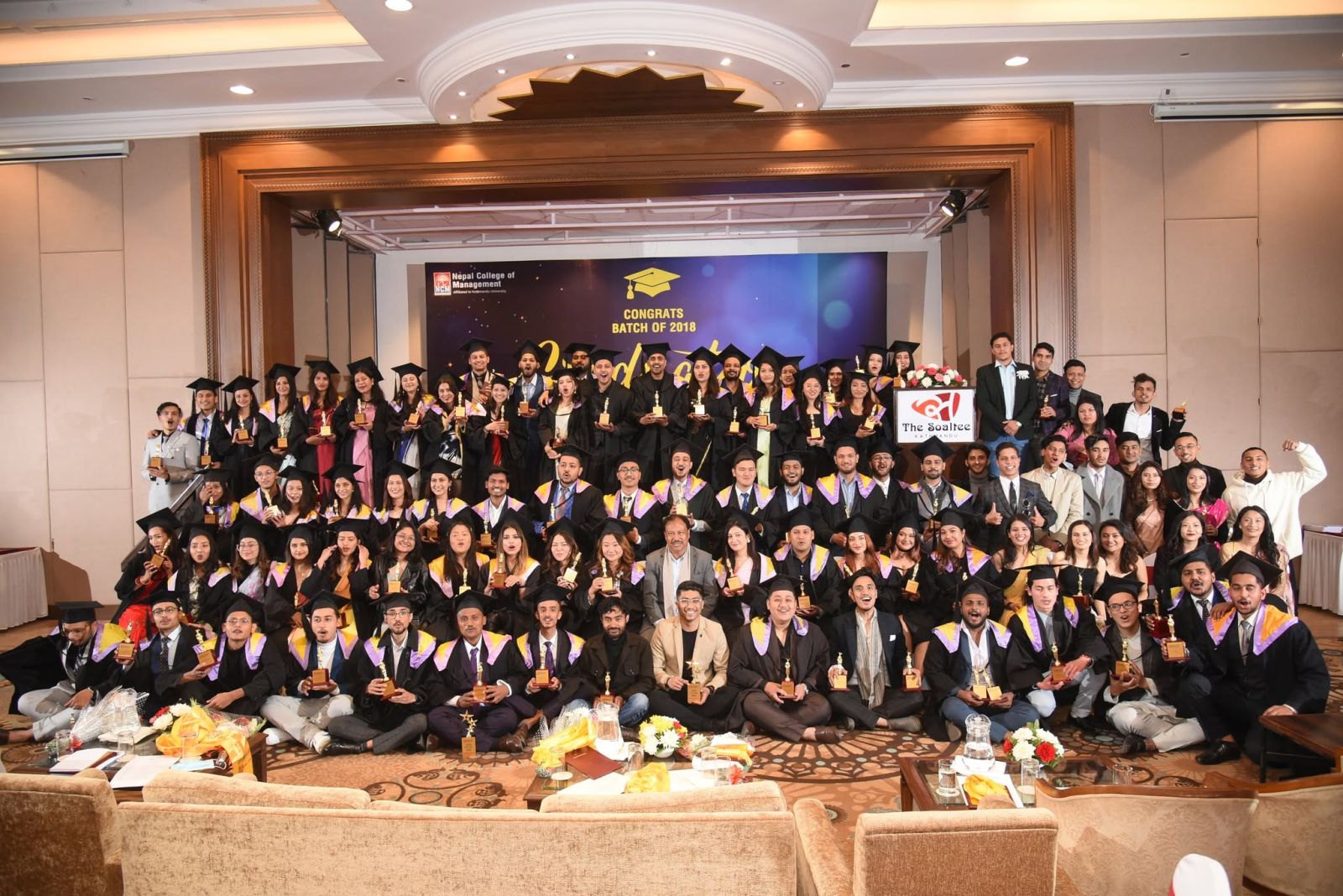
At Nepal College of Management and similar institutions, we understand that quality cannot come from syllabus alone. A syllabus may look similar across the world. The broad structure of a management course in Nepal may not be very different from that of a reputed foreign university. The real difference lies in teaching practice. If teaching remains lecture-based and examination-focused, students will not become professionals. Teaching pedagogy must change. Management students should learn through case studies, presentations, internships, field exposure, business simulations, research assignments, teamwork and problem-solving. Only then can education become meaningful.
The situation in hospitality management shows why students are attracted abroad. When students go for internships in foreign countries, they may receive better wages, food, lodging. In Nepal, interns are often underpaid or not paid properly, and sometimes they are treated without dignity. If a student can earn nearly one lakh rupees abroad through wages, while receiving very little in Nepal, the motivation to leave becomes understandable. The problem is not that students dislike Nepal. The problem is that Nepal has not created enough respectable opportunities for them.
Nepal’s management education needs urgent reform in curriculum, teaching pedagogy, monitoring, fee regulation and employment linkage.
Employment generation is central to higher education reform. If students complete BBA, BHM, BBM or BBS but cannot find decent work, they naturally begin to question the value of studying in Nepal. A country that depends heavily on remittance cannot stop migration through slogans. It must create employment, ensure fair wages and connect higher education with industry needs, not only academic routines.
Fee structure is another factor pushing students abroad. Some private colleges charge very high fees for management and IT-related programmes. The same course may cost six lakhs in one college and ten or eleven lakhs in another. This difference does not always reflect better academic quality. The faculty, syllabus and pedagogy may be almost the same. Sometimes the additional cost comes from glamorous infrastructure, buildings or facilities, rather than better teaching. Education quality should not be confused with luxury facilities. The government must monitor fees and evaluate whether higher costs truly produce better outcomes.
Consultancies also influence the mindset of students. Many Plus Two students are repeatedly told that there is no future in Nepal and that going abroad is the only path. Some consultancies are more interested in commission and service charges than in the academic future of students. Students and parents must therefore be careful. Decisions about higher education should not be made under pressure, glamour or incomplete information.
I do not say that students must never go abroad. But I strongly believe that it is better to go after completing graduation. After Plus Two, many students are still young, not fully prepared for the hardships of foreign life. Age restrictions may prevent them from working legally, and some may end up doing cash work where exploitation is possible. If anything goes wrong in such informal work, protection becomes weak. Abroad, life is not always the dream shown in advertisements. Many students struggle in gas stations, restaurants.
If students complete their bachelor’s degree in Nepal first, they become more mature. Their knowledge expands, their decision-making improves, and they can go abroad for master’s level education with clearer purpose. A master’s degree may take eighteen months to two years, while undergraduate study abroad requires higher cost and longer struggle. At graduate level, international exposure becomes more meaningful.
Students should complete their bachelor’s degree in Nepal before going abroad because graduation brings maturity, stronger knowledge and better decision-making capacity.
However, for students to remain in Nepal for bachelor’s study, Nepali institutions must also improve. Nepal College of Management and other management institutions must show that studying here has value. This means strong academic monitoring, practical teaching, industry linkage, internship support, ethical evaluation and employability. Examination systems must also be credible. If students score high grades in Plus Two but lack basic conceptual understanding in university, something is wrong. Quality control must begin before university and continue throughout higher education.
Parents also have an important role. They should not choose colleges only by name, building, fee level or social prestige. They must examine teaching quality, faculty commitment, student support, internship systems and graduate outcomes. Similarly, students should not rush into bridge courses or foreign preparation simply because everyone else is doing so. They should first understand their interest, ability and purpose through serious self-assessment.
Reform, therefore, is not a matter of fashion; it is a matter of survival for national higher education and for the confidence of families.
Higher education in Nepal can be strong if we reform it honestly. The issue is not that Nepal lacks potential. The issue is that curriculum, pedagogy, employment and governance must move together. At Nepal College of Management, my belief is that management education should produce practical, ethical, confident and employable graduates. If we improve our systems, monitor quality, control unnecessary costs and generate opportunities, students will not feel forced to leave immediately after Plus Two. They will see that Nepal too can offer meaningful higher education and a dignified future.

Popular Categories
Trending This Month








 Established in 2065 BS, COLLEGE READERS is a premier national-level educational magazine dedicated to serving the academic and informational needs of school and university students, teachers, educators, and concerned ones in Nepal. The magazine provides current and comprehensive information on various educational opportunities worldwide, aiming to guide school and college-level students in their academic and career journeys. It also highlights essential support services and service providers that play a crucial role in shaping students' career paths in today's competitive world.

- Our Location Putalisadak, Kathmandu
- Send Us Email collegereaders123@gmail.com
- Call Us Now 977 01 4518759
