
Call now
977 01 4518759
Send Message
collegereaders123@gmail.com
Our Location
Putalisadak, Kathmandu
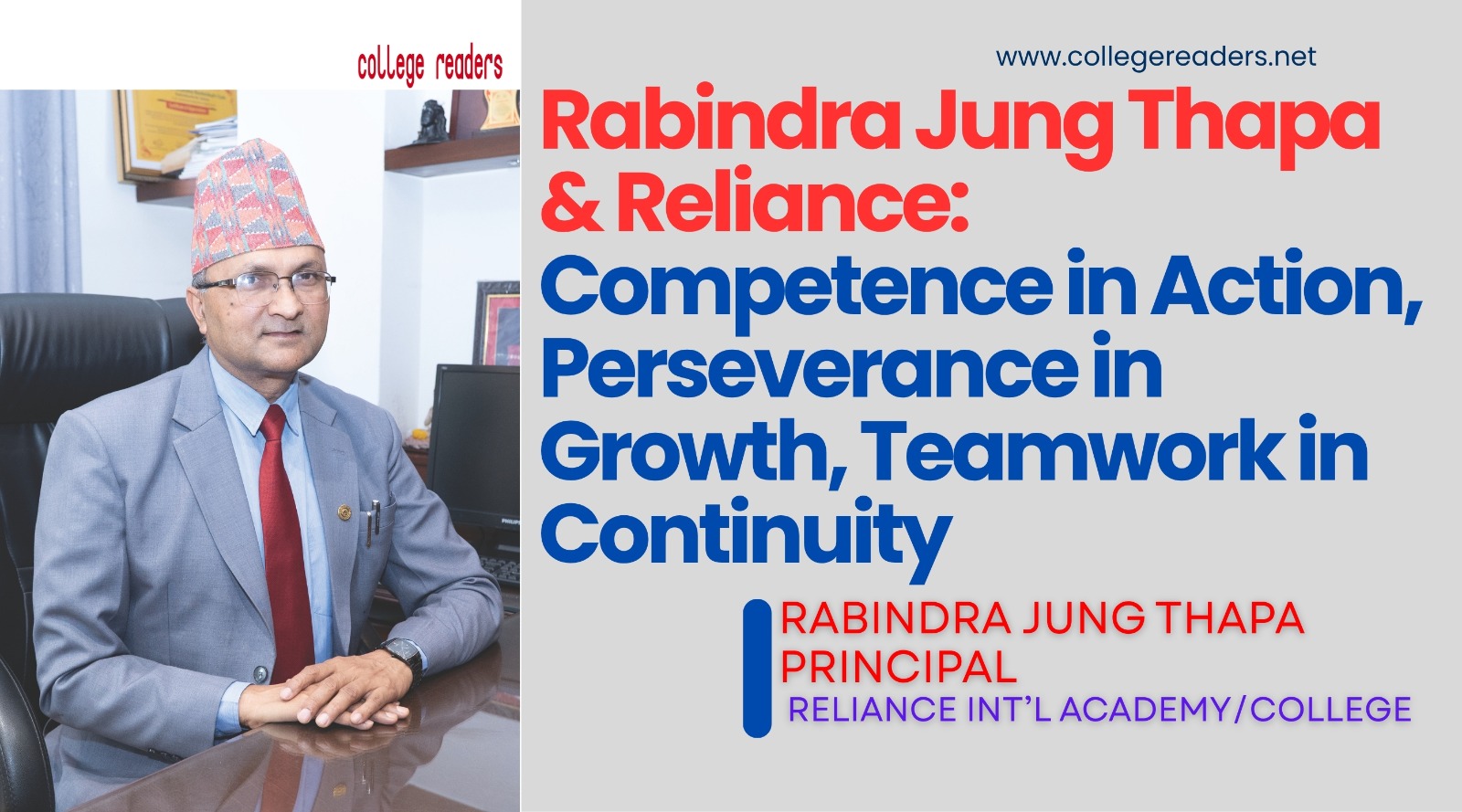
Rabindra Jung Thapa & Reliance: Competence in Action, Perseverance in Growth, Teamwork in Continuity
- College Readers
- 18 May 2026
- Views
- Interviews
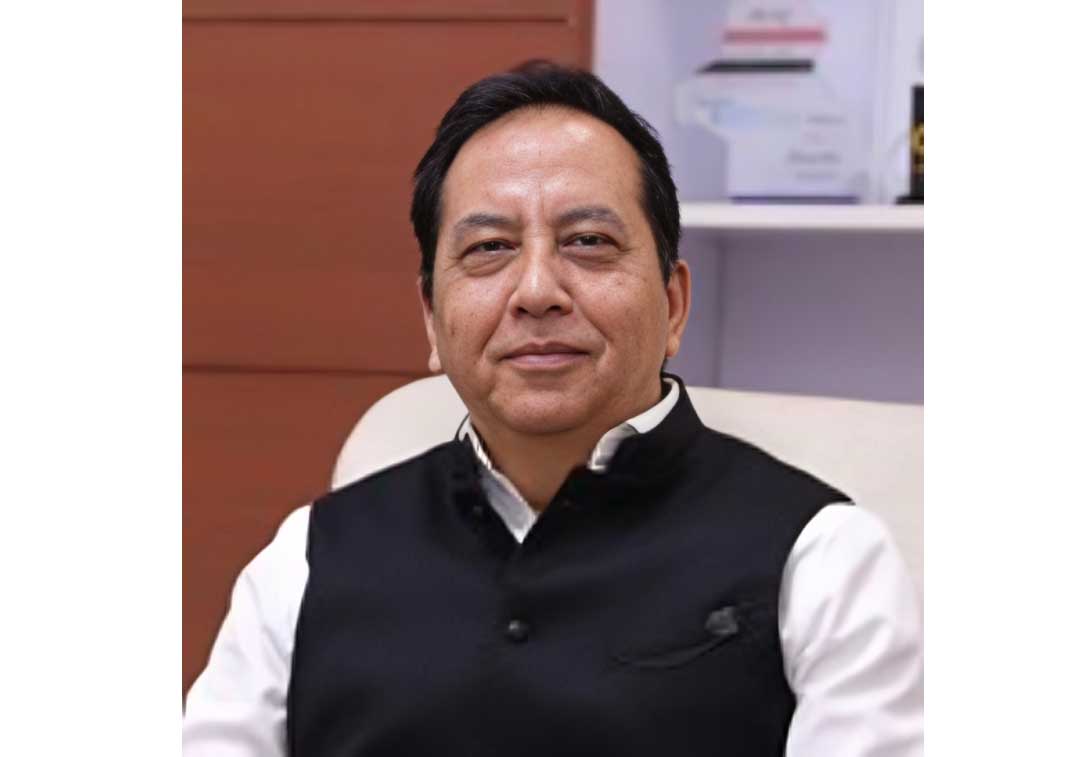
Rabindra Jung Thapa stands as a transformative force in Nepal's private education sector, serving as the Executive Chairman of Reliance International Education Network and Principal of Reliance College. Originally from Chitwan, Thapa has dedicated approximately 25 to 30 years exclusively to the education sector, becoming one of the most respected institutional leaders in Nepal's competitive educational landscape. His remarkable journey from a young teacher to executive chairman of a comprehensive educational network demonstrates how passionate commitment combined with strategic vision can create lasting institutional impact while serving thousands of students across multiple campuses.
Under Thapa's leadership, Reliance International Education Network has evolved into a comprehensive educational ecosystem comprising seven institutions serving over 6,000 students. The network operates Reliance Nepal Vidya Sadan School, Reliance International Academy School, and five colleges offering BBA, BBS, and BCA programs. This systematic expansion from a single school in 2055 BS to a multi-institutional network represents one of Nepal's most successful private education enterprises, demonstrating sustainable growth across nearly three decades while maintaining quality standards and institutional integrity.
Thapa's entry into education followed an interesting trajectory. Immediately after completing his own studies, he briefly engaged in the teaching profession, working approximately one year before deciding to pursue entrepreneurial educational ventures. In 2055 BS, collaborating with like-minded colleagues, he established what would become Reliance International Academy School, focused on private institutional education. Remarkably, the founding team has largely remained intact through the years, with original colleagues continuing to work alongside him as the network expanded. This continuity of leadership represents a significant institutional strength, creating consistent vision implementation and shared institutional culture spanning decades.
Reflecting on what drew him into teaching, Thapa offers profound insights about his first batch of students. When he meets these former students today, he tells them genuinely that they made him a teacher—their affection and warmth transformed him into an educator. He believes the greatest power exists in love, and without genuine emotional engagement, sustained commitment to any profession becomes impossible. He emphasizes that teachers who cannot truly love their students cannot become authentic educators. This love-centered philosophy permeates his entire educational vision, shaping how he approaches institutional leadership and teacher development throughout the network.
Initially, Thapa actively taught classes himself, continuing classroom instruction even after opening colleges. However, around 2062 BS, his role gradually transitioned from direct teaching to comprehensive institutional oversight. He realized that focusing on one or two classes prevented him from addressing systemic needs—guiding all students effectively required attending to overall institutional development, supporting teachers in their responsibilities, and ensuring quality across all departments. This evolution from teacher to systemic leader represents the natural progression of educational entrepreneurship, where direct teaching gives way to creating environments enabling many teachers to flourish.
Thapa firmly believes he was born for teaching, finding genuine joy in educational work. He acknowledges that other professions would not have provided similar fulfillment—he could not happily sit at a desk in administrative work, function as an engineer, or maintain the doctor-patient relationship medical professionals require. His personality thrives on engaging with children's behaviors and temperaments, finding satisfaction in their growth and development. This self-awareness about his ideal professional fit explains the authentic passion driving his educational ventures.
Regarding national educational development, Thapa articulates clear convictions about teacher responsibility. He believes every teacher should ask how they can elevate Nepal's education system and engage honestly in this mission. If everyone takes responsibility in their respective positions, building the nation requires no extended time. However, he criticizes the prevailing tendency of individuals juggling four or five different occupations seeking personal benefit—an approach that builds neither the nation nor the individual. This focused commitment to single-minded dedication characterizes his own career and what he expects from educational professionals.
For Thapa, teacher fulfillment parallels athletic achievement—a footballer's joy in scoring goals, a cricketer's satisfaction in earning runs. For teachers, ultimate happiness comes from witnessing student achievements: excellent results, successful careers, and meaningful professional establishment. He takes pride in encountering former students working in banking, insurance, and various professional sectors throughout Nepal. These achievements represent more important measures than mere examination results, demonstrating education's lasting impact on individual lives and societal contribution.
Quality maintenance in serving over 6,000 students requires systematic attention to multiple factors. Thapa emphasizes intake policies, teacher training quality, and creating vibrant, positive teaching-learning environments. He views these elements as essential foundations producing excellent results naturally. The network has consistently ranked among Nepal's top 10 institutions since establishment, demonstrating that systematic quality attention produces measurable outcomes. He emphasizes that genuine education extends beyond academic study to comprehensive development—a holistic perspective shaping institutional practices throughout the network.
Addressing contemporary challenges, Thapa identifies significant evolving demands. Investment requirements in private educational institutions continue increasing dramatically. Teacher development presents equally serious challenges as traditional lecture methods become obsolete in our digitalized environment. Teachers must continuously update their technological capabilities. Additionally, today's students—digital natives raised in connected environments—require sophisticated understanding of child psychology and developmental science. Parental engagement challenges have intensified, as many parents struggle to provide adequate time for their children, creating responsibility for educational institutions to bridge these gaps through parent education and engagement initiatives. Government policy frameworks also require continuous improvement to remain relevant to evolving educational needs.
Thapa champions experiential learning beyond textbook limitations. He emphasizes that countless valuable lessons exist outside formal curricula, including talent development through extracurricular activities. He stresses appropriate information delivery aligned with age-group needs—incorrect or untimely information shapes student mindsets negatively, affecting their future decision-making. Many schools fail in this regard, leaving SEE graduates uncertain about subject selection, college choice, and career direction.
To address these challenges, Reliance Network conducts innovative programs predating government initiatives. Their "Meet with Alumni" sessions, running biweekly for two to three years, connect current students with successful graduates across various professions—social workers, artists, professionals from diverse fields. These sessions help internal students avoid confusion about educational and career pathways. External students can join annual open sessions, while individual counseling sessions support enrollment-time decision-making. Thapa emphasizes that lack of valuable information causes students to wander away from their destinations, wasting precious time and resources—both economic and temporal losses that proper guidance prevents.
The network operates Reliance College in Saraswati Nagar, Chabahil, offering education from nursery through master's degree level. Recent additions include Chartered Accountancy (CA) programs, expanding student opportunities while maintaining the network's commitment to comprehensive educational provision. Students completing studies in one institution can continue their educational journey within the network, ensuring consistent quality and supportive transitions through different educational stages.
Thapa extends heartfelt congratulations to recent SEE graduates and welcomes parents seeking clarity about educational decisions. He invites them to visit Reliance College in Saraswati Nagar, Chabahil, to address questions and discuss educational planning. His approach reflects genuine care extending beyond enrollment considerations to authentic concern for student success regardless of which institution families ultimately choose.
Rabindra Jung Thapa exemplifies educational leadership combining genuine passion, strategic vision, systematic execution, and authentic care for student welfare. His transformation of Reliance from a single school to a comprehensive educational network demonstrates that sustained commitment to quality, continuous innovation, and love-centered leadership creates lasting institutional excellence. In an era where education increasingly commercializes, Thapa reminds Nepal's educational community that transformative impact emerges from leaders viewing education as sacred calling rather than mere business opportunity, building institutions that genuinely serve students, families, and ultimately, the nation's developmental aspirations.

Popular Categories
Trending This Month






 Established in 2065 BS, COLLEGE READERS is a premier national-level educational magazine dedicated to serving the academic and informational needs of school and university students, teachers, educators, and concerned ones in Nepal. The magazine provides current and comprehensive information on various educational opportunities worldwide, aiming to guide school and college-level students in their academic and career journeys. It also highlights essential support services and service providers that play a crucial role in shaping students' career paths in today's competitive world.

- Our Location Putalisadak, Kathmandu
- Send Us Email collegereaders123@gmail.com
- Call Us Now 977 01 4518759
