
Call now
977 01 4518759
Send Message
collegereaders123@gmail.com
Our Location
Putalisadak, Kathmandu
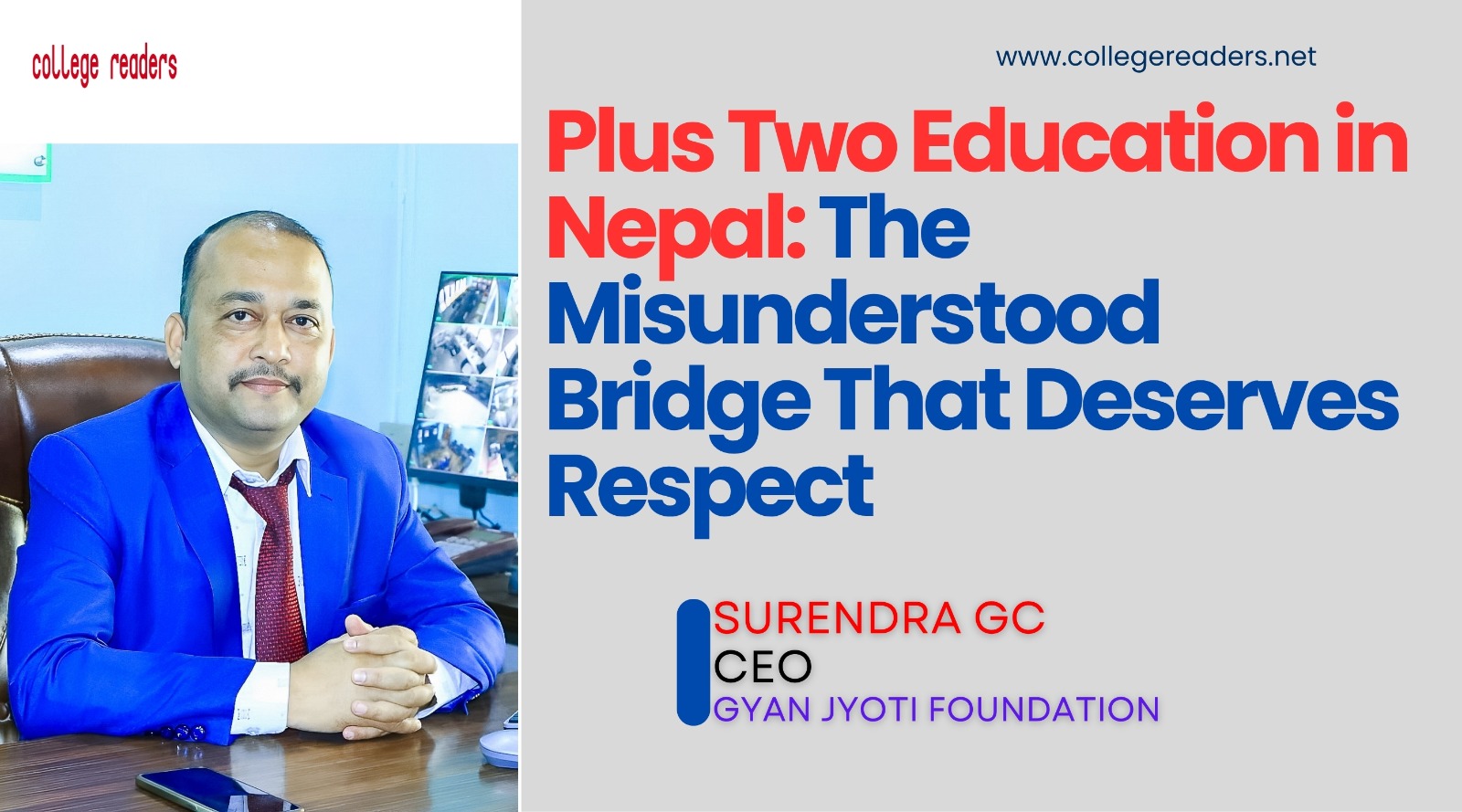
Plus Two Education in Nepal: The Misunderstood Bridge That Deserves Respect
- College Readers
- 19 May 2026
- Views
- Features , Op-ed
The Most Underrated Stage in Nepal's Education Ladder
Plus Two — Grades Eleven and Twelve — is the most underrated stage in Nepal's entire education ladder. It is the bridge that decides whether a young Nepali enters university with momentum or with confusion; whether the next decade is professionally directed or quietly drifts. Yet in the public conversation it is treated as a peripheral year, sandwiched between school and "real" higher education. After three decades of watching cohort after cohort pass through this stage, and analyzing the latest data from 2026, I can say with conviction that the way we discuss Plus Two — and the assumptions students continue to make about where to study it — both deserve a serious refresh.
The Beauty of Plus Two
The beauty of Plus Two lies precisely in what most people overlook. For the first time in their lives, students choose a stream. They commit to Science, Management, Humanities, Law, or Education, and that choice begins to shape their professional identity. The stage introduces structured laboratory work, project-based learning, internships at stronger institutions, and the rhythm of independent study.
The two years are short. The transformation, when taken seriously, is permanent. But that transformation cannot occur if students treat Plus Two as a mere continuation of school. The single most damaging mindset I see today is the assumption that, because the stage now sits under the National Examinations Board within the school-education framework, it is "just school plus two." It is not. It demands self-directed study, active engagement, and a maturing relationship with one's own learning. As of 2026, the NEB has prepared action plans for question bank construction and teacher training, signaling that quality is being prioritized at this level.
A Shifted Map: Why District Plus Twos Now Hold the Ground
Twenty years ago, roughly eight out of every ten Plus Two-bound students from outside Kathmandu Valley packed their bags for the capital. Today, my own observation places that ratio closer to two in ten. The reversal is dramatic, and it has happened quietly. Two forces drive it.
First, the number, range, and quality of district and provincial Plus Two colleges has risen sharply since the early 2000s. With approximately 4,800 functioning +2 schools across Nepal, including around 1,200 private institutions, students now find quality options in the vicinities beyond Kathmandu like Tulsipur, Butwal, Birgunj, Pokhara, Biratnagar, Damak, Surkhet, and many other cities and district headquarters. Where once a serious student had no choice but Kathmandu for pre-medical or pre-engineering preparation, today such preparation is run with comparable rigor outside the valley.
Second, the cost-and-stress equation has shifted. Sending a sixteen-year-old to Kathmandu means rent, transport, separation from family, and exposure to a fast and sometimes unforgiving urban environment, at exactly the age when emotional and academic foundations are still forming. Families now ask, reasonably, whether the marginal academic advantage justifies the human cost. With private schools covering only 25 percent of total +2 schools but achieving pass rates of 80 to 90 percent — and more than 90 percent of A+ recipients coming from private schools — quality is no longer a Kathmandu monopoly.
What Local Plus Two Institutions Now Offer
What students once travelled to Kathmandu for — qualified teachers, modern laboratories, library and digital resources, structured entrance preparation, and a disciplined academic culture — is now demonstrably available beyond the Valley. Practical and project-based learning is no longer the exclusive preserve of capital-city colleges. Skill-oriented supplementary courses, extracurricular programmes, and counselling services have become standard at the better local institutions.
Many offer scholarships generous enough to absorb most of the fee burden for deserving students. Competition between local colleges has, on balance, raised the floor for everyone.
After SEE: Choosing the Right Subject
For an SEE graduate now staring at the stream menu, the rule is simple and oddly difficult: choose by personal interest and aptitude, not by peer pressure or parental expectation. Assess what you actually enjoy and what your foundational knowledge can carry. A student who reads ferociously and argues with evidence should not be forced into science merely because the family admires doctors. A student who genuinely enjoys numbers should not be steered into humanities because a cousin once "wasted" a science seat.
Take honest stock of your strengths, talk to teachers who have observed you over years, and consider both the immediate study workload and the longer-term career direction the stream opens. Genuine interest, paired with capacity, produces far better outcomes than any imposed choice will. The 2026 SEE results, with 512,421 students registering and a pass rate of 65.98 percent, remind us that foundational preparation matters immensely.
Choosing the Right College
Once the stream is decided, the college choice should be made on five quiet but decisive criteria: the qualifications and accessibility of the teaching faculty; the depth of laboratory, library, and digital infrastructure; the historical record of academic achievement; the overall supportive academic environment, including counselling and pastoral care; and the financial reasonableness of the institution for the family that will pay the bills.
A local college that scores well across these five is, in nearly every case, a better proposition than a distant one that scores marginally higher on prestige but drags a heavy social and economic tail behind it. Staying near home keeps daily commute manageable, family support active, food and routine stable, and study hours genuinely available rather than swallowed by city traffic and hostel adjustment. With over 80 percent of students choosing +2 education nationally, the local option is not a compromise — it is a strategic choice.
A Word to Parents and Students
Plus Two is not a way station; it is a foundation. Quality foundations are now genuinely available outside the Valley. Visit the colleges within reach of your home, speak to current students and recent alumni, examine results and facilities honestly, and trust your considered judgement. The map has shifted. It is time our choices shifted along with it.

Popular Categories
Trending This Month








 Established in 2065 BS, COLLEGE READERS is a premier national-level educational magazine dedicated to serving the academic and informational needs of school and university students, teachers, educators, and concerned ones in Nepal. The magazine provides current and comprehensive information on various educational opportunities worldwide, aiming to guide school and college-level students in their academic and career journeys. It also highlights essential support services and service providers that play a crucial role in shaping students' career paths in today's competitive world.

- Our Location Putalisadak, Kathmandu
- Send Us Email collegereaders123@gmail.com
- Call Us Now 977 01 4518759
