
Call now
977 01 4518759
Send Message
collegereaders123@gmail.com
Our Location
Putalisadak, Kathmandu
Our +2 Education has Scale and Access — But it Still Lacks Effective Pedagogy
- College Readers
- 19 May 2026
- Views
- Op-ed , Interviews
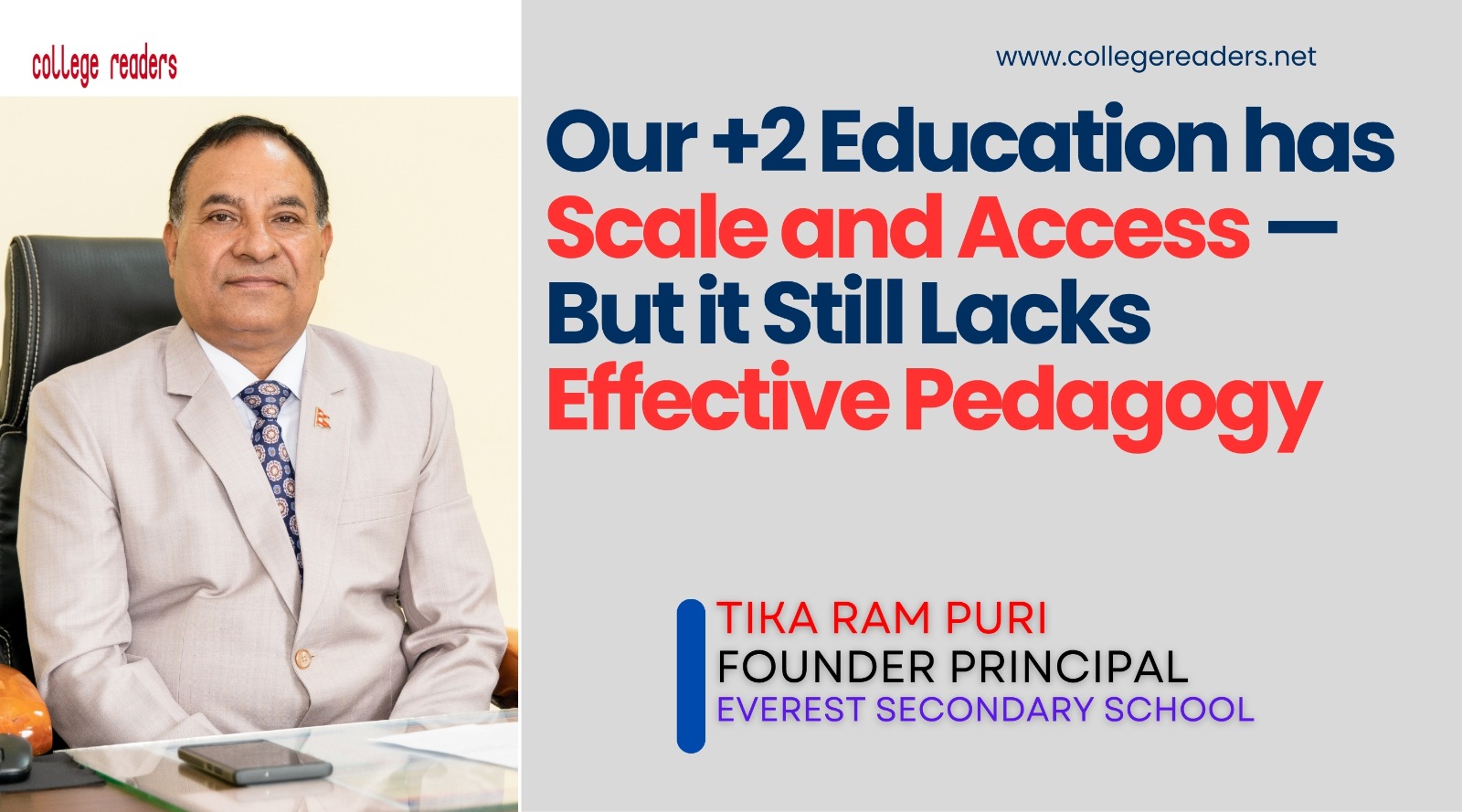
Tikaram Puri, Founder Principal of Everest Secondary School and College, Biratnagar, and Former Central President of PABSON, shares candid reflections on the present state of Plus Two education in Nepal. Drawing on thirty-three years of experience in the education sector, Puri critically examines the recent SEE results, the irregularities surrounding answer-sheet evaluation at examination centres, the unhealthy competition during Grade XI admissions, and the structural gaps that push students abroad. Interviewed by Jeetendra Ghimire, CEO of College Readers, he proposes policy reforms, decentralisation, pedagogical training, and a clearer school-level identity for Grades XI and XII to elevate Nepali education to globally competitive standards.
Sir, the recent SEE result was published within a single month, and pass percentages have been rising gradually over the past few years. How do you analyse this acceleration?
The government's intention to publish results swiftly is commendable in spirit. But when we look closely, the curriculum is unchanged, teachers are the same, technology has not been upgraded, and teaching methods remain identical. Even student preparation followed familiar patterns. What truly changed was the procedure for conducting the examination and publishing the result. The system of evaluating answer sheets at the examination centre itself created more negatives than positives. Speed alone is not improvement; a faster result does not automatically mean better learning. The sudden flood of 4 GPAs cannot be explained by a leap in academic excellence — it points to weaknesses in evaluation, not genuine progress. When the result suddenly looks different but everything underneath remains identical, something has clearly happened in the system itself, not in our students. The government's eagerness to demonstrate progress is welcome, but improvement must be earned through better classrooms, not engineered through procedural shortcuts. Inflating results at the final stage while compromising the dignity of the examination is cosmetic correction, not reform.
What specific irregularities did you observe in the answer-sheet evaluation process?
When papers are checked locally, immediately after the examination, the teachers and principals at the centre often know one another personally. In some places, sheets were marked under mutual understanding; in others, personal grudges influenced the outcome. This compromised the fairness of evaluation. Schools from Gorkha and other districts have raised legitimate concerns. The procedure designed for local checking was fundamentally flawed. Instead of bringing reform, it introduced irregularities into a process that demands strict neutrality. The dignity of an examination cannot be sacrificed for speed or inflated outcomes. Real improvement requires strengthening the curriculum, retraining teachers, and reforming classroom pedagogy — not adjusting appearances at the end through procedural shortcuts that erode public trust.
The Plus Two admission season has become notorious for irregularities. What are the principal challenges, and how should stakeholders respond?
One positive step the government has taken is ending the bridge-course practice that effectively allowed institutions to buy and sell students. Students now genuinely choose where to pursue Grades XI and XII. However, the deeper problem lies within our institutions. Many cross the minimum dignity of education through aggressive advertising and inducements. There is no ceiling on enrolment — some colleges admit two to four thousand students in Grade XI, while others struggle to fill sixty seats. This imbalance is unhealthy. We urgently need a quota system and clear enrolment limits per school. Door-to-door recruitment, harassing phone calls to teenagers, and pressuring parents strip education of dignity and breed unhealthy competition. A rule-based environment must replace the haphazard scramble we witness every year.
With bridge courses closed, are students now staying in their local provinces, or does migration to Kathmandu still continue?
Honestly, migration to Kathmandu has not stopped this year because bridge courses ended. Even at Everest, fifteen to twenty of my own SEE graduates approached me to verify their grade sheets and travel to Kathmandu for admission. Some may leave a month later than before, but the trend continues. Yet the genuine reduction over the past decade has already eased excessive centralisation. Under federalism, every province has its own capital. There are excellent schools and colleges outside the Valley — with strong infrastructure, qualified teachers, and well-managed systems, sometimes better than those in Kathmandu. Decentralisation is healthy. Students who wish to go should not be stopped, but those who remain in the provinces deserve confidence that the institutions serving them are equally capable.
Plus Two institutions seem preoccupied with board examinations and pay less attention to higher education, employment, and responsible citizenship. How do you respond?
This is a deeply structural issue. In earlier decades, our curriculum oriented students toward the outside world rather than grounding them in Nepali society. Social studies was introduced to correct this, but we have not honestly measured its effectiveness. Today, many students complete Grade XII with one dominant ambition — to go abroad. We cannot place this burden solely on schools and colleges. The real question is whether the state offers students a credible path to build their future within Nepal. Schools take students through Grade XII, but cannot promise employment because students do not yet hold a degree. The responsibility shifts to universities and the government — they must guarantee job placement, dignified salaries, and a future students can believe in. Abroad, universities actively help students earn while studying. Even in India, colleges actively place graduates. In Nepal, that ecosystem is almost absent. The weakness lies not only in our schools, but in state policy and the inability of our universities to deliver employment outcomes. Students go abroad not merely for better education, but because they see a tangible future there. Until Nepal builds that same assurance — guaranteed placement, dignified income, and a clear professional pathway — the outflow of talent will continue regardless of how good our schools become.
How globally competitive is our Plus Two curriculum and pedagogy, and what practical steps are needed for Nepali students to compete internationally?
In the global context, we have not aligned Nepali education with modern pedagogy. One central reason is teacher training. Although some training reaches teachers up to Grade X, very little exists for those handling Grades XI, XII, or even bachelor-level instruction. At the university level, structured pedagogical training is almost absent — there is talk of research and seminars, but minimal discussion on how teaching itself must evolve. Some universities, including Kathmandu University, have made commendable efforts, yet a system-wide gap persists. To compete internationally, we must invest in continuous training for senior-secondary and tertiary teachers, redesign curricula around recognised global standards, and create structured forums for pedagogical reform.
JG: Technology, artificial intelligence, and digital platforms are reshaping classrooms. How should Plus Two education respond while preserving discipline, critical thinking, and human values?
There is no alternative to embracing technology. The world has moved far ahead — artificial intelligence is no longer optional but foundational. The new generation must engage with it confidently, and our education must do the same, at both school and university level. The starting point is the curriculum itself, which must be redesigned to integrate technology meaningfully. Teachers must then be retrained as facilitators rather than information providers. Schools must develop both physical and digital environments for genuine integration. If we cannot teach this way, our students will fall behind globally. At the same time, technology must never displace discipline, critical thinking, or ethical grounding. These human qualities remain the core of any education worth giving young people.
Looking ahead a decade, what is your vision for Plus Two education, and what role must institutional leaders play?
First, we must repair policy at the foundational level. Education up to Grade XII is school-level, not college-level. We created Plus Two and zero Plus Two institutions and treated them as colleges, which was conceptually incorrect. Grades IX to XII together form the secondary level and must be integrated with school administration. Practically, the registration form filled in Grade IX should remain valid through Grade XII, not require a fresh registration in Grade XI. The Grade X examination should be conducted by the provincial board, while the Grade XII board examination remains with the National Examination Board — a clear federal-provincial division. We must also fix enrolment limits per school. Classrooms with seventy or eighty students cannot deliver quality. Until these structural reforms are genuinely implemented, confusion will persist. And until classroom sizes are regulated, even our best institutions will dilute their own quality. These are not radical proposals — they are minimum administrative hygiene for any serious education system.
After SEE, students and parents often rush around looking for the right Grade XI college. What is your advice?
Normally, if the existing school offers Grades XI and XII, that is the most appropriate option. The administration and teachers already know the student and can build on that foundation. Of course, students retain the right to move if genuinely dissatisfied. When choosing, three things matter. First, Grades XI and XII remain pre-university — a macro-level starting point before bachelor-level specialisation. Performance here shapes future stream choices, so subjects must be selected on personal aim, interest, and destination, not a friend's preference or casual suggestion. Second, physical infrastructure, the teaching-learning environment, and the quality of peers must be evaluated carefully. The wrong company in a crowded institution can derail an entire academic future. Reflect deeply before committing. Third, do not treat Grades XI and XII as a holiday from school discipline. These two years quietly shape adult character, work habits, and intellectual seriousness — choose the institution that will reinforce, not relax, those qualities.
Finally, why should students consider Everest for their Plus Two studies?
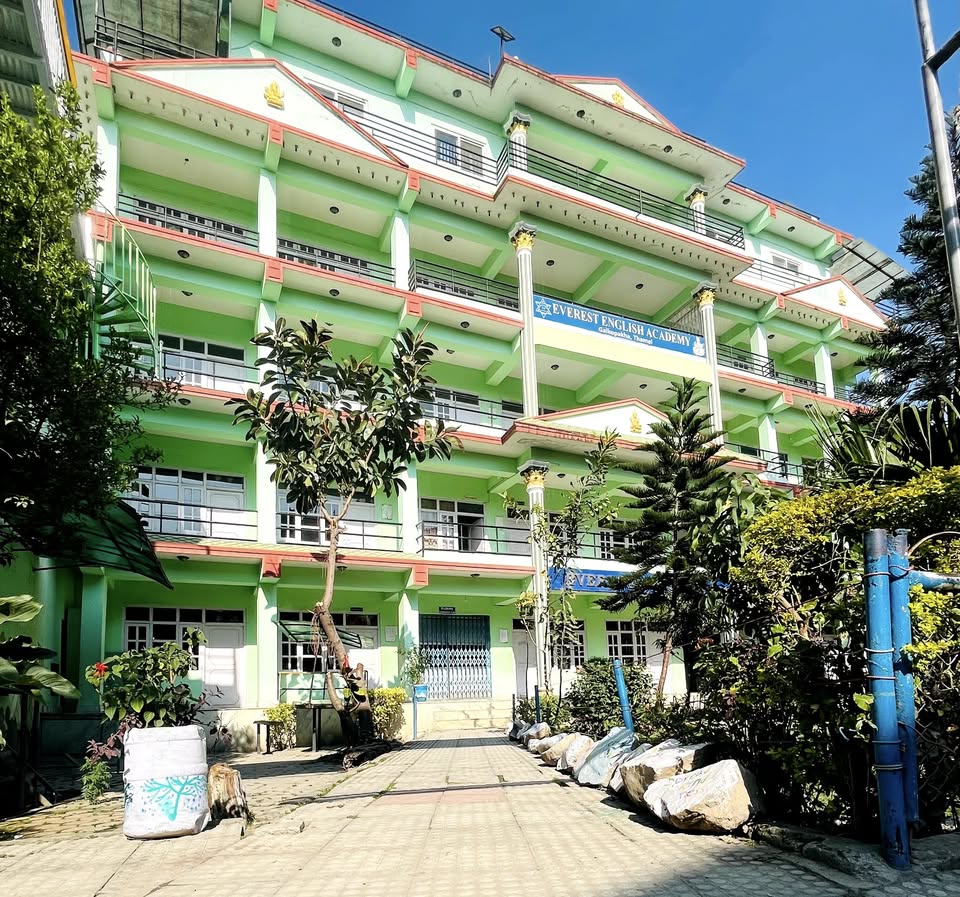
Everest is academically strong. This is not a college built on paid awards or promotional publicity. The Government of Nepal has formally recognised Everest as one of the best-performing colleges nationally. Year after year, we have achieved 100 percent results in the Grade XII board examination, and our graduates pursue prestigious streams including medicine, engineering, chartered accountancy, and other competitive disciplines. Our physical infrastructure is among the best in Nepal. Although Biratnagar is famously hot, our campus is designed for comfort, and we offer dedicated facilities for every kind of extracurricular activity, supported by efficient management. I warmly invite students and parents to visit, observe everything firsthand, and then decide. Education is a long journey, and Everest offers a foundation worth trusting.
Popular Categories
Trending This Month








 Established in 2065 BS, COLLEGE READERS is a premier national-level educational magazine dedicated to serving the academic and informational needs of school and university students, teachers, educators, and concerned ones in Nepal. The magazine provides current and comprehensive information on various educational opportunities worldwide, aiming to guide school and college-level students in their academic and career journeys. It also highlights essential support services and service providers that play a crucial role in shaping students' career paths in today's competitive world.

- Our Location Putalisadak, Kathmandu
- Send Us Email collegereaders123@gmail.com
- Call Us Now 977 01 4518759
