
Call now
977 01 4518759
Send Message
collegereaders123@gmail.com
Our Location
Putalisadak, Kathmandu
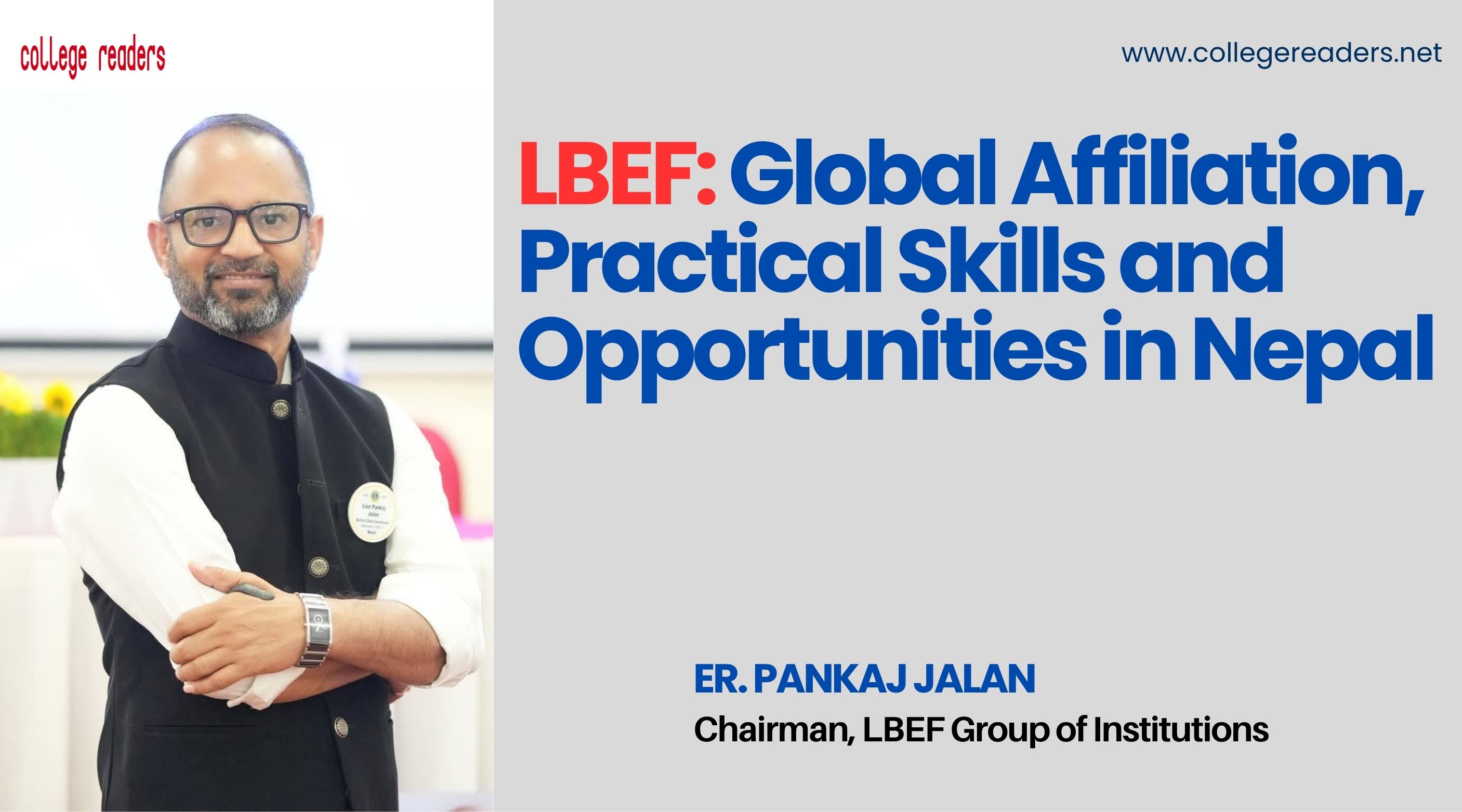
LBEF: Global Affiliation, Practical Skills and Opportunities in Nepal
- College Readers
- 07 Jul 2026
- Views
- Interviews
Contribution of Foreign Universities to Higher Education
Foreign university-affiliated institutions have made a meaningful contribution to Nepal’s higher education. IT education itself began in Nepal through a foreign university-affiliated college, and LBEF was the first IT college in the country. Similarly, Nepal’s first private hotel management college was also initiated under a foreign university model. Many programmes that later entered Nepali universities were first introduced through foreign affiliations.
Their contribution is not limited to programme introduction. They brought timely academic calendars, punctual sessions, timely results, updated curricula, innovative academic practices and a stronger sense of academic discipline. Students also benefit from easier credit transfer opportunities and smoother academic mobility when they need to continue studies abroad or pursue master’s degrees internationally.

College Fees and Domestic Versus Foreign Education
There is a public perception that foreign-affiliated colleges are always more expensive. I do not believe this is fully true. Fees vary from college to college. Some foreign-affiliated colleges are expensive, some are affordable, and some are in the middle. The same is true for colleges affiliated with Nepali universities. We have seen Nepali IT colleges publicly promoting fees of up to Rs. 2 million. To my knowledge, no foreign university-affiliated IT college has charged that much for IT education.
Therefore, students should not judge quality only by fee level or university name. Higher fee does not automatically mean better education. At the time of admission, students should examine their interest, capacity, satisfaction and the actual academic environment. The right college is the one that provides value, discipline, facilities, practical exposure and confidence.
Curriculum and the Importance of Practical Education
When students compare Nepali universities and foreign universities, they should not say one is always good and the other is always weak. Every university has its own strengths. What matters is whether the curriculum matches the student’s interest and future goal. Domestic curricula in Nepal are often more theory-oriented, while foreign universities usually focus more on practical learning, programming and applied work. But this also differs from university to university.
Foreign university-affiliated colleges have contributed significantly to Nepal’s higher education by introducing IT and other professional programmes, maintaining academic discipline and promoting practical curricula.
My advice to students is simple: do not run after names. Study the syllabus. See what subjects are included. Ask what facilities, labs, assignments, projects and industry exposure are available. If students choose a programme after understanding its content, they will face fewer problems later. In IT education especially, practical learning is essential. A certificate without skill cannot create a career. Students must graduate with the ability to solve real problems.
The Arrival of AI and the Future of IT Education
AI has arrived, and tomorrow another new technology may arrive. Therefore, IT students should not depend only on one trend. They must first build strong fundamentals: programming languages, core IT concepts, networking, data structures, databases, systems and problem-solving. If the foundation is strong, students can adapt to any new technology.
Specialization is important, and even at LBEF we offer specialized areas. But specialization without foundation is risky. New technologies come and go. Data analytics will remain important because IT is built around data. Cloud engineering will remain relevant because digital infrastructure needs space and systems. Networking will not disappear because connections are essential. Cybersecurity will continue to grow because digital systems always need protection.
In IT, learning never ends. What is new today may become old within three years. Students, employees and entrepreneurs must keep upgrading themselves. The right approach is to choose a relevant course, remain connected with the market, keep learning and move with emerging technologies.
Nepali Students Going Abroad and Opportunities at Home
Many students believe that life abroad is easier. I think this belief often comes from hearing only success stories. Struggle exists everywhere. No foreign country lays out a red carpet for us. We must work hard there too. If struggle is necessary, why not struggle in our own country and contribute here?
There is a mentality that Nepal has no work and nothing can be done here. This is not true, especially in IT. Everything depends on skill, preparation, research and effort. Some people are earning very well in Nepal, even in dollars, while some are struggling abroad. We cannot generalize. Students must understand their own ability, interest and direction.
The state also has responsibility. Government policy should encourage young people to stay in Nepal by creating opportunities. But students should also research the market. Many international jobs can now be done from Nepal. If one prepares properly, learns continuously and develops skills, Nepal itself can become a strong base for global work.
Student Retention and Employment Status at LBEF
At LBEF, around 70 to 75 percent of our students have remained in Nepal, while about 20 to 25 percent have gone abroad. Many who went abroad have done well. Some have opened companies, some are working in IT, some are teaching, and some have entered other businesses. Our graduates have also done well in Nepal. Some run companies; some have even opened colleges.
I can say confidently that not a single student produced by our institution is unemployed. They may be self-employed, employed in organizations, working in IT, or engaged in related fields, but they are doing something meaningful. The reason is that we send students out with skills. A student cannot complete the degree without developing practical ability.
Salary differs from person to person and company to company. The same work may pay differently in different places. But when I meet our graduates, I find that most are satisfied at a certain level. They feel the college helped them stand on their own feet and live with dignity.
Benefits of Studying a Bachelor’s Degree in Nepal
I strongly believe students should complete their bachelor’s degree in Nepal before going abroad. There are many reasons. The cost is lower. Money remains inside the country. Students can live with family, relatives and social support. Their concentration remains on study rather than survival.
When students go abroad immediately after Plus Two, many families send them by taking loans. Once students arrive there, their first tension becomes finding a job, paying the next semester’s fee and sometimes sending money home. Study becomes secondary. In Nepal, expenses are lower, risks are fewer, and part-time work opportunities are growing. At LBEF, from the second year, almost 70 percent of students start working, and we have around 80 companies connected with us.
Maturity is another important factor. At 18, students may not be fully ready to handle foreign pressure alone. In Nepal, if a problem arises, they can consult parents, relatives, friends and teachers. Abroad, under loan pressure and emotional isolation, decision-making becomes difficult. We hear success stories, but failure stories remain hidden. Some students face depression, financial pressure and painful consequences.
Students should complete their bachelor’s degree in Nepal because it is affordable, safer, skill-oriented and increasingly connected with local and global employment opportunities.
Studying in Nepal also allows students to physically verify colleges, meet people, understand the environment and make informed choices. Abroad, even after research, students may not know the full reality of an institution.
Finally, we must remember that certificates alone do not create employment. Skills do. The corporate sector still needs capable manpower in IT, marketing, accounting and many other areas. Students must gain knowledge appropriate to their degree. If they do, opportunities exist in Nepal.
For me, quality higher education means relevance, discipline, practical skill, updated curriculum and employability. LBEF’s mission is to prepare students who can work in Nepal, compete globally and remain confident in their own abilities. Nepal does not lack opportunity; it needs skilled, informed and determined young people who believe in building their future from here.
As educators, our duty is to guide them honestly, not merely attract admissions. If parents, colleges, universities and the state work together, Nepal can retain talent, reduce unnecessary educational migration and transform higher education into a national strength. This is the future I believe in for LBEF and for Nepal. It is a future built on skills, confidence, responsibility and continuous learning for every capable Nepali student.



Popular Categories
Trending This Month









 Established in 2065 BS, COLLEGE READERS is a premier national-level educational magazine dedicated to serving the academic and informational needs of school and university students, teachers, educators, and concerned ones in Nepal. The magazine provides current and comprehensive information on various educational opportunities worldwide, aiming to guide school and college-level students in their academic and career journeys. It also highlights essential support services and service providers that play a crucial role in shaping students' career paths in today's competitive world.

- Our Location Putalisadak, Kathmandu
- Send Us Email collegereaders123@gmail.com
- Call Us Now 977 01 4518759
