
Call now
977 01 4518759
Send Message
collegereaders123@gmail.com
Our Location
Putalisadak, Kathmandu
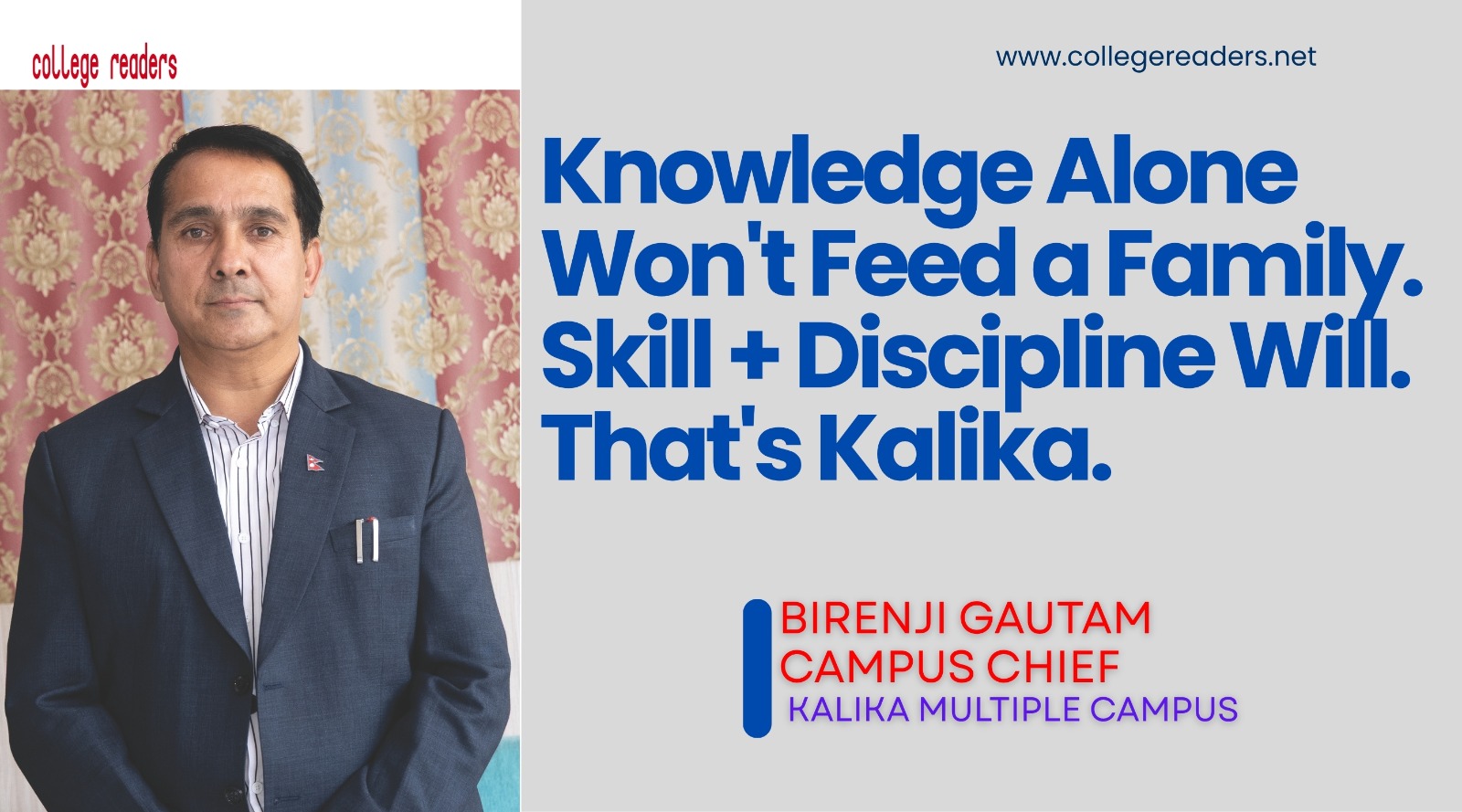
Knowledge Alone Won't Feed a Family. Skill + Discipline Will. That's Kalika.
- College Readers
- 18 May 2026
- Views
- Interviews , News
Campus Chief Biranji Gautam argues that grade 11 and 12 should be more than a bridge to exams — it should be a foundation for higher study, nationality and entrepreneurship. In conversation, he sets out why interest must guide subject choice, why high fees do not guarantee quality, and how a community campus is quietly building a model rooted in knowledge, skill and discipline.
What should students and parents weigh when choosing a college for Plus Two?
Begin with freedom of choice. Too many students simply continue at the school where they completed earlier grades, or follow the pull of friends, parents and advertisements. That cannot be the main basis. A college should be chosen only after a student has understood their own interest, learning style, goals and confidence.
We also need to retire two myths. The first is that one particular institution can guarantee success — no institution can, and we should stop telling students otherwise. The second is that quality tracks fees. It does not. Many affordable schools and community campuses offer strong teaching, discipline and facilities. What students should actually look for is a supportive environment, experienced teachers, respect for practical knowledge and a culture of discipline. Visit the campus. Talk to seniors. Compare facilities. Ask whether the institution treats your voice as worth hearing. The right college is one where a student feels safe, inspired and willing to work hard every day.
How should a student approach subject selection in grade 11?
Interest and ability should lead — never fashion or family pressure. The current grade 11 and 12 curriculum is flexible by design: science, management, education, humanities and other streams are open to students according to their capacity. That flexibility is a real opportunity, but it has to be used with care. A student who picks a subject without genuine interest will struggle, fall behind, and sometimes lose an entire academic year.
This is why pre-admission counselling matters. Campuses should review a student's SEE performance, earlier strengths, study habits and ambitions before recommending a stream. And no faculty should be ranked as superior or inferior. Science, management, education and humanities all become meaningful when the learner takes them seriously and connects them to real opportunity.
Once the choice is made, how should a campus prove it delivers quality?
Through visible work, not promises. Proper classrooms, functional laboratories, furniture, learning materials and a clean academic environment are the baseline. Beyond that, you need experienced teachers, regular classes, counselling, discipline and a culture where students feel free to ask questions. Parents and students can — and should — observe whether classes actually run, whether teachers are sincere, and whether the institution prepares learners for life beyond exams.
At Kalika, we treat grade 11 and 12 as a foundation for both higher education and citizenship. That means combining theoretical knowledge with practical skill, confidence, ethical behaviour and social responsibility. Classroom teaching must be reinforced by evaluation, feedback, library use, project work and laboratory practice. Quality is not a single achievement; it is a continuous process in which students, teachers and administrators all remain accountable.
Since you took over, Kalika has strengthened its profile and entered the QAA-certified framework. What is driving this push?
Identity. Kalika is a community campus and a non-profit institution, and that matters. Our management committee, teachers, staff, parents and the surrounding community work together for student welfare. When a problem appears, the management committee moves quickly and arranges the resources we need.
Our teachers, too, do not treat teaching as merely a job. They guide students as they would their own children — counselling, motivating, correcting course. This collective spirit existed before my time and has only deepened since. The QAA process has reinforced it by pushing us to document our work, improve systems and make every unit more transparent and student-centred.
What does the campus look like today, in terms of programmes and student numbers?
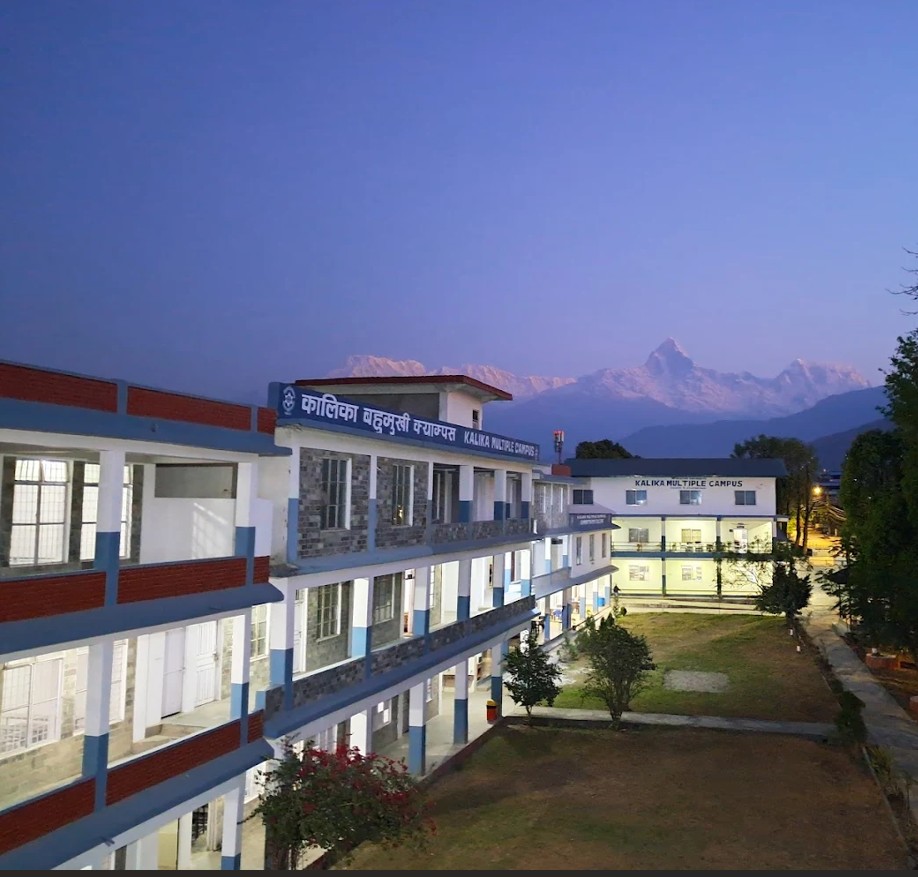
Plus Two runs in the day shift under a separate coordination system, including a coordinator and assistant campus chief, because the level has autonomous administrative status. Around 600 students are enrolled across grades 11 and 12, with classes, laboratories, furniture, supervision and discipline arranged to let them study seriously.
At the higher levels, roughly 1,100 students are pursuing bachelor's programmes, and around 125 are at master's level. We offer MBS and MIRD — and we remain the only campus in this region running MIRD. Proposals are also in place for more market-oriented programmes including BBA, BIC and BSN.
Our guiding principle is access with quality. Students from ordinary families should not have to settle for less than what expensive institutions provide. That commitment matters most for learners outside the major cities.
Your closing message to students, parents and the community?
Kalika Multiple Campus is working to build an educated, aware and self-reliant society. We do not want our graduates leaving here unemployed or uncertain about what comes next. That is why we have established an incubation centre and are linking students to entrepreneurship, and why our non-credit courses and trainings sit alongside the regular curriculum.
The idea at the centre of everything we do is simple: bring together knowledge, skill and discipline. When those three move together, students are equipped not just to pass examinations but to contribute to their families, communities and the nation. That is the mission of Kalika Campus.
Popular Categories
Trending This Month






 Established in 2065 BS, COLLEGE READERS is a premier national-level educational magazine dedicated to serving the academic and informational needs of school and university students, teachers, educators, and concerned ones in Nepal. The magazine provides current and comprehensive information on various educational opportunities worldwide, aiming to guide school and college-level students in their academic and career journeys. It also highlights essential support services and service providers that play a crucial role in shaping students' career paths in today's competitive world.

- Our Location Putalisadak, Kathmandu
- Send Us Email collegereaders123@gmail.com
- Call Us Now 977 01 4518759
