
Call now
977 01 4518759
Send Message
collegereaders123@gmail.com
Our Location
Putalisadak, Kathmandu
Joseph College Guides Students from Uncertainty to Purposeful Pathways through Structured, Personalized Counseling
- College Readers
- 18 May 2026
- Views
- Interviews , Op-ed
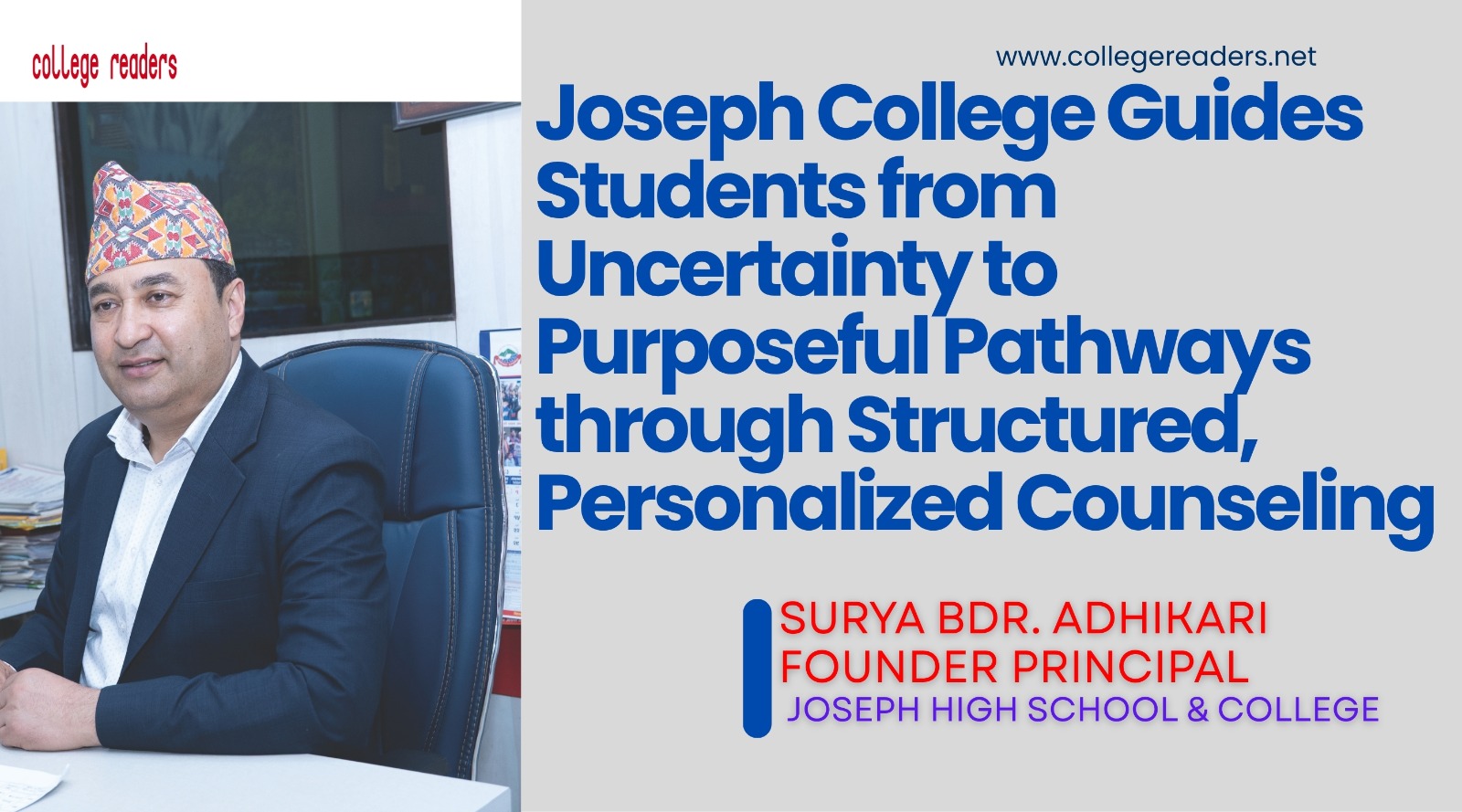
Surya Bahadur Adhikari, Founder Principal of Joseph High School & College and Senior Vice President of National PABSAN, brings 29 years of distinguished experience in Nepal's educational sector. Under his visionary leadership, Joseph High School & College has emerged as a respected institution serving generations of students with quality education and dedicated counseling support. The institution's core theme emphasizes comprehensive student development through personalized academic guidance, future career planning, and recognition of individual capabilities. In this exclusive interview, Adhikari analyzes recent SEE result reforms, evaluates the elimination of traditional waiting gaps, identifies persistent challenges in evaluation methodologies, and shares profound insights about transforming Plus Two education in Nepal.
CR: SEE results have been recently announced. How do you analyze parental investment in education?
SBA: When we discuss SEE results, parents have invested 13 years in their children's education by this point. After 13 years of investment, when results arrive, parents experience profound satisfaction regardless of their children's shortcomings or weaknesses. They essentially forget all the gaps and limitations once they see meaningful outcomes. This emotional release demonstrates how heavily families invest emotionally, financially, and temporally in education, making result-time decisions extraordinarily significant for entire family futures.
CR: How do you evaluate the government's recent quick result reform?
SBA: The government recognized that prolonged waiting periods and resulting uncertainty significantly affected children's continued education. Understanding this, they quickly initiated reforms addressing these issues. The reform represents responsive governance—quick response, as we call it—which is genuinely commendable. This breaks traditional patterns where children waited many months or years for results. Quick result publication aligns with contemporary expectations and reduces unnecessary anxiety among students transitioning to higher education.
CR: What concerns persist despite faster results?
SBA: While quick response is commendable, several issues require careful analysis. The student failure system hasn't been substantially corrected. The government's expectation of increased pass rates wasn't fully achieved through this mechanism. This generated significant discussion in educational circles. Private boarding schools show relatively better results, though improvements are modest—just 4-5%. However, Terai region results and government school outcomes remain disappointing, indicating systemic improvements are still desperately needed across geographic and institutional divides.
CR: What evaluation methodology improvements do you recommend?
SBA: Current internal evaluation methods provide three hours for assessment of full-day activities. A student must demonstrate everything in one day's writing—what if they experience stomach pain, physical discomfort, mental stress, or family tension that day? Their results suffer despite genuine capability. They remain excellent individuals, but evaluation methodology and momentary circumstances diminish their assessment outcomes. We've essentially made these temporary performance measures the basis for permanent evaluation. This methodology requires fundamental transformation to capture authentic student potential rather than single-day performance.
CR: How do students respond to reduced gap periods?
SBA: Students show overwhelmingly positive response. They express relief about studying immediately—Classes 11 and 12 begin promptly without extended waiting. The reduced gap eliminates confusion, allowing immediate continuation of educational momentum. Three observations emerge: students are happy because they can study right away, they feel they received what they expected, and the elimination of gaps prevents disruption to their educational rhythm and age-appropriate progression through academic stages.
CR: What about students dissatisfied with results?
SBA: Some negative responses exist, particularly from students whose evaluations didn't reflect their capabilities. Comments emerge like "my evaluation wasn't conducted properly" or "I couldn't pursue my preferred subject." However, overall, the reduced gap produces excellent outcomes. Students no longer wait extensive periods for Class 11 and 12 enrollment, allowing seamless educational progression. The fundamental question concerns examination and evaluation methodology—this is a first attempt, and comprehensive long-term assessment remains pending.
CR: How do you view the school versus college perception for Classes 11-12?
SBA: Until now, public perception considered Class 10 as school-ending and Classes 11-12 as college-level studies. Government regulations actually define education through Class 12 as secondary level, but student psychology still perceives Classes 11-12 as college. Neither government nor educational institutions have effectively communicated this redefinition. However, the current short gap suggests Classes 11-12 should genuinely be considered school-level since enrollment campaigns begin alongside, treating them as continuous secondary education rather than separate college experiences.
CR: What's your perspective on changing this perception?
SBA: Students and parents continue viewing school as ending at Class 10. There's no doubt about this prevailing mentality. However, structurally, Classes 11-12 should integrate with school systems. The current reform implicitly supports this transition, but we haven't comprehensively communicated this conceptual shift. Educational institutions, government bodies, and society must collaboratively redefine these stages for clearer student pathways and reduced confusion during these critical transition years.
CR: How does Joseph College support Class 10 graduates?
SBA: Students completing Class 10 stand at a crucial crossroads without clear direction. At our college, we conduct formal counseling sessions. I cannot speak for other schools, but at Joseph College, we systematically guide students through this decision-making process. We assess each student's capabilities, interests, and aspirations, then provide informed recommendations about appropriate subjects and career pathways.
CR: What counseling specifically do you provide?
SBA: We tell students directly: "You can study this subject because you have this capability. If you pursue this direction, your future becomes secured—economically, socially, and within family context. This subject is appropriate for you." This personalized approach considers individual student strengths rather than imposing generic recommendations. We believe authentic counseling transforms educational decisions from confusion-driven choices into informed strategic planning.
CR: Your final message for SEE graduates and parents?
SBA: Class 10 graduates haven't truly stood independently yet—they need substantial guidance. Parents must engage actively with counseling processes rather than imposing predetermined preferences. Students should select subjects matching genuine capabilities and authentic aspirations. Schools providing structured counseling deserve preference over institutions focused solely on enrollment numbers. From Joseph College, we extend our commitment to supporting every student's journey with personalized attention, comprehensive guidance, and dedicated mentorship throughout their critical educational transitions, ensuring their Plus Two years build foundations for lifelong success.



Popular Categories
Trending This Month






 Established in 2065 BS, COLLEGE READERS is a premier national-level educational magazine dedicated to serving the academic and informational needs of school and university students, teachers, educators, and concerned ones in Nepal. The magazine provides current and comprehensive information on various educational opportunities worldwide, aiming to guide school and college-level students in their academic and career journeys. It also highlights essential support services and service providers that play a crucial role in shaping students' career paths in today's competitive world.

- Our Location Putalisadak, Kathmandu
- Send Us Email collegereaders123@gmail.com
- Call Us Now 977 01 4518759
