
Call now
977 01 4518759
Send Message
collegereaders123@gmail.com
Our Location
Putalisadak, Kathmandu
From Bright Future to Your Future: Holistic Development Begins with an Informed Choice
- College Readers
- 18 May 2026
- Views
- Op-ed , Interviews
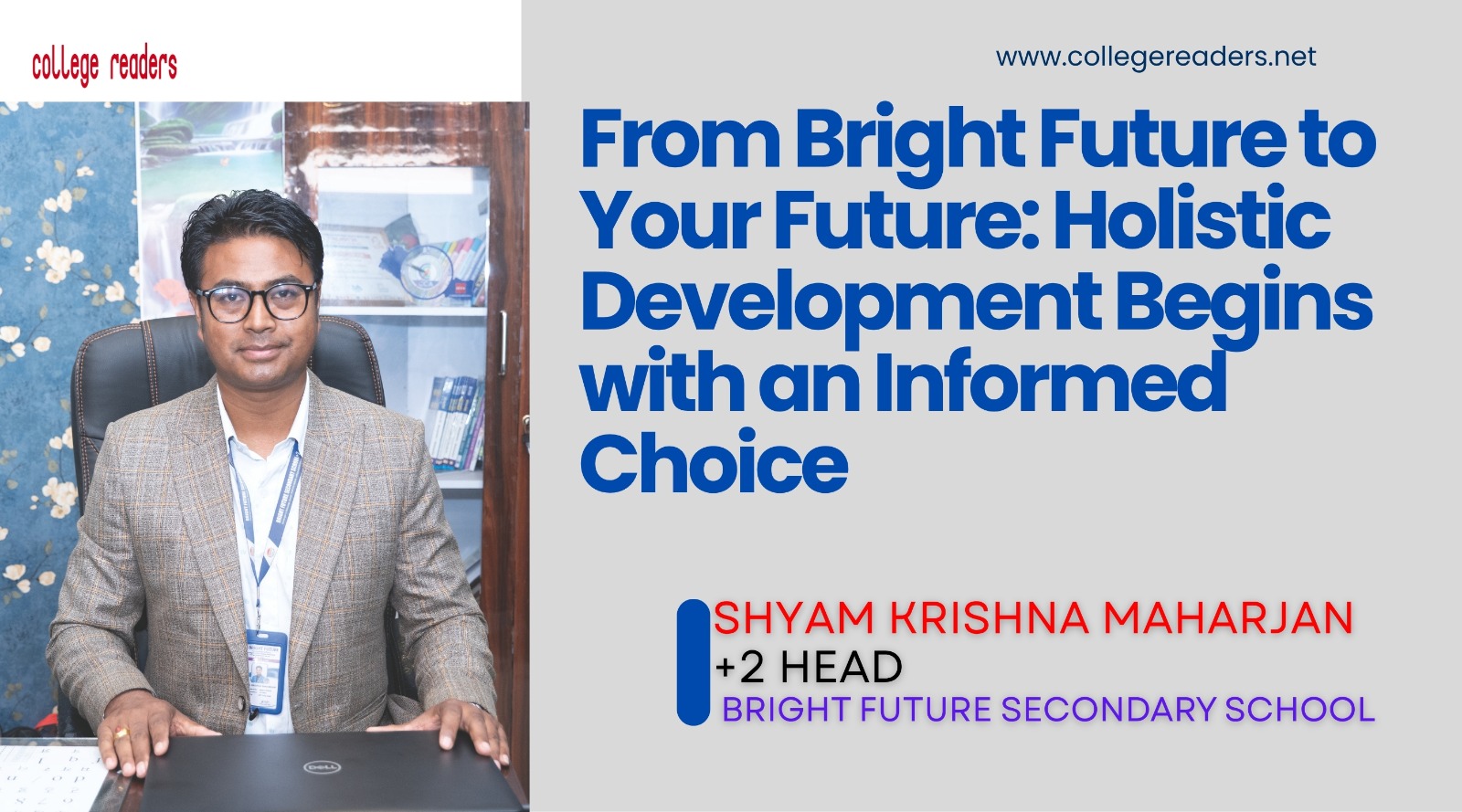
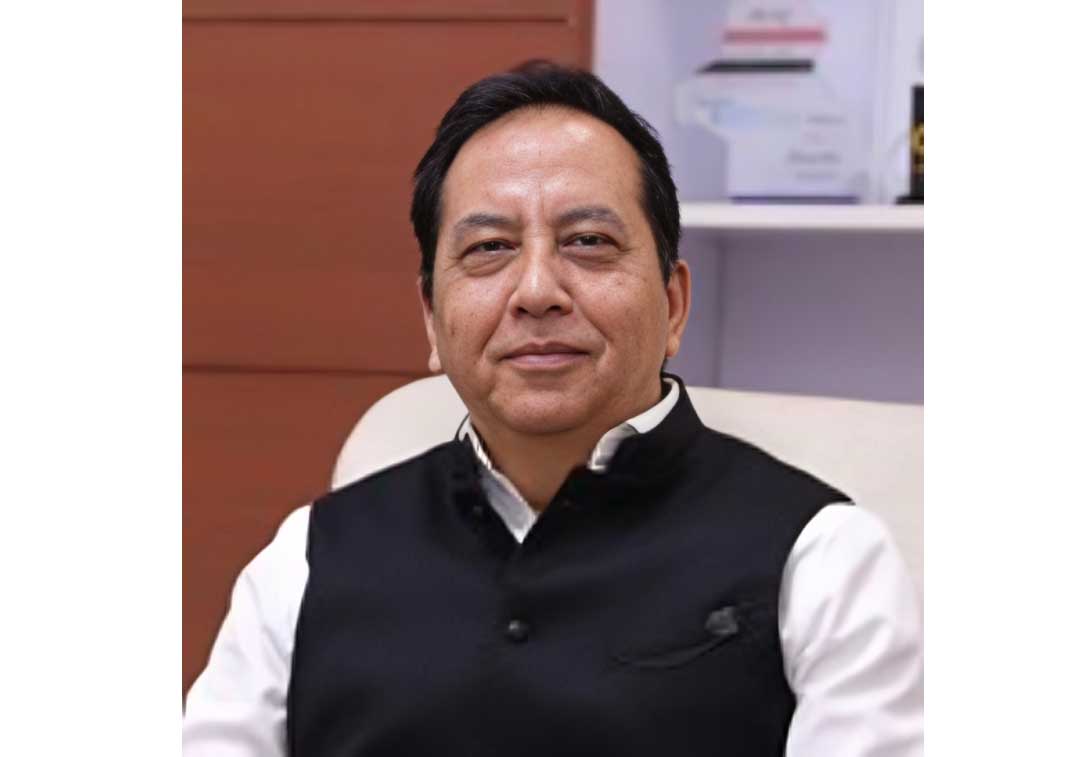
Shyam Krishna Maharjan, Plus Two Head of Bright Future Secondary School and Secretariat Member of HISSAN Kathmandu, represents thoughtful educational leadership combining academic excellence with character formation. Bright Future Secondary School, established in 2076 BS, has rapidly emerged as a distinctive institution providing quality education infused with Nepali cultural values (sanskar). The school's main motto centers on delivering excellent academic outcomes while nurturing students with discipline, ethics, and traditional values essential for holistic development. Under Maharjan's leadership, the institution has built strategic international partnerships, including connections with Japanese universities and the International School Sports Federation, providing students unprecedented global exposure opportunities while maintaining strong local cultural foundations and educational excellence.
CR: Recent SEE results have been announced, and students are searching for Plus Two education options. What should students consider when selecting institutions?
SKM: This is an excellent and timely question. When students select colleges for Plus Two studies, they should definitely examine the institution's academic history—what kind of educational legacy does it carry? Additionally, students must investigate the teaching faculty—who are the educators delivering instruction, what are their qualifications, and what is their experience level? Furthermore, I sincerely urge students to consider colleges located near their homes for Plus Two studies. These two years truly represent the foundational base of educational journey. If you can perform well during these two years, your entire subsequent academic trajectory becomes more successful. The reason I emphasize nearby colleges is that traveling long distances consumes significant time and energy during the commute, which negatively impacts academic activities. Students lose precious study hours, experience exhaustion, and cannot fully engage with educational opportunities when transportation dominates their daily routine.
CR: What other factors should students prioritize beyond location?
SKM: When selecting colleges, students should emphasize three critical factors: infrastructure, teaching faculty, and extracurricular activities. The physical learning environment significantly impacts educational quality—well-equipped classrooms, libraries, laboratories, and recreational spaces create conditions where genuine learning flourishes. Teaching faculty determines pedagogical excellence—experienced, qualified, and dedicated teachers transform potential into achievement. Equally important are extracurricular activities, which develop holistic personality alongside academic excellence. Today's competitive world demands well-rounded individuals who excel academically while possessing leadership skills, creative abilities, and social competencies developed through diverse activities. Institutions ignoring any of these three pillars provide incomplete education that disadvantages students in their future endeavors.
CR: Tell us about Bright Future Secondary School and what attracts students to your institution.
SKM: Speaking about Bright Future Plus Two, our institution was established in 2076 BS. Since establishment, we have consistently provided quality education along with sanskar (cultural values and character formation)—this dual commitment defines our educational philosophy. When discussing our results, we cater to diverse student capabilities. We've structured our programs to accommodate students with various talents and interests. For example, we provide special scholarships to karate players and athletes from other sports disciplines. We recognize that academic excellence isn't the only measure of student potential. Beyond academically outstanding students, we focus significantly on extracurricular activities, helping students achieve excellence in these areas. Through this comprehensive approach, we've attracted excellent intake, and our institution has become a preferred choice for students seeking balanced development.
CR: What advice do you give students about goal setting before selecting subjects?
SKM: Students must establish extremely clear goals before joining Class 11. They should ask themselves fundamental questions: Am I pursuing Science, Management, or Law? What genuinely interests me? Many students make critical mistakes by following peer choices—if their friend selects Science, they assume they must also study Science. This approach proves disastrous in subsequent years. Therefore, students must consider both their genuine interest and capability. Mere interest is insufficient; students must honestly evaluate whether they possess academic capacity to handle their chosen subjects. I've observed students who entered Science streams unable to deliver excellent results because they couldn't manage subject demands. Students should examine their academic history, identify their strengths, and select subjects accordingly. This realistic self-assessment combined with passion creates conditions for academic success and meaningful career development.
CR: What special facilities does Bright Future Secondary School provide students?
SKM: Our institution offers distinctive advantages that distinguish us from other Plus Two colleges. Our Founder Principal and Director serves as Country Director of ISF Nepal—International School Sports Federation. This is significant because ISF is recognized as the "Mini Olympics" for school students worldwide. Through this connection, our students gain access to international sports platforms across the globe. We've provided opportunities for under-aged students from Nepal to participate in international competitions through this federation. Recently, one of our students won a silver medal at the ISF Asia event held in Bahrain—we proudly call this the Mini Olympics. We continuously select students from various colleges and schools for international competitions, sometimes in futsal, sometimes in karate, and other sports disciplines.
CR: Are there academic opportunities abroad through your institution?
SKM: Yes, certainly. We've established partnerships with universities internationally. We have a formal tie-up with a Japanese university, which I'm sharing with your readers. For students completing Plus Two who wish to pursue higher studies, we offer merit-based scholarship pathways to China, Korea, and Japan. We can facilitate placement of qualified students in universities across these countries based on their academic performance and merit. This international dimension provides our students unprecedented opportunities, allowing them to pursue global education through our institutional network. Combined with strong local foundations, these international connections position our graduates for both national and international success, creating pathways previously accessible only through expensive international schools.
CR: Any final advice for students and parents currently making educational decisions?
SKM: I sincerely encourage students and parents to make informed decisions through proper research. Don't rely on unhealthy practices like aggressive marketing or peer pressure that I observe in current educational marketing. As I mentioned earlier, study the college's educational history thoroughly, examine the qualifications of teachers who will deliver instruction, evaluate the institution's environment and location, and analyze comprehensive facilities provided. Visit institutions personally, speak with current students and parents, observe the learning environment, and verify claims through direct experience. Plus Two education shapes your entire future—this decision deserves careful consideration rather than impulsive choices. To students currently selecting institutions, remember that you're not just choosing a college; you're choosing the foundation upon which your entire professional and personal future will be built. Choose wisely, choose thoughtfully, and choose institutions genuinely committed to your holistic development. From Bright Future Secondary School, we extend warm wishes to all SEE graduates and welcome those seeking quality education combined with strong cultural values to visit our campus and experience our distinctive educational approach firsthand.

Popular Categories
Trending This Month






 Established in 2065 BS, COLLEGE READERS is a premier national-level educational magazine dedicated to serving the academic and informational needs of school and university students, teachers, educators, and concerned ones in Nepal. The magazine provides current and comprehensive information on various educational opportunities worldwide, aiming to guide school and college-level students in their academic and career journeys. It also highlights essential support services and service providers that play a crucial role in shaping students' career paths in today's competitive world.

- Our Location Putalisadak, Kathmandu
- Send Us Email collegereaders123@gmail.com
- Call Us Now 977 01 4518759
