
Call now
977 01 4518759
Send Message
collegereaders123@gmail.com
Our Location
Putalisadak, Kathmandu
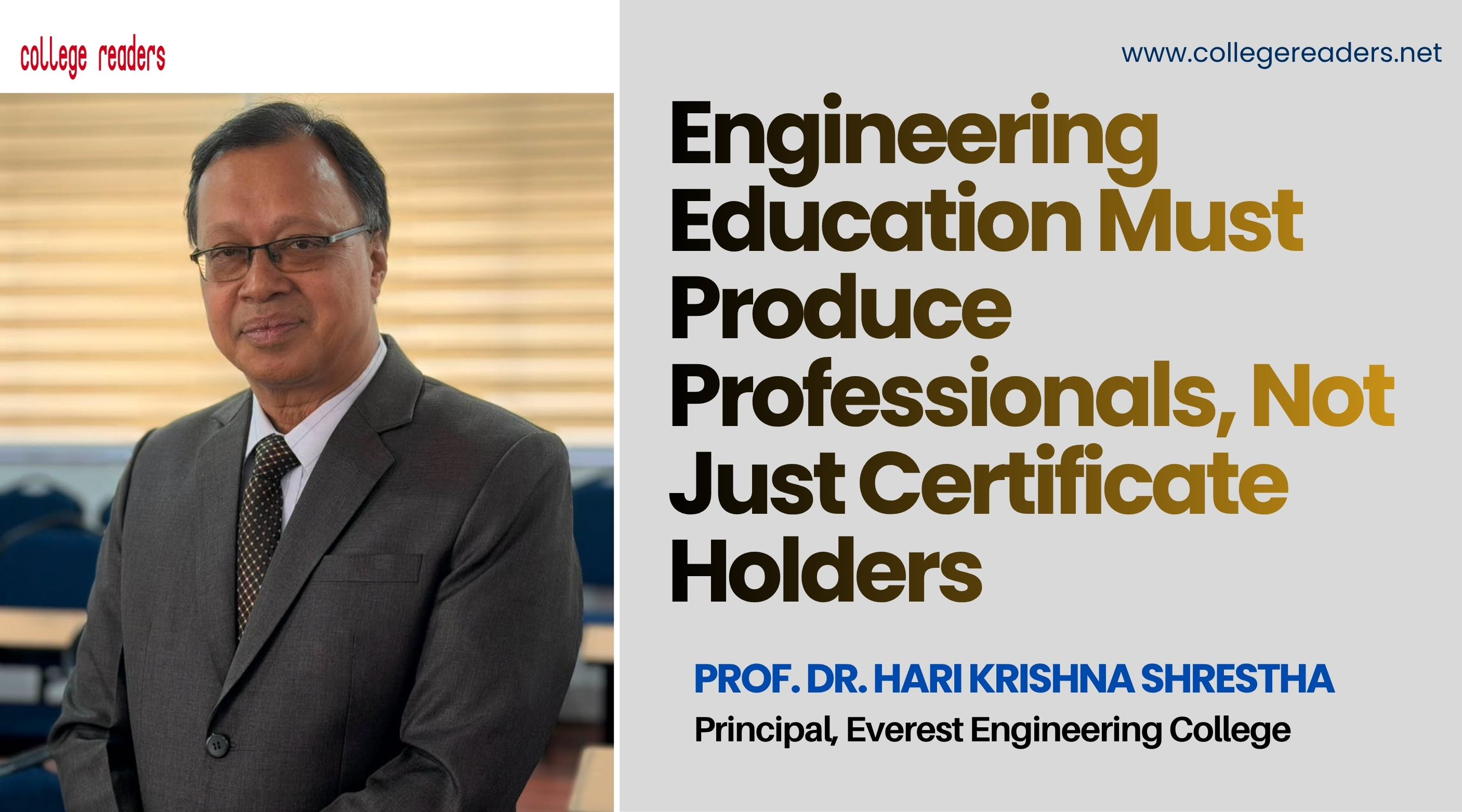
Engineering Education Must Produce Professionals, Not Just Certificate Holders
- College Readers
- 06 Jul 2026
- Views
- Interviews
The world has moved away from knowledge merely for the sake of knowledge. Today, education must show what a learner can do after completing a programme. A bachelor’s or master’s graduate should not be judged only by the amount of theory stored in the mind, but by the skills, judgement and professional capacity developed through learning. In Nepal, however, we still ask what grand knowledge a student should possess, while paying less attention to what the student will actually be able to perform. This is the central gap.
Decision-makers in universities were themselves educated under the old tradition. Vice chancellors, rectors, registrars, deans and senior professors have often continued what they inherited. Many of them know global trends because they travel abroad, but institutional change remains slow. Internationally, the emphasis is now on outcome-based learning. If a student can perform a defined task competently, that is meaningful learning. In an age when knowledge is accessible through a phone or laptop, there is no need to overload students with content that has little practical value.
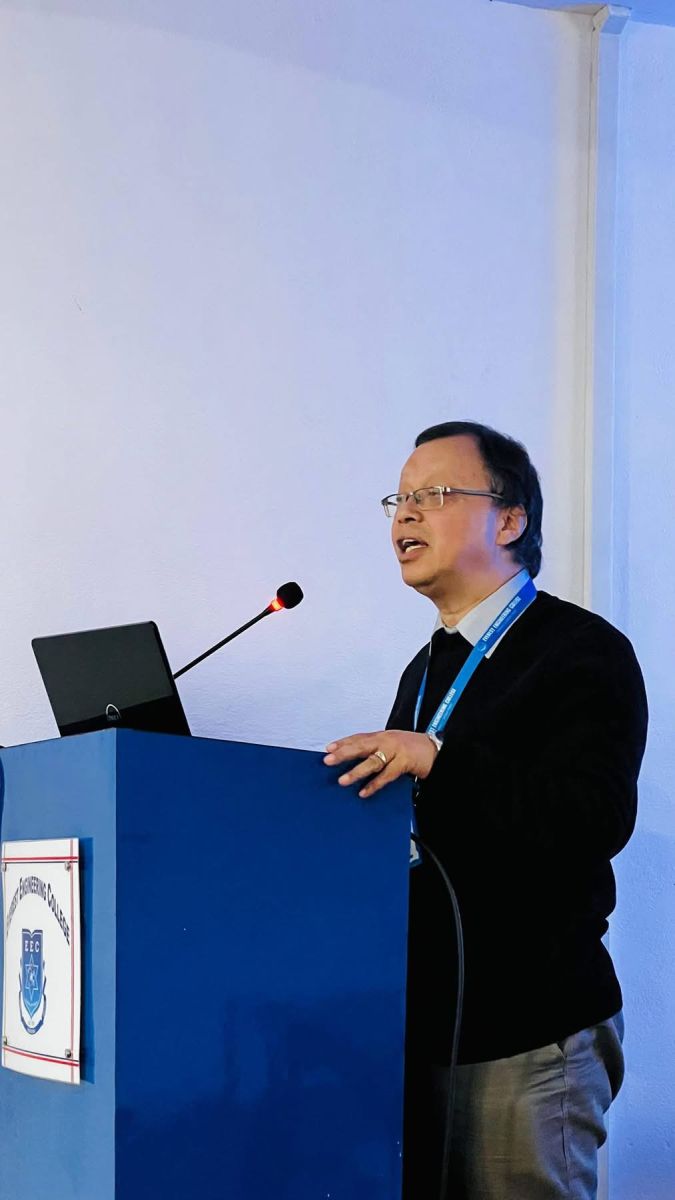
Because we have not restructured engineering education in this direction, our degrees lack professional international recognition. A graduate may be accepted for further study abroad, but that does not automatically mean the degree is professionally recognized. Countries and employers examine whether the programme is accredited internationally, whether it is connected to systems such as the Washington Accord, and whether its curriculum produces competent engineers. Nepal remains outside such recognition largely because our curriculum is not sufficiently application-oriented.
Nepal’s engineering curriculum must shift from theory-heavy teaching to outcome-based, practical and internationally accredited education.
The second weakness is the curriculum development process itself. We usually invite subject specialists—professors of structures, transportation, water resources or other areas—to design the curriculum. They know their subjects, but subject knowledge alone is not curriculum expertise. A curriculum must determine the balance between soft skills and core technical skills, between theoretical knowledge and practical competence, between compulsory subjects and electives. Nepal has people trained in curriculum studies, but they are rarely involved. As a result, curricula are often built by adding subjects, not by designing learning.
A proper curriculum should begin with a study of the market and society. What industries are emerging in Nepal? What industries may grow in the next five or ten years? Where will our graduates be employable? What skills, theories and practical abilities are required for that employability? Only after answering these questions should we decide what to teach. Instead, we often copy from previous years or from foreign universities, combine available subjects, and call the result a curriculum. This is neither scientific nor responsible.
We also try to teach too much. Many internationally recognized universities consider around 120 credits sufficient for an engineering bachelor’s degree. In Nepal, we often raise the load to 130, 135 or even 140 credits in the belief that more teaching means better education. But a learner has a limit. If a 20-litre bucket is filled with 40 litres of water, half of it spills out. Students experience the same overload. They see many subjects as irrelevant, study them only for examinations, lose interest, miss classes and become passive. When learning is clearly connected with real life, students do not need to be forced into classrooms.
Another injustice to students is the weak link between curriculum outcomes and examinations. Some curricula now mention learning outcomes, but often as a formality. What is written as expected learning and what is later asked in examinations do not always match. Question setters may ask whatever they prefer. When the curriculum says students should learn one thing and the examination demands something else, failure becomes not only an academic problem but also an institutional injustice.
Engineering education must also become flexible enough to support “earning while learning.” Around the world, students work while studying, take breaks, return to study, and connect workplace experience with academic learning. In Nepal, rigid academic structures make this difficult. A student who needs to work for six months may be forced to lose an entire year or re-enroll. Some argue that engineering requires full-time study and cannot allow such flexibility. I believe the real problem is our overloaded curriculum. Countries such as Japan, the United States, the United Kingdom and Germany have shown that flexibility is possible when programmes are designed practically.
Unnecessary content often enters the curriculum unintentionally. One professor studied in Banaras, another in India, another in Japan, and each wants to include what he learned. But those subjects may have been designed for those countries, industries and river systems, not for Nepal. In my own field, formulas developed for the gentle rivers of Bihar and Uttar Pradesh are applied to Nepal’s steep rivers. If I do not teach them, students may fail because they appear in examinations. So I must teach them, even when their practical relevance is weak. This leaves little time for depth or problem-based learning.
Teacher quality, curriculum flexibility, industry relevance and professional recognition are essential for making Nepali engineering graduates globally competitive.
Problem-based learning is a powerful idea. Students should receive real problems and learn how to solve them. But teachers are pressured to complete overloaded syllabi. Even electives, which could provide flexibility, are not always used properly.
Teacher quality is another concern. Teaching is not an attractive profession in Nepal. Society often treats it as a fallback option, and salaries are comparatively low. Many capable teachers become discouraged. Some turn into “helmet teachers,” rushing from one college to another to survive financially. Such teachers cannot devote enough energy to students, research or innovation.
Teachers also need regular pedagogical training. Subject knowledge is not enough; one must know how to teach. With artificial intelligence and technology changing rapidly, teachers must keep learning continuously. A few teachers are doing excellent work, but they are too few to transform the system.
Politics has further weakened academic culture. I believe teachers should not be deeply involved in politics, although everyone has personal freedom. Institutions need professionalism, not factionalism.
Nepal can still make engineering education attractive, marketable and globally acceptable. Initial discussions related to international accreditation have begun through the Nepal Engineering Council, and some universities have participated. Yet resistance remains, especially where old institutional pride creates the belief that existing practice is already the standard. If one university gains recognition under the Washington Accord, students will naturally choose it, and others will feel pressure to reform.
For me, reform must begin with honesty. We should stop defending outdated practices merely because they are familiar. Universities, councils, industries and teachers must sit together, define competencies, test outcomes, and accept accountability. Only then can engineering education regain public trust and become a true instrument of national development for the coming generations ahead.
The path is clear. We must redesign curricula through expert curriculum processes, align them with industry needs, reduce unnecessary content, link outcomes with examinations, make learning flexible, strengthen teachers, encourage problem-based learning and seek international accreditation. Engineering education should not merely produce certificate holders; it should produce professionals capable of building Nepal and competing with the world. Reform is no longer optional. It is urgent, practical and entirely possible.
Popular Categories
Trending This Month








 Established in 2065 BS, COLLEGE READERS is a premier national-level educational magazine dedicated to serving the academic and informational needs of school and university students, teachers, educators, and concerned ones in Nepal. The magazine provides current and comprehensive information on various educational opportunities worldwide, aiming to guide school and college-level students in their academic and career journeys. It also highlights essential support services and service providers that play a crucial role in shaping students' career paths in today's competitive world.

- Our Location Putalisadak, Kathmandu
- Send Us Email collegereaders123@gmail.com
- Call Us Now 977 01 4518759
