
Call now
977 01 4518759
Send Message
collegereaders123@gmail.com
Our Location
Putalisadak, Kathmandu
Beyond Access Ace Prepares Graduates for the Real-World Skills
- College Readers
- 06 Jul 2026
- Views
- Interviews
You have been in academia for nearly three decades. How do you read the current state of higher education in Nepal — and what changes do you believe are most urgent?
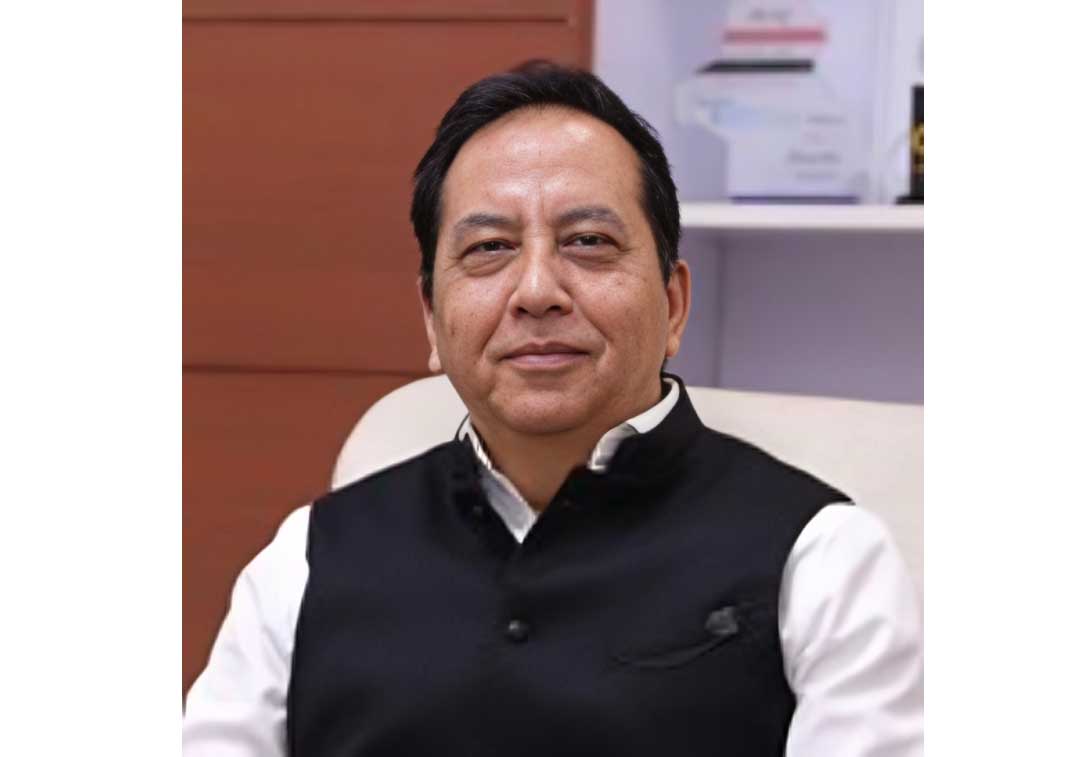
Dr. Ashish Tiwari: Nepali higher education has been through an extraordinary transformation. Look at the gross enrollment ratio at the tertiary level. Forty to forty-five years ago, we were hovering around 5%. Today we are at approximately 22%, with around 6,33,000 students enrolled in tertiary education according to the latest figures. The government's stated ambition is to push that figure to 50%.
Those numbers tell a story. We have spent decades — and spent them well — on access and inclusion. That phase has largely been won. But the next phase is qualitatively different. From here on, the central question is no longer whether Nepalis can get into a college; it is whether what they get inside the classroom is worth the years they invest.
Right now, if we are honest, there is a great deal of work to do on quality. The goal should be nothing less than making Nepali higher education a recognized hub in the region and beyond.
If access has been achieved, what specific competitivenesses does Nepal need to develop to translate that access into quality?
Dr. Ashish Tiwari: It is multi-faceted, but a few priorities stand out.
First, the student experience. At the end of the day, the consumer of higher education is the student. Everything — curriculum, faculty, infrastructure — has to be designed around the kind of experience we want them to have.
Second, the integration of technology into teaching and learning, and increasingly, the deliberate and ethical integration of artificial intelligence. AI is not a passing wave; it is the new substrate of learning, and our institutions must adapt.
Third — and this is the one we most often neglect — alignment between what we produce and what the economy demands. Our graduates leave campuses and walk into industry, government, the financial sector, hospitality, the creative industries. If we are not in continuous conversation with those sectors about the competencies they need, we are essentially producing supply in a vacuum.
You have touched on the industry connection. What has Ace specifically done to bridge it? Industry often complains that graduates are not job-ready.
Dr. Ashish Tiwari: The complaint exists — but let me be clear: it is not solely an academia problem. It is a two-sided problem. Industry must also be ready to engage with academia, to open its doors, to co-create curriculum, to take interns seriously, to mentor. We cannot do this alone.
That said, at Ace, this has been our orientation since 1999. We have always believed that management education must be relevant to real life and real practice. To formalize that conviction, roughly six or seven years ago we established a dedicated Centre for Industry Relations and Career Services.
The Centre currently holds formal MOUs with 100 partner organizations — we crossed the hundred mark just last week — spanning multiple sectors in Nepal as well as a growing number of international partners, particularly within South Asia. These partners are not signature-on-the-wall relationships. They are working partnerships. They facilitate case studies, guest lectures, live projects, industry mentoring, internships, and final placements for our students.
I am not aware of any other institution in the country with a comparable, dedicated structure of this scale. It is, I believe, one of Ace's defining contributions.
"Earn while you learn" has become something of a buzz phrase. What does it actually look like at Ace?
Dr. Ashish Tiwari: It is real, and it is operational. From day one, every student at Ace can register with the Centre for Industry Relations and Career Services. If a student needs part-time work, on-campus work, internship income, or freelance assignments — including the kind of remote, project-based work that defines today's gig economy — the Centre facilitates the match.
A meaningful number of our students are now funding a portion of their education through such assignments. Some work a few weeks from home on defined projects; others take on part-time roles with our partner organizations. The model is flexible, but the principle is firm: financial constraint should not be the reason a capable student drops out.
Alumni success is often the most visible proof of an institution's worth. Can you share a few names from Ace whose journeys you find particularly proud?
Dr. Ashish Tiwari: It would be unfair to single out a few names. With over 9,000 alumni, choosing favourites is like asking a book-lover to pick two books from a beloved library, or a parent to name their favourite child. I will say this instead: every one of our alumni is a gem.
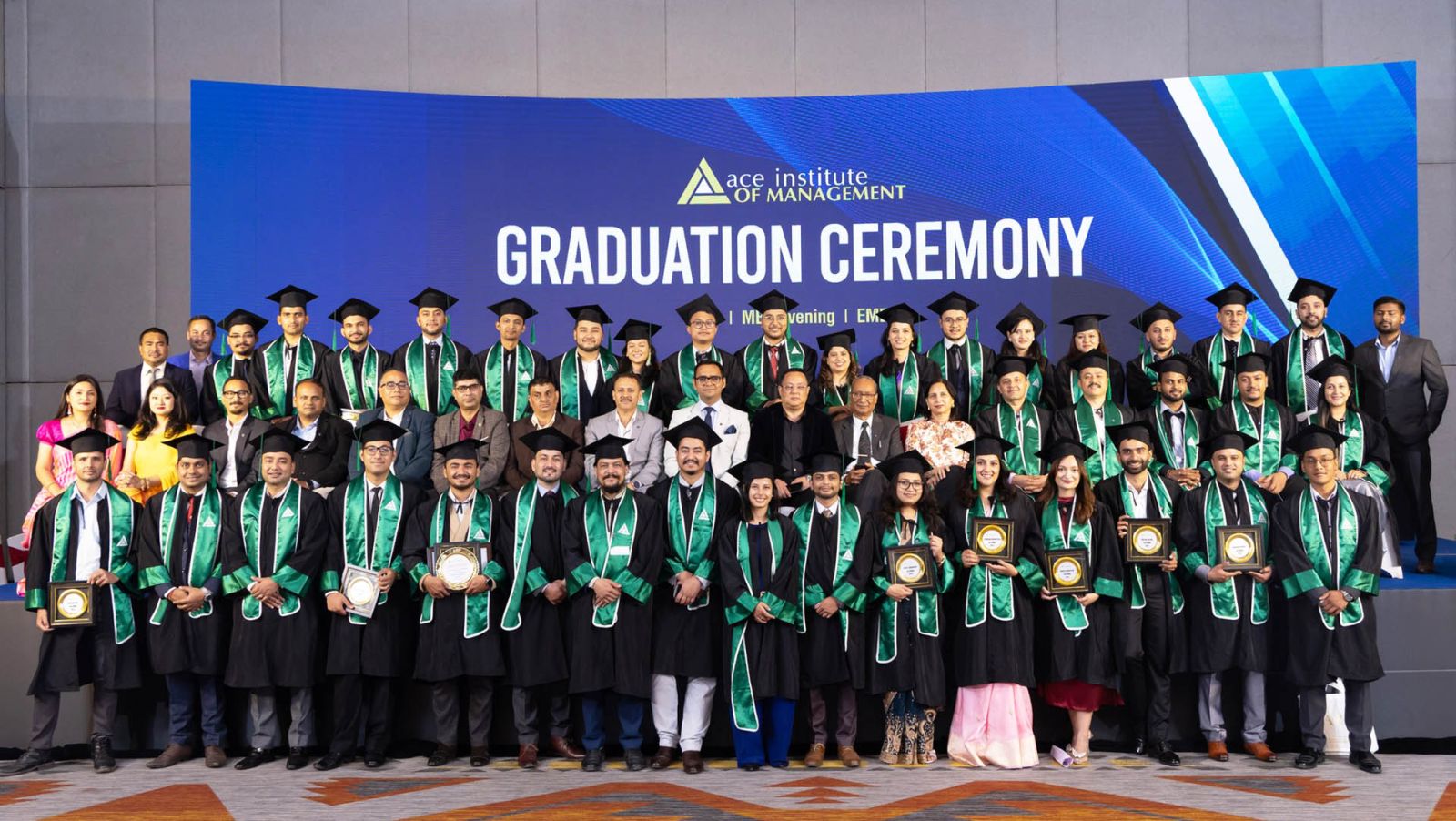
But walk into any major organization in Nepal — any sector — and you are very likely to find an Ace alumnus in a leadership position. They are in banking, in the civil service, in hospitality, in the entertainment and film industry, in music, in photography, in entrepreneurship. Many of the CEOs you read about in Nepali business pages today are Ace graduates. That is the answer.
Many Nepali students are eager to pursue higher education overseas. What is Ace's stance — and your personal view — on this trend?
Dr. Ashish Tiwari: We live in a globalized world. Cross-border mobility for education is not a modern phenomenon; it has existed for as long as higher education itself. So no, I would never say we should "curtail" it.
But we should be discerning. If a Nepali student secures admission to a genuinely strong university abroad, with a scholarship, with proper academic rigour — that student should be encouraged, wholeheartedly.
What should be discouraged is the pattern we see too often: students flying out on the strength of an agent's glossy brochure and a dream that a foreign landing guarantees a foreign quality of life. That promise is often empty. There are hardships, exploitation, and degrees of questionable value waiting at the other end of those flights.
On the other hand, we must also say this clearly: Nepal now has world-class universities, strong curricula, and good institutions. Students should be encouraged to look here first. There is an advantage to studying in your own land — your language, your family, your network, your dignity — that no foreign degree can replicate. You are the king in your own land. That is an advantage nothing can match.
For a prospective student considering Ace, what would you say are the institution's distinctive strengths?
Dr. Ashish Tiwari: First, a strong brand and reputation built over 27 years. Second, exceptionally high industry acceptance of our graduates — when a recruiter sees "Ace" on a CV, the conversation begins from a different starting point. Third, a curriculum and pedagogy that are relentlessly practical and connected to real life. And fourth, the student experience — what we often call the "Ace experience." In terms of student experience, industry connections, and networking opportunities, I do not think it is an overstatement to say we lead the country.
Emerging technology, particularly AI, is reshaping how learning happens. How is Ace managing the balance between technological advancement and the practical demands of employers?
Dr. Ashish Tiwari: We have been proponents of integrating technology into teaching and learning from very early on. That integration runs through the entire delivery and learning process at Ace. With the arrival of AI, we have been deliberate about adopting it in our models of teaching and learning. As an institution, we are highly agile when it comes to technology adoption — that is part of our DNA.
But I want to be specific about something. There is a real concern — and a fair one — that students are over-relying on AI in research and other academic work, and that the rigour of student research has been slipping as a result.
At Ace, we have addressed this through a dedicated Ace Research Centre, and we have a clear position: we do not ban AI, but we require ethical collaboration with AI. We have a formal plagiarism policy and a formal AI policy. There are strict guidelines on research ethics. Ethical use of AI is the line — and we are among the pioneers in the country in articulating it clearly.
Any final advice for students considering higher education — at Ace or anywhere else?
Dr. Ashish Tiwari: When you are choosing where to invest your years and your money, do not go by opinions. Go by facts. Do your research properly. Be clear about what you are seeking from higher education — what kind of experience, what kind of network, what kind of outcome — and choose the institution that fits those priorities.
What your cousin's friend says on social media, what a consultant whispers into your parent's ear at a tea stall — none of that is research. Make your own decision, on the basis of evidence. That, more than anything else, is the most important thing.
Pull Quote
"Access and inclusion we have achieved. Now the focus must be on quality — so that we can make Nepali higher education known to the region and to the world."
Pull Quote
"If you walk into any major organization in Nepal, in any sector, you are very likely to find an Ace alumnus in a leadership position. We are proud of that."
Pull Quote
"Ethical collaboration with AI — not a ban, not blind use. That is the line, and we have built the policy to hold it."
Popular Categories
Trending This Month








 Established in 2065 BS, COLLEGE READERS is a premier national-level educational magazine dedicated to serving the academic and informational needs of school and university students, teachers, educators, and concerned ones in Nepal. The magazine provides current and comprehensive information on various educational opportunities worldwide, aiming to guide school and college-level students in their academic and career journeys. It also highlights essential support services and service providers that play a crucial role in shaping students' career paths in today's competitive world.

- Our Location Putalisadak, Kathmandu
- Send Us Email collegereaders123@gmail.com
- Call Us Now 977 01 4518759
