
Call now
977 01 4518759
Send Message
collegereaders123@gmail.com
Our Location
Putalisadak, Kathmandu
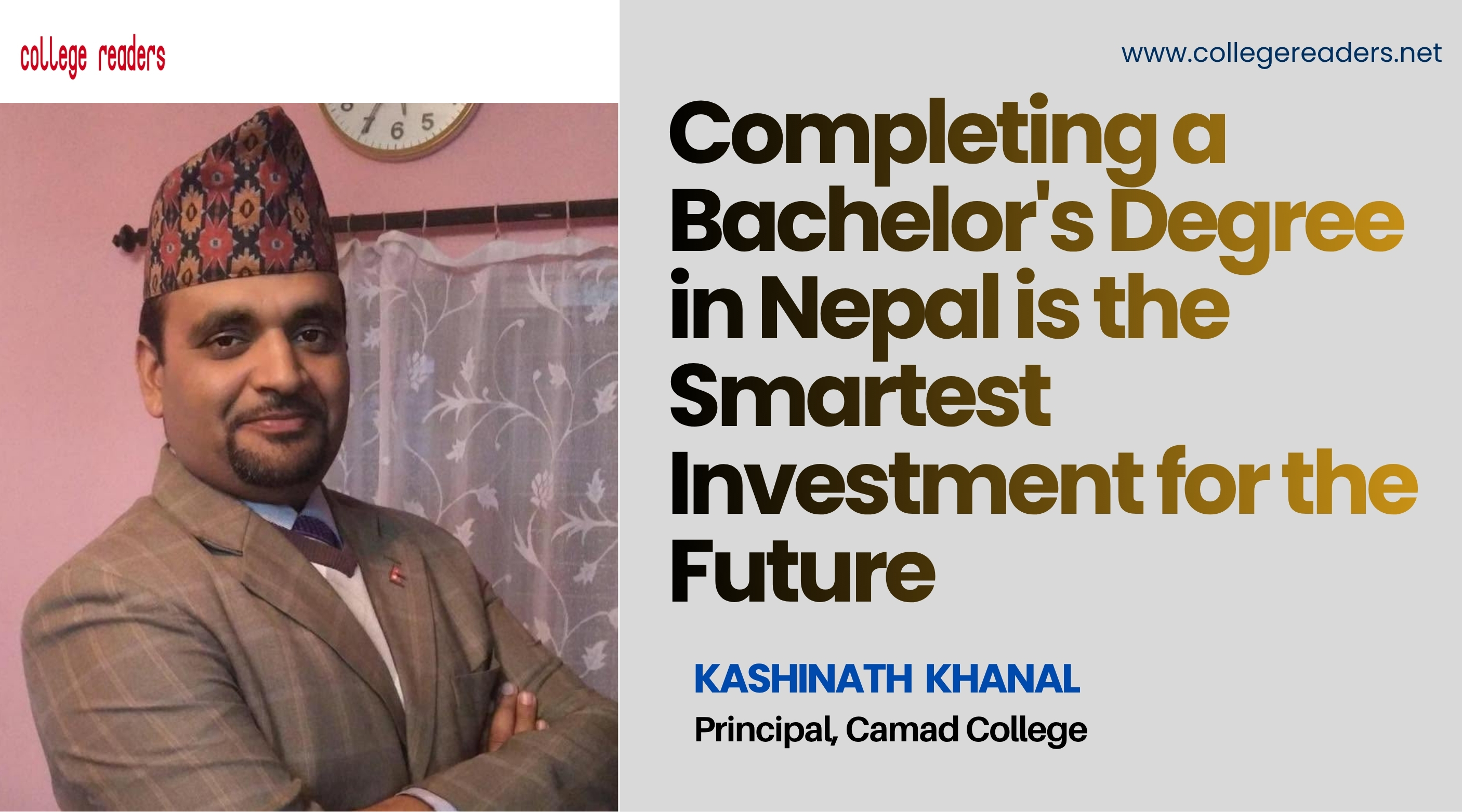
Completing a Bachelor's Degree in Nepal is the Smartest Investment for the Future
- College Readers
- 08 Jul 2026
- Views
- Interviews
The first misunderstanding we must correct is that quality education exists only outside Nepal. Today, Nepal has universities and colleges capable of providing updated courses, relevant syllabi and world-class academic exposure. Pokhara University, for example, has been following an academic calendar for years, completing four-year programs within four years and sending graduates to the market on time. Recently, several undergraduate programs, including BBA, have also been updated in line with the needs of society, industry and the global environment. Therefore, if the purpose is education alone, students do not need to leave Nepal immediately after Plus Two.

The stronger reason behind migration is the belief that students can “study and earn” abroad. Parents and students often think that foreign countries provide both income and lifestyle. That is why at Kamad College we have adopted the philosophy of “Studying, Learning and Earning.” Education should not mean only attending classes for four years. Students must study, learn practical skills and apply those skills in real life. Around 70 percent of our bachelor’s students are already engaged in jobs, small businesses or professional activities while studying. We have arranged our class schedules to support this balance. For IT and BBA students, classes begin early in the morning and end around 10 a.m., allowing them to work afterward. For BHM students, classes are arranged during the day because many work in the evening.
However, earning alone is not enough. A student who only collects bookish knowledge may pass examinations, but may not learn the art of living, leading and creating. That is why colleges must focus on skill development, personality development, communication ability, confidence, grooming and entrepreneurship. Universities provide the formal syllabus, credit structure and academic framework, but colleges must execute that curriculum in a practical way. When university knowledge and college-level skill activities are properly blended, strong human resources can be produced.
Nepal now has quality higher education, updated syllabi and academic systems that can support students at the bachelor’s level.
At Kamad College, our effort is to create opportunities rather than merely talk about them. We encourage students to become job creators, not only job seekers. This does not mean every student will become an entrepreneur. Society needs both employers and employees. Some students prefer stable jobs and limited income; others have the courage to take risks and build something new. Our responsibility is to identify their interests, awaken their abilities and provide platforms.
For this reason, we organize entrepreneurship activities almost every week. Students set up stalls, sell products, bring goods from villages or online platforms, pitch ideas and test the market among friends and the surrounding community. Every Friday, we are developing the idea of a college fair where organic food and different products from various districts can be displayed and sold. This practice gives students real business exposure. I have seen students who invested Rs. 2,000 one week gradually gaining confidence to invest Rs. 5,000 or Rs. 10,000 in the following weeks. This is how risk-taking capacity grows.
Alongside entrepreneurship, we also support students who want jobs. We have signed memorandums of understanding with hotels, resorts, restaurants, IT companies and corporate organizations. Through these partnerships, our students are regularly placed in workplaces. The goal is not to make hollow promises of employment, but to prepare students so that they can enter the market with confidence.
Some people say Nepal’s universities only produce certificate holders who cannot sustain themselves. I do not agree. The problem is not that our graduates are useless; the problem is that academic learning must be matched with practical skills. Nepal may appear to have limited earning opportunities because our economic activities have been slow. But if we look deeply, Nepal is full of possibilities. For capable and creative people, this country is like a virgin land. Many products are yet to be produced, many services are yet to be developed, and many sectors are waiting for young leadership.
Students should complete at least bachelor’s education in Nepal while developing skills, earning experience and entrepreneurial confidence.
Tourism, hospitality, IT, business, social service and rural development all offer immense possibilities. Many Nepali youths are already working for foreign clients from Nepal in the IT sector. With political stability and gradual system-building, economic activities are expanding. Industries, enterprises and services are emerging. Instead of waiting for opportunities prepared by others, the new generation must say, “I will prepare my own plate.” If this generation does not build the country, who will?
At Kamad College, we therefore advise students not to chase only perfect grades. Scoring four out of four is good, but it is not everything. Completing a four-year course in four years with a strong average, such as 3.5 and above, while investing additional time in skills, is more valuable. Students should learn communication, IT, AI tools, leadership and practical problem-solving. We have 11 student clubs, regular presentations, guest lectures, seminars, flagship events and annual programs. Our BHM students, for instance, are organizing a Food and Music Festival by finding sponsors, arranging stalls and coordinating with artists themselves. Such experiences create real learning.
My sincere request to students and parents is clear: do not send young children abroad immediately after Plus Two only for education. A bachelor’s degree abroad can cost crores, while the same level of education in Nepal may be completed for around Rs. 10 to 15 lakhs. The money saved, the maturity gained and the skills developed here are valuable. Let students complete at least their bachelor’s degree in Nepal. After that, if they go abroad, they should go not as labourers, but as capable, skilled and confident professionals. This is the direction Nepal’s higher education must now follow with courage collectively.


Popular Categories
Trending This Month









 Established in 2065 BS, COLLEGE READERS is a premier national-level educational magazine dedicated to serving the academic and informational needs of school and university students, teachers, educators, and concerned ones in Nepal. The magazine provides current and comprehensive information on various educational opportunities worldwide, aiming to guide school and college-level students in their academic and career journeys. It also highlights essential support services and service providers that play a crucial role in shaping students' career paths in today's competitive world.

- Our Location Putalisadak, Kathmandu
- Send Us Email collegereaders123@gmail.com
- Call Us Now 977 01 4518759
