
Call now
977 01 4518759
Send Message
collegereaders123@gmail.com
Our Location
Putalisadak, Kathmandu
Community Campuses Must Move with Technology, Skills and Collective Ownership
- College Readers
- 08 Jul 2026
- Views
- Interviews
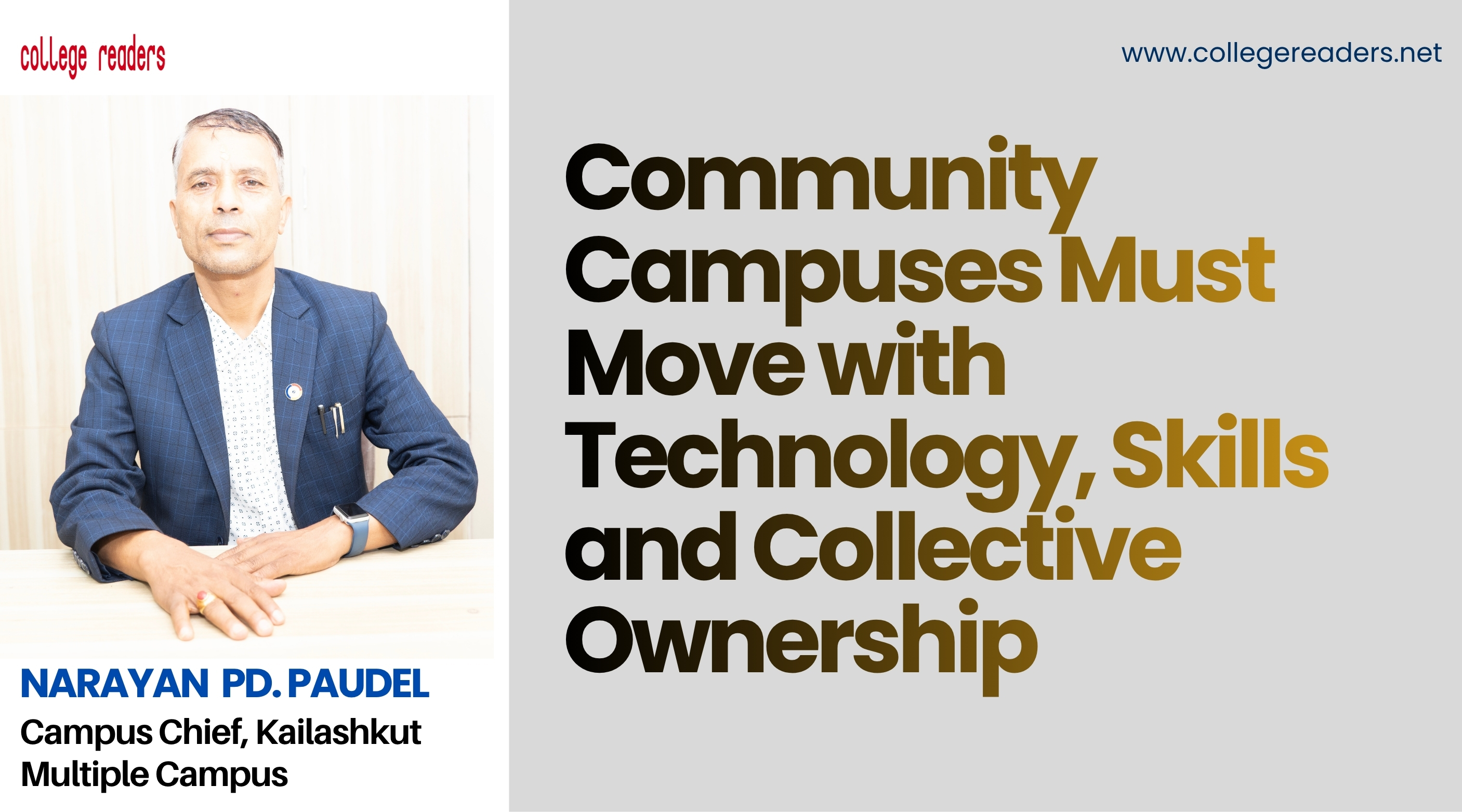
College Readers: You have returned as Campus Chief of Kailashkut Multiple Campus for a second term. How do you describe the campus today?
Narayan Prasad Paudel: Kailashkut Multiple Campus is located at Jayabageshwori, in the heart of Kathmandu. Established in 2048 B.S., it has completed almost 35 years, passing through many phases and challenges.
This is a community campus, and its strength lies in the ownership of the community, teachers, staff, students and well-wishers. I believe unity is strength.
.jpg.jpeg)
College Readers: What programmes does Kailashkut Multiple Campus currently offer?
Narayan Prasad Paudel: At the +2 level, we offer Humanities, Education, Management and Law. Under Management, we also run Hotel Management and Computer Science. At the Bachelor’s level, we conduct BA and BBS programmes. These programmes are affordable and suitable for students from different economic and social backgrounds.
We also provide scholarships and support to deserving students. Our aim is not only to teach but also to serve, encourage and guide students. Kailashkut has a long history and strong results among community campuses in the Valley. We are proud of that achievement, but we must continue improving.
College Readers: What motivated you to accept the campus chief responsibility again?
Narayan Prasad Paudel: I had earlier served a full term as Campus Chief. Later, by my own decision, I stepped aside for rest. However, respected intellectuals, the management committee, teachers, professors and community members encouraged me to return. Since this campus belongs to the community, I felt I should respond to that call.
I have not come back merely to hold a position. I have come with a plan, vision, mission and clear objectives. I am moving ahead with courage, enthusiasm and confidence.
Community campuses should advance with technology, skills and collective ownership.
College Readers: What are your major plans for campus development?
Narayan Prasad Paudel: My first priority is institutional stability, and for that, arranging land for the campus is essential. Although student numbers have declined in many institutions, I am working to bring students from different areas, including remote parts of the country. I also want to give dignity to teachers and staff.
We are discussing professional grading, motivation, reward and reinforcement. Teachers and employees should receive exposure to other institutions so that good practices can be applied here. I have many dreams for Kailashkut, and I am determined to achieve them with collective support.
College Readers: How important is technology in your academic vision?
Narayan Prasad Paudel: Technology is no longer optional. The 21st century is the age of technology and Artificial Intelligence. Therefore, we must provide education according to the needs of time.
If we fail to adopt technology, our education will decline. A community campus may not immediately provide the same facilities as large international universities, but we can adopt modern teaching methods.
College Readers: What major challenges do you see in community campuses?
Narayan Prasad Paudel: Community campuses in Nepal face many challenges. One of the biggest is brain drain. We educate students, but the country often fails to provide them employment. As a result, the knowledge and skills produced here benefit other countries more than our own society.
The solution is to provide education suitable to Nepal’s soil, needs and economy. We need vocational education, skill-based courses and science- and technology-oriented programmes. Tribhuvan University should provide affiliation for relevant courses to community campuses. If community campuses are to become strong, they must run programmes that match present demands.
College Readers: What support should Tribhuvan University and the government provide?
Narayan Prasad Paudel: Community campuses carry a huge responsibility in Nepal’s higher education. Many students from poor, marginalised, indigenous, Dalit and remote communities study in these campuses because they are affordable and accessible. Yet teachers working here do not receive the same recognition and grading as teachers in constituent campuses of Tribhuvan University.
This inequality must be addressed. Teachers in community campuses must be respected, graded and supported. Tribhuvan University and the government should treat community campuses as partners, not as secondary institutions. With affiliation, resources and policy support, we can contribute more strongly to national education.
College Readers: Many people are worried about students going abroad. How do you understand this trend?
Narayan Prasad Paudel: Student mobility is a global reality. Therefore, we should not only complain that Nepali students are going abroad. Instead, we must improve our own education system and think about bringing foreign students to Nepal.
Nepal must focus on practical and productive education. We are an agricultural country, so we should connect education with production, marketing, entrepreneurship and internationalisation of local products. When education creates income and employment, students will see possibilities at home.
Kailashkut aims to offer affordable, inclusive and quality education.
College Readers: What message would you like to give to students and parents?
Narayan Prasad Paudel: I invite students and parents to visit Kailashkut Multiple Campus and understand our environment closely. This is a community-owned, affordable and student-friendly institution. We are committed to giving education that is timely, practical and connected with employment opportunities.
Students should not think that quality education is possible only in expensive institutions. A committed community campus can also provide meaningful education with care, discipline and responsibility. I request students to come, study, grow and use the opportunities available here. Kailashkut belongs to the community. Our purpose is to make education accessible, respectful and relevant so that students can build confidence, skills and hope within Nepal itself and the nation’s future together.
.jpg)

Popular Categories
Trending This Month








 Established in 2065 BS, COLLEGE READERS is a premier national-level educational magazine dedicated to serving the academic and informational needs of school and university students, teachers, educators, and concerned ones in Nepal. The magazine provides current and comprehensive information on various educational opportunities worldwide, aiming to guide school and college-level students in their academic and career journeys. It also highlights essential support services and service providers that play a crucial role in shaping students' career paths in today's competitive world.

- Our Location Putalisadak, Kathmandu
- Send Us Email collegereaders123@gmail.com
- Call Us Now 977 01 4518759
