
Call now
977 01 4518759
Send Message
collegereaders123@gmail.com
Our Location
Putalisadak, Kathmandu
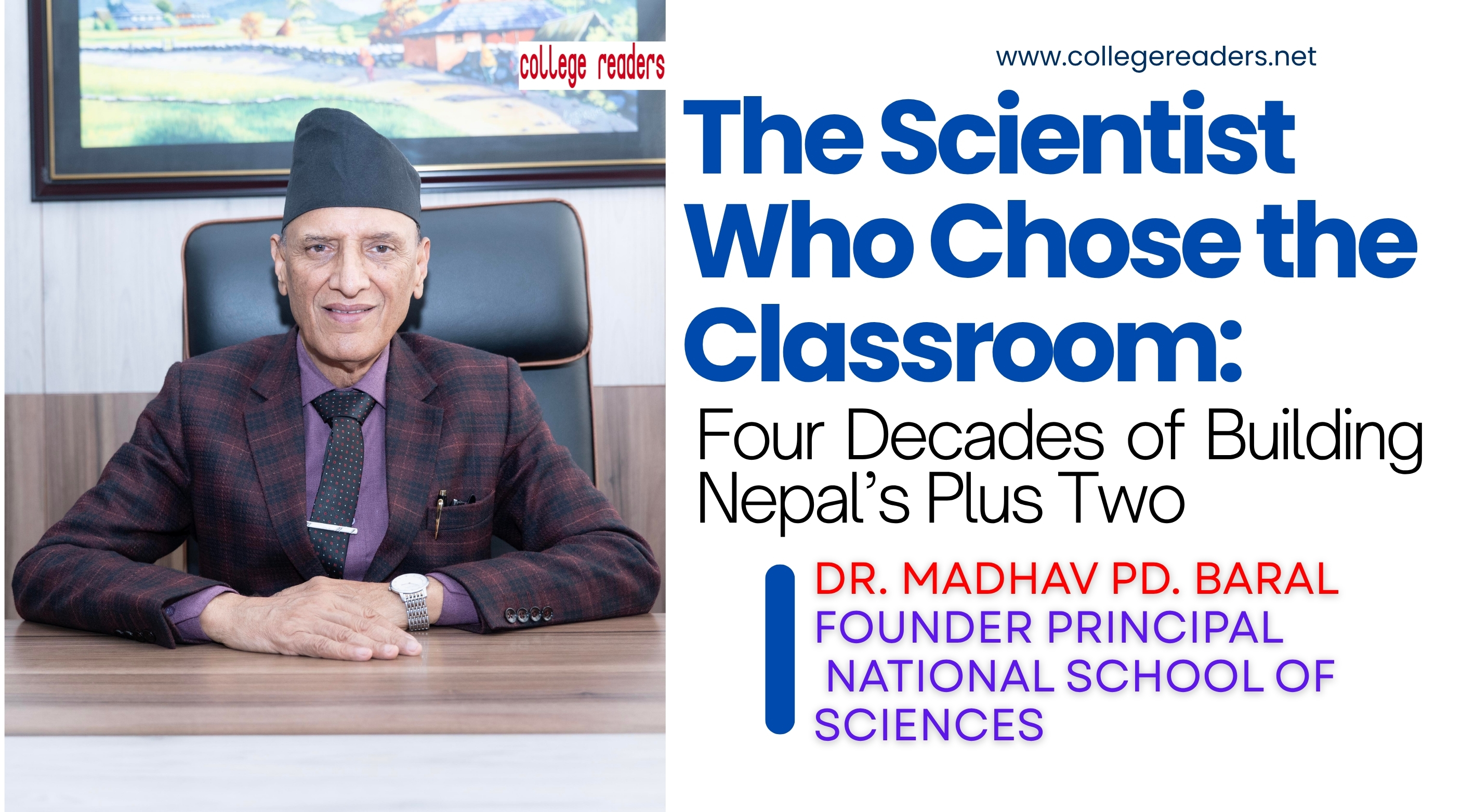
The Scientist Who Chose the Classroom: Four Decades of Building Nepal’s Plus Two
- College Readers
- 17 May 2026
- Views
- Interviews , Op-ed
Dr. Madhav Prasad Baral, Founder Principal of NIST (National Institute of Science and Technology), is one of the quiet but consequential architects of modern higher secondary education in Nepal. A scientist by training, an educator by vocation, and an institution-builder by conviction, he has spent the better part of four decades shaping how science is taught in Nepali schools. His name is woven into nearly every significant chapter in Nepal’s plus two journey—from the earliest pilot programmes in 1993 to today’s debates on curriculum, examination quality, and the everyday science laboratory experience that shapes outcomes.
Baral completed his PhD in 1983 and returned to Nepal soon after, joining what was then RONAST—the Royal Nepal Academy of Science and Technology, today known as NAST—as a scientist. The experience proved formative but ultimately unsatisfying. Within a couple of years, he found himself restless with what he describes as the rhythms of life at a science academy, where days were filled with tea, coffee, occasional physical work, and few opportunities for meaningful production. A practitioner by instinct, he wanted to build, teach, and create rather than passively administer. That restlessness became the turning point of his career.
His route into teaching had, in fact, begun well before his PhD. As a younger man, Baral had taught engineering at the Institute of Engineering, Pulchowk, for five to six years—a foundational experience he often draws on when speaking of classroom practice. After returning from doctoral studies, during a particularly turbulent stretch marked by strikes and shutdowns, he opened a coaching institute in the Indrawati Bank area, simply because he refused to remain idle. He later joined Saint Joseph College and took up assignments across other institutions, gradually discovering that teaching, not laboratory science, was where his real contribution lay.
The defining chapter began with NIST. Baral helped launch Nepal’s plus two programme as early as 1993, well before the formal +2 framework had stabilised. He started the institution with just seventeen students under a trust model, originally as Shanti Vidyalaya. In those years, securing students, building curriculum, designing examinations, and writing textbooks all had to be done from scratch. Nepali parents had little confidence in domestic plus two science programmes—families with means sent their children to India. Baral and his small team worked patiently to convince them, year by year, that quality science education was finally available at home.
That experience naturally drew him into HISAN—the Higher Institutions Association of Nepal—of which he became a founding member. For nearly a decade he served the organisation in shaping the very ecosystem of plus two education. Working alongside HSEB, he helped develop examination patterns, contributed to result management, supported textbook preparation, and offered administrative input where the new board needed it most. Baral is candid that without HISAN’s collective effort in those formative years, HSEB itself would have struggled to reach the standing it eventually achieved. Today he serves as Chairman of HISAN’s Academic Council, continuing his commitment to systemic improvement.
Baral has long argued that today’s plus two science curriculum, while sound in principle, is undermined in practice by weak Grade 9 and 10 preparation in basic sciences. Students arrive in plus two technically credited with seventy-five marks of secondary science, yet often struggle with the fundamentals of Physics, Chemistry, Biology, and Mathematics. To address this, he has personally developed supplementary curriculum and laboratory materials designed to bridge that gap—initially deployed at NIST, but ready, in his view, for adoption across all HISSAN member schools. His position is firm: practical science cannot be sacrificed to save money.
From its modest origin, NIST has grown into a network of institutions under Baral’s stewardship. Branches now operate in Bhaktapur, Banepa, Janakpur, and other locations, with an IGCSE programme based at Banepa serving students drawn toward an international curriculum. Each expansion has been driven not by commercial calculation but by demand—families and students who wanted access to the quality of teaching that NIST had become known for. Beyond NIST, Baral has held faculty board responsibilities and academic council membership at Tribhuvan University, ensuring that his perspective from the institutional ground reached the university policy table as well.
The journey, however, has been anything but smooth. Baral speaks openly about the trials that have accompanied his career—political pressure during turbulent periods, organised opposition from individuals he once trusted, and even formal anti-corruption complaints filed by nine of the original ten student associates. While most of them eventually moved abroad, Baral stayed in Nepal and continued building. He carries a quiet sense of weariness about how often loyalty has been tested, but he refuses to let bitterness define him. His response is a phrase he often returns to: when the elephant moves forward, the dog will bark.
Looking forward, Baral has fixed his sights on something larger than any single institution—building NIST as a personal trust capable of lasting two centuries. He cites the Mayo Clinic in Minnesota, where his son works, as the model that captures his imagination: an institution started by two brothers, sustained by trust governance long after the founders were gone, now ranked among the world’s leading hospitals with thirty-four thousand staff. Nepal, he insists, lacks not capability but patience and integrity. A genuine trust structure, properly governed, can outlast individuals and protect quality across generations. That is what he wants to leave behind.
At home, Baral remains supported by a family deeply rooted in service—his wife, their daughter who practises medicine in the United States, a son working in Minnesota, and grandchildren now considering Nepal’s future from afar. They have urged him to slow down; he has chosen instead to keep moving. Today, his proposal for HISAN is to convene a workshop with all member colleges to set the next chapter of quality plus two education in Nepal—shared curriculum thinking, supportive materials, and resource books built collectively. A founder principal at heart, Dr. Madhav Prasad Baral continues to lead by example and conviction.
Popular Categories
Trending This Month








 Established in 2065 BS, COLLEGE READERS is a premier national-level educational magazine dedicated to serving the academic and informational needs of school and university students, teachers, educators, and concerned ones in Nepal. The magazine provides current and comprehensive information on various educational opportunities worldwide, aiming to guide school and college-level students in their academic and career journeys. It also highlights essential support services and service providers that play a crucial role in shaping students' career paths in today's competitive world.

- Our Location Putalisadak, Kathmandu
- Send Us Email collegereaders123@gmail.com
- Call Us Now 977 01 4518759
