
Call now
977 01 4518759
Send Message
collegereaders123@gmail.com
Our Location
Putalisadak, Kathmandu
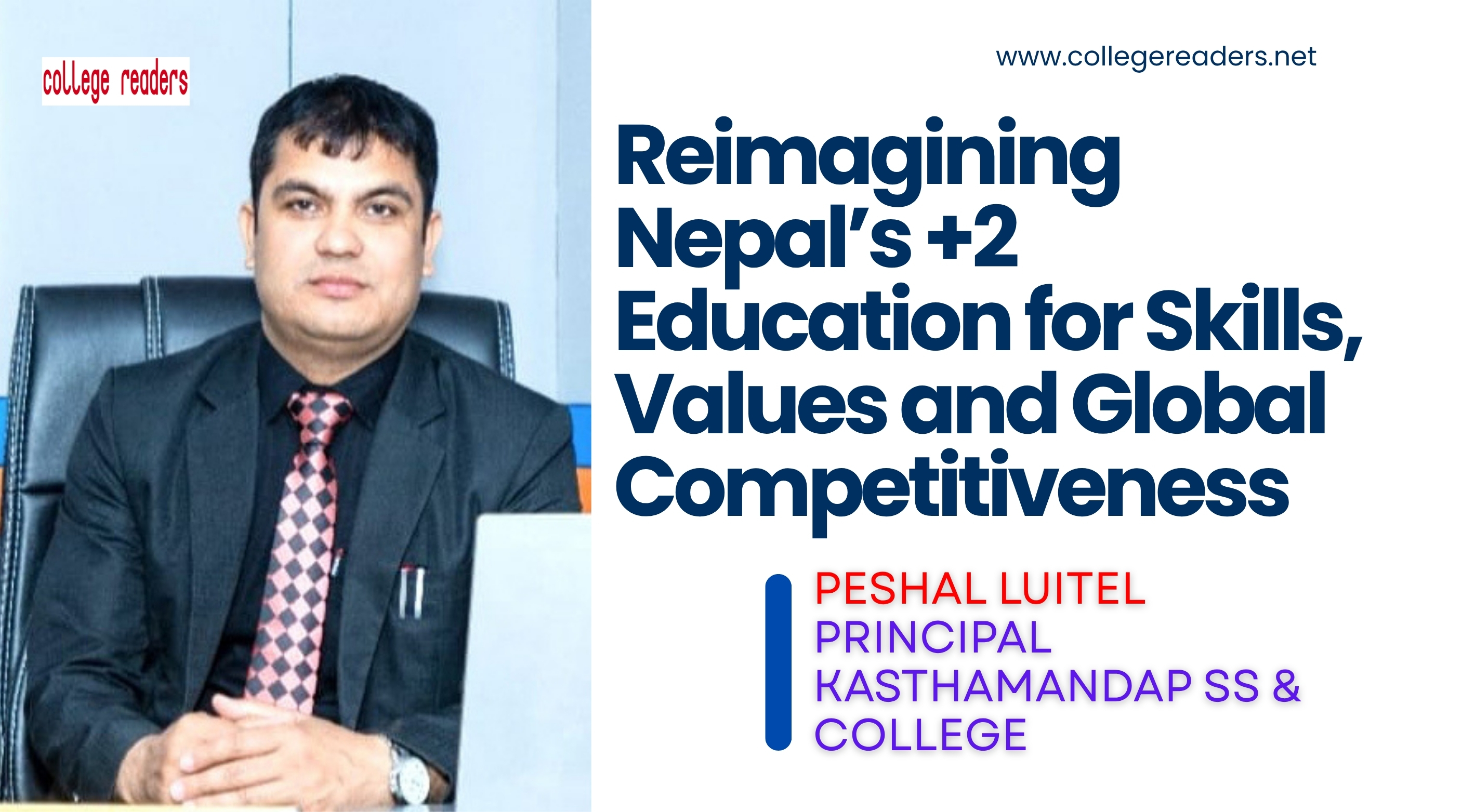
Reimagining Nepal’s +2 Education for Skills, Values and Global Competitiveness
- College Readers
- 17 May 2026
- Views
- Interviews
In this interview, Peshal Luitel, Principal of Nepal Kasthamandap Secondary School and College, reflects on the urgent need to transform Nepal’s +2 education system. Drawing on his twenty-four years of academic leadership, he identifies exam-oriented learning, outdated pedagogy, weak counseling, limited practical education, and poor links with employment as key challenges. Luitel advocates competency-based curriculum reform, teacher training, digital integration, career guidance, research-based learning, internships, and community service. He emphasizes that technology and artificial intelligence should support, not replace, human interaction, discipline, ethics, and critical thinking. His vision for the next decade is an innovative, value-based, globally competitive +2 system guided by visionary institutional leaders who prepare students for examinations, careers, citizenship, and national progress.
In your assessment, what are the most pressing challenges currently facing the +2 education system in Nepal, and what reforms do you believe are essential to address them effectively?
In my twenty-four years of experience as Principal of Nepal Kasthamandap Secondary School and as a central member of HISSAN, I believe the major challenges facing the +2 education system in Nepal are excessive exam oriented learning, outdated teaching methods, lack of practical and skill-based education, weak counseling systems and the growing disconnect between education and employment. Many students focus only on securing GPA rather than developing creativity, critical thinking, communication skills and ethical values. Although Nepal has talented students, the system still lacks strong policy implementation, teacher training and technological integration. To address these issues, Nepal needs competency-based curriculum reform, practical and research-oriented teaching, continuous teacher development, career counseling, digital learning infrastructure and stable educational policies that prepare students not only for examinations but also for higher education, employment and responsible citizenship.
How should Plus Two institutions redesign their academic approach to ensure that students are prepared not only for board examinations, but also for higher education, employment and responsible citizenship in a rapidly changing world?
Plus Two institutions in Nepal should move beyond traditional exam centered education and adopt a holistic and student-centered academic approach. Schools and colleges must focus on developing critical thinking, leadership, communication skills, digital literacy, creativity and problem-solving ability alongside academic excellence. At Nepal Kasthamandap Secondary School, we have realized that students achieve the best results when they are guided academically, emotionally and morally. Institutions should therefore integrate project work, presentations, research activities, career counseling, internships, community service and mentorship programs into regular academic practice. Education should not only produce high scorers in NEB examinations but also capable, disciplined, socially responsible and globally competitive citizens who can contribute positively to Nepal and the wider world.
With the growing influence of technology, artificial intelligence, and digital learning platforms, what strategies should schools adopt to integrate innovation while preserving academic discipline, critical thinking, and human values?
Technology and artificial intelligence have created tremendous opportunities in education but schools must adopt them carefully and responsibly. In the Nepali context, institutions should integrate smart classrooms, digital platforms, and AI supported learning tools while ensuring that technology supports learning rather than replacing human interaction and discipline. Teachers should be trained to use technology in interactive and meaningful ways that encourage analysis, discussion, and independent thinking. At the same time, schools must continue emphasizing human values such as respect, honesty, empathy, responsibility and discipline through counseling, mentorship and institutional culture. As an academician and counselor, I strongly believe that technology can provide information, but teachers and educational institutions remain essential for shaping character, ethics and critical thinking among students.
To what extent do you believe the present +2 curriculum and teaching methodology align with global standards, and what practical steps are needed to enhance the competitiveness of Nepali students at the national and international levels?
Although Nepal’s +2 curriculum has improved over the years, it still does not fully align with global educational standards because teaching remains largely theoretical, examination-focused, and dependent on rote learning. International education systems emphasize practical learning, innovation, research, communication skills, and interdisciplinary understanding, whereas many Nepali classrooms still prioritize syllabus completion over conceptual depth and application. To enhance the competitiveness of Nepali students, curriculum revision, practical and research-based teaching methods, digital integration, English communication enhancement, entrepreneurship education, and international academic exposure are essential. Institutions like Nepal Kasthamandap Secondary School, which have produced NEB toppers with outstanding results, show that Nepali students can compete globally when they receive quality guidance, disciplined academic environments, and visionary leadership.
Looking toward the next decade, what is your vision for the future of +2 education in Nepal, and what role should institutional leadership play in shaping that transformation?
My vision for the next decade is to see Nepal’s +2 education system become innovative, value-based, technologically advanced, and globally competitive while remaining socially and culturally rooted. Education should focus not only on academic achievement but also on creativity, leadership, ethical values, entrepreneurship, research and national responsibility. Institutions should become centers of intellectual growth where students are encouraged to think independently and contribute meaningfully to society. In this transformation, institutional leadership will play the most important role. Educational leaders must act not only as administrators but also as mentors, innovators, policy advocates and motivators who inspire teachers and students toward excellence. Through visionary leadership, strong academic culture, and commitment to quality education, institutions can significantly contribute to the long-term development of Nepal’s education sector and national progress.

Popular Categories
Trending This Month








 Established in 2065 BS, COLLEGE READERS is a premier national-level educational magazine dedicated to serving the academic and informational needs of school and university students, teachers, educators, and concerned ones in Nepal. The magazine provides current and comprehensive information on various educational opportunities worldwide, aiming to guide school and college-level students in their academic and career journeys. It also highlights essential support services and service providers that play a crucial role in shaping students' career paths in today's competitive world.

- Our Location Putalisadak, Kathmandu
- Send Us Email collegereaders123@gmail.com
- Call Us Now 977 01 4518759
