
Call now
977 01 4518759
Send Message
collegereaders123@gmail.com
Our Location
Putalisadak, Kathmandu
Quality Without Compromise The Real Measure of Global College
- College Readers
- 17 May 2026
- Views
- Interviews
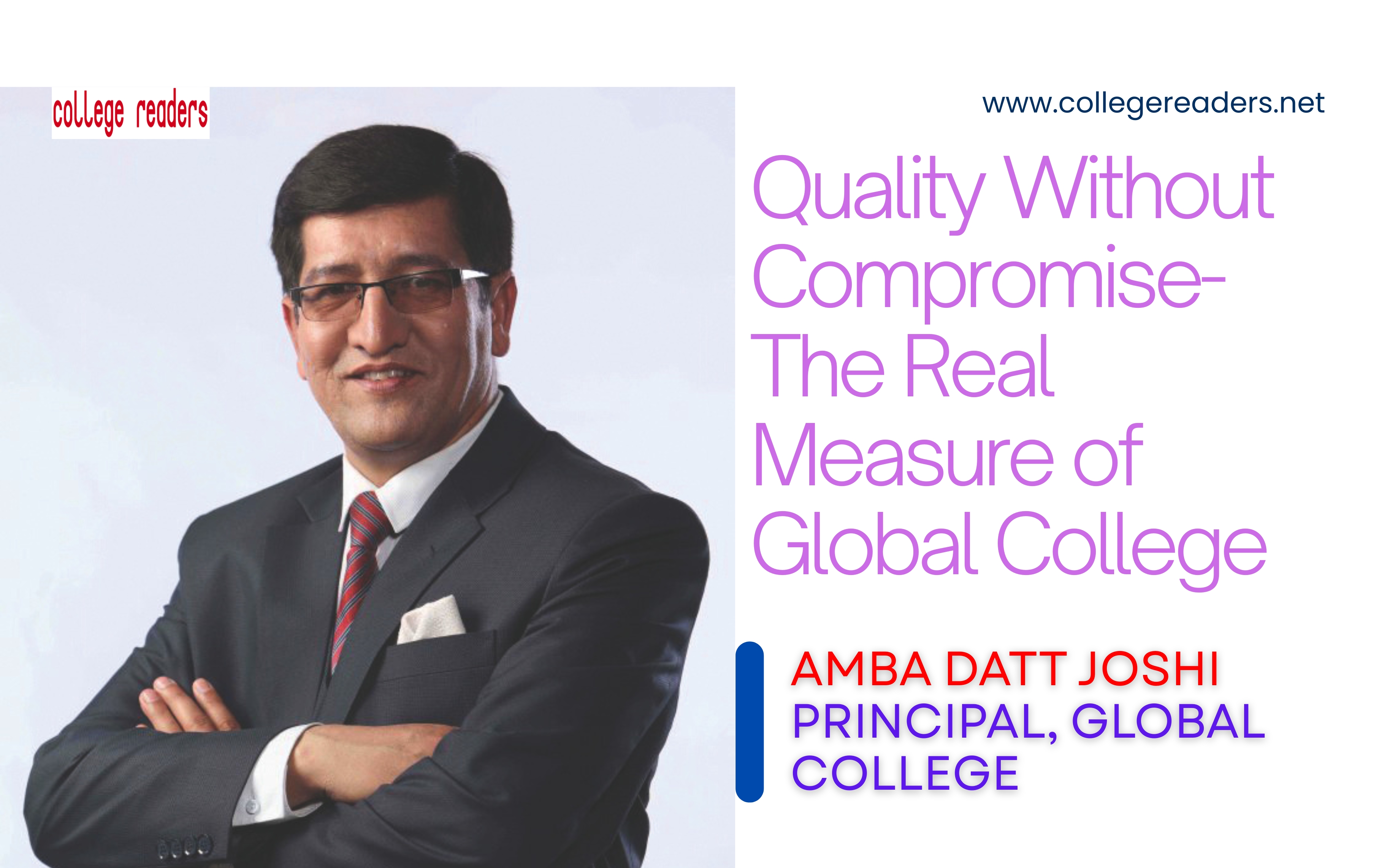
The plus two stage—Grades 11 and 12—is widely regarded as the iron gate of Nepal’s education system, where today’s choices echo through tomorrow’s careers. In this exclusive conversation with College Readers, Mr. Amba Datt Joshi, Principal of Global College of Management and Global School of Science, shares insights drawn from twenty years at the institution and eleven as Principal. Global College operates on a single guiding motto: no compromise on quality, with the student placed at the centre of every decision. Principal Joshi expresses how students should choose their stream, evaluate a college, understand what ‘result’ truly means, and recognize the shared responsibility of college, parents, and student.
College Readers: Plus two is often called the iron gate of Nepal’s education. What should students consider when choosing between Management and Science at this critical stage?
Amba Datt Joshi: Plus two is genuinely the entry gate to university—the moment that shapes tomorrow’s career. My first message is this: the choice of subject should never come from someone else’s pressure. If a student has clarity about their future, they should follow that path. If unsure, they may seek guidance from parents or seniors who understand their interest. Whether one chooses Management or Science, both offer equally wide scope today. We are no longer in an era where only Science leads to engineering or medicine. Through Computer Science within Management, students can pursue all IT subjects. So look at your own goals, not the crowd.
College Readers: Many students choose Science out of interest but struggle academically. Beyond interest, what qualities does a student need to succeed in Science?
Amba Datt Joshi: That is exactly the right question. To pursue Science honestly, a student must be laborious—willing to put in sustained, daily effort. Science yields no shortcuts. But here is the encouraging truth: if a student is ready to work hard, nothing in Science is impossible. The curriculum has been created by someone, and we have experienced teachers to walk students through it. With a supportive college, qualified faculty, and the student’s own commitment, Science becomes entirely achievable. But if a student is not prepared for that effort, then Science may not be the right choice. That is an honest conversation worth having early, not after a year of struggle.
College Readers: Students often choose colleges and faculties because their friends do, and many later switch streams. What advice would you offer to families during this process?
Amba Datt Joshi: A student’s success rests on three pillars working together: parents, the college team, and the student—and the student is always the main pillar. When students cannot decide for themselves, or when parents impose a stream against the child’s interest, the outcome is often unfortunate. We sometimes lose students that way, and that is painful for everyone. To parents directly: please do not pressure your child into a subject. Allow them to choose according to their interest. Sit with the college’s counselling team, understand the subject together, then decide. Whichever subject is chosen—Management, Education, Law, or Science—a capable, committed student can excel anywhere.
College Readers: Choosing the right college is itself a major decision. What should students and parents actually look for when evaluating one?
Amba Datt Joshi: Let me say first that at Global College, fee has never been—and will never be—a barrier for a genuinely interested student. When choosing a college, infrastructure is the most visible factor but the least important to evaluate, because anyone can see a building. What truly matters are three things. First, faculty stability—how long have the teachers been there? Buildings do not teach; teachers do. Second, real results—where are the graduates today? Third, the ECC and CCA ecosystem, including the facilities for them. A student’s all-round development depends on engagement beyond textbooks. Examine these three honestly, and you will find the right college.
College Readers: Many still equate ‘result’ with grades and percentages. How do you define a genuine result?
Amba Datt Joshi: When I speak of result, I am not pointing at grade points or percentages alone. I am pointing at placement—where students of a college actually end up. For Science, the real result is how many graduates have made their way into engineering and medical institutions. For Management, it is how many have cleared Chartered Accountancy and built strong positions in the market. Marks are part of the picture, but placement is the true measure. A school that produces high scorers who go nowhere has not succeeded. A school that produces graduates building meaningful careers—that is a school doing its job for the next generation.
College Readers: Students often see Global College as the place where their dreams will take shape. How confidently can you assure them those dreams will be realised here?
Amba Datt Joshi:
Without doubt. Twenty years ago we began Global College of Management as a small institution. Today it is a first choice for management students across Nepal—visible in our applications, where students rank us first, and in our placements: graduates serving in banks, insurance companies, and Nepal Rastra Bank, in Nepal and abroad. Seven years ago we established Global School of Science. In a short time, it has reached impressive heights. Last year our student Sagar Parajuli secured the second rank nationally at Pulchowk. Several students secured medical scholarships. Four were nationally top-ranked and honoured by NAST. Quality is non-negotiable here.
College Readers: What role must parents play once their child has entered college?
Amba Datt Joshi: As I said earlier, three factors shape a student’s future: the college, the parents, and the student—who remains the main pillar. The college handles academic care. But realistically, a Science student spends about eight hours a day with us, a Management student about five. The remaining hours belong to the parents. So I ask parents to play just two roles. First, ensure your child attends college regularly—consistency is everything. Second, check that assignments and projects are completed on time, and stay in regular communication with us. If you see any shortcoming on our side, share it as feedback. If parents fulfil these two roles, the rest is our commitment to your child.
Popular Categories
Trending This Month








 Established in 2065 BS, COLLEGE READERS is a premier national-level educational magazine dedicated to serving the academic and informational needs of school and university students, teachers, educators, and concerned ones in Nepal. The magazine provides current and comprehensive information on various educational opportunities worldwide, aiming to guide school and college-level students in their academic and career journeys. It also highlights essential support services and service providers that play a crucial role in shaping students' career paths in today's competitive world.

- Our Location Putalisadak, Kathmandu
- Send Us Email collegereaders123@gmail.com
- Call Us Now 977 01 4518759
