
Call now
977 01 4518759
Send Message
collegereaders123@gmail.com
Our Location
Putalisadak, Kathmandu
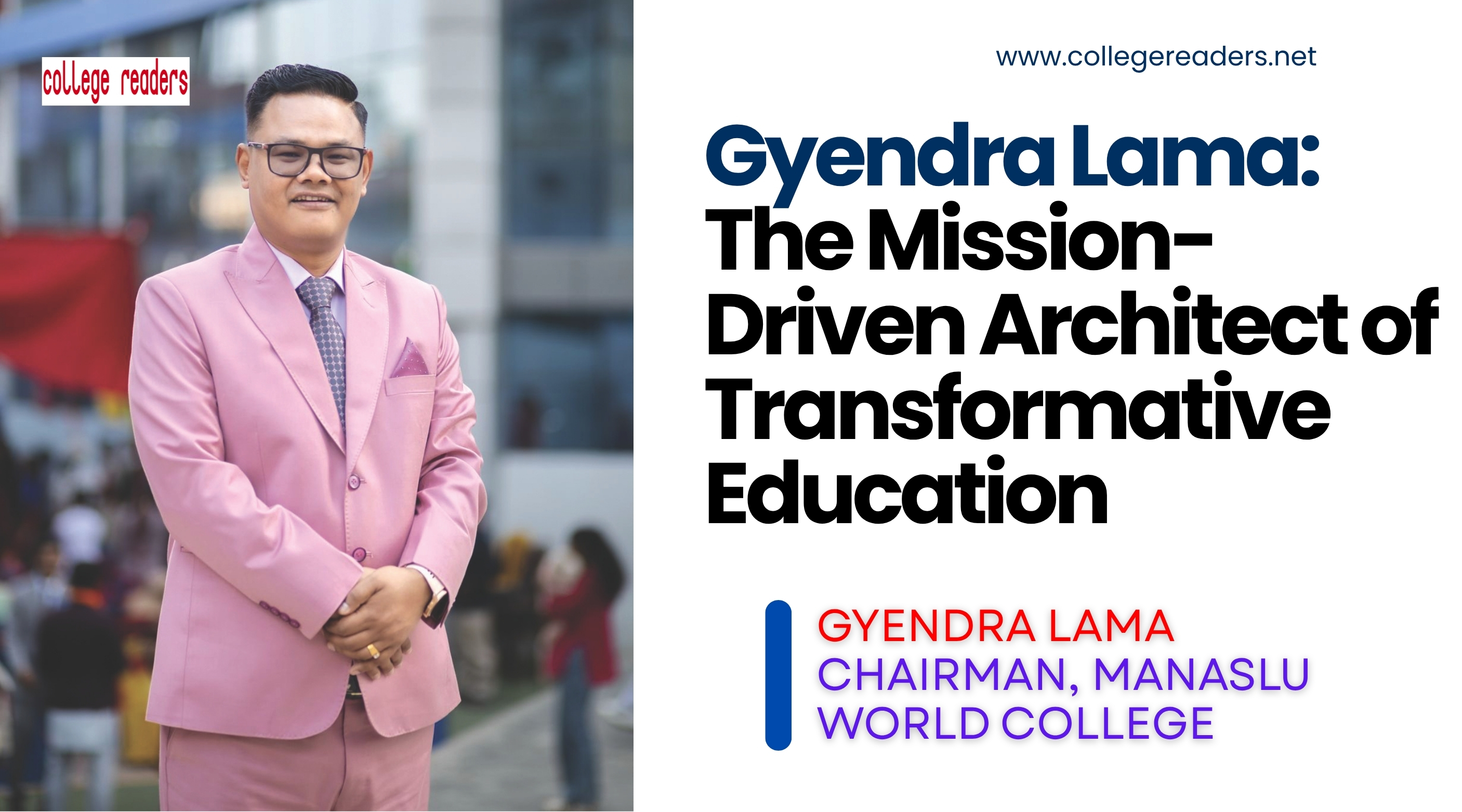
The Mission-Driven Architect of Transformative Education
- College Readers
- 17 May 2026
- Views
- Interviews , Op-ed
Gyendra Lama, Executive Chairman of Manaslu World College, is widely regarded as one of Nepal’s most committed and forward-thinking educational leaders. His story is one of vision, perseverance, and an unshakable belief that education can transform lives, reshape society, and contribute to national development. From humble beginnings to the helm of a respected academic institution, his journey embodies the conviction that meaningful leadership in education is built not on privilege or position, but on purpose, character, and continuous service. Decades into that mission, the conviction behind it has only deepened.
Lama’s professional journey began at the remarkably young age of seventeen, when he stepped into a classroom as a teacher. Coming from a modest background, he had experienced firsthand both the opportunities education could open and the limitations it could expose. Those early struggles planted within him a quiet but powerful desire to contribute meaningfully to Nepal’s education sector. Standing before his first students, he discovered that teaching was not merely a profession but a profound responsibility—one of shaping human potential, awakening confidence, and inspiring future generations.
Alongside his teaching career, Lama remained deeply committed to academic growth. He completed his M.A. in English Literature and his M.Ed. in Educational Planning and Management from Tribhuvan University, gaining a strong grounding in educational leadership, institutional management, and social responsibility. He realised early that Nepal needed institutions capable of bridging the gap between theoretical knowledge and practical life skills. Students, he believed, deserved more than syllabus completion; they deserved character, creativity, leadership, moral values, and global competence. That conviction would later become the foundation of Manaslu World College, an institution he envisioned as a meeting point between academic rigour and real-world preparation.
The early phase of his career was marked by uncertainty, doubt, and continuous learning. Many questioned whether someone so young could effectively lead, teach, or shoulder institutional responsibilities. Financial limitations, restricted resources, and the constant pressure to prove himself became part of his daily reality. Yet those difficulties gradually became his greatest teachers. He learned that hard work alone was never enough—success required smart work, discipline, communication, innovation, adaptability, and strategic thinking. He understood that leadership is built through consistency, integrity, and patience, and that calm under pressure is one of its truest tests.
Those early years deepened his humility, resilience, emotional intelligence, and empathy. They taught him to understand the realities faced by teachers and students alike—realities that continue to guide his decisions today. A defining turning point came when he became one of the youngest principals in Nepal at the age of twenty-two. It was a moment of trust, possibility, and responsibility, and it reinforced his lifelong belief that leadership is determined not by age, but by vision, dedication, and commitment.
The growth of Manaslu World College became his most meaningful undertaking. Building an institution that combined academic excellence with innovation, practical exposure, and progressive values was never easy. There were sleepless nights, difficult decisions, financial pressures, operational hurdles, social criticism, and moments of doubt. But Lama refused to view obstacles as barriers; he saw them as opportunities to grow stronger, wiser, and more determined. His personal philosophy—“I don’t just chase success, I build systems that create success”—has guided him through every difficult chapter, a reminder that institutions endure only when their roots run deeper than their visibility.
His transition from teacher to educational leader was shaped deeply by the classroom itself. Lessons learnt in front of students could not be found in any management book or leadership seminar. Each child, he observed, carried unique dreams, fears, talents, and potential. That insight convinced him that education must be human-centred rather than system-centred—that true education is about inspiring confidence and nurturing potential, not merely delivering lessons. From those years he carried forward patience, communication, adaptability, and active listening, along with a firm conviction that leadership is service, not power.
Today, watching former students grow into confident professionals, entrepreneurs, leaders, and responsible citizens remains his greatest reward. The awards and honours he has received nationally and internationally have been encouraging, but he insists the real recognition has always been the trust of students, parents, teachers, and society. That trust strengthens his ongoing commitment to delivering education that is quality-driven, affordable, practical, innovative, and transformative.
Lama is candid that success has come at a personal cost. Behind every achievement, he notes, lie years of consistency, dedication, teamwork, faith, and perseverance—and many sleepless nights that few outsiders see. He learnt early not to allow temporary failure or criticism to define his journey; instead, every setback became preparation for greater responsibility. That mindset has shaped a leader marked by emotional resilience, sharp decision-making, and the rare gift of remaining grounded amid recognition.
His vision for Manaslu World College reflects the same values he champions for Nepal’s wider education ecosystem. He believes students must be prepared not only for examinations but for life—equipped with creativity, communication, leadership, ethics, and the ability to function in a globally connected world. His leadership philosophy remains rooted in respect for teachers, inspiration for students, trust from parents, and shared vision within management. He believes institutions flourish only when each of those pillars stands strong.
To young educators struggling to build their path, his message is direct and sincere. Education, he reminds them, is not just a profession but one of society’s noblest responsibilities. The beginning of every journey is difficult, marked by criticism, financial strain, and self-doubt, but these phases are temporary if vision and intent remain strong. He urges them to keep learning, innovating, and adapting, to embrace creativity and emotional intelligence, and never to let success disconnect them from humanity. True success in education, he insists, is measured by the positive impact one creates in the lives of others. Humility and compassion, he reminds them, must never be lost.
For Gyendra Lama, education has never been a profession. It has always been a mission—to empower individuals, transform society, and contribute toward nation-building, one student at a time.
Popular Categories
Trending This Month








 Established in 2065 BS, COLLEGE READERS is a premier national-level educational magazine dedicated to serving the academic and informational needs of school and university students, teachers, educators, and concerned ones in Nepal. The magazine provides current and comprehensive information on various educational opportunities worldwide, aiming to guide school and college-level students in their academic and career journeys. It also highlights essential support services and service providers that play a crucial role in shaping students' career paths in today's competitive world.

- Our Location Putalisadak, Kathmandu
- Send Us Email collegereaders123@gmail.com
- Call Us Now 977 01 4518759
