
Call now
977 01 4518759
Send Message
collegereaders123@gmail.com
Our Location
Putalisadak, Kathmandu
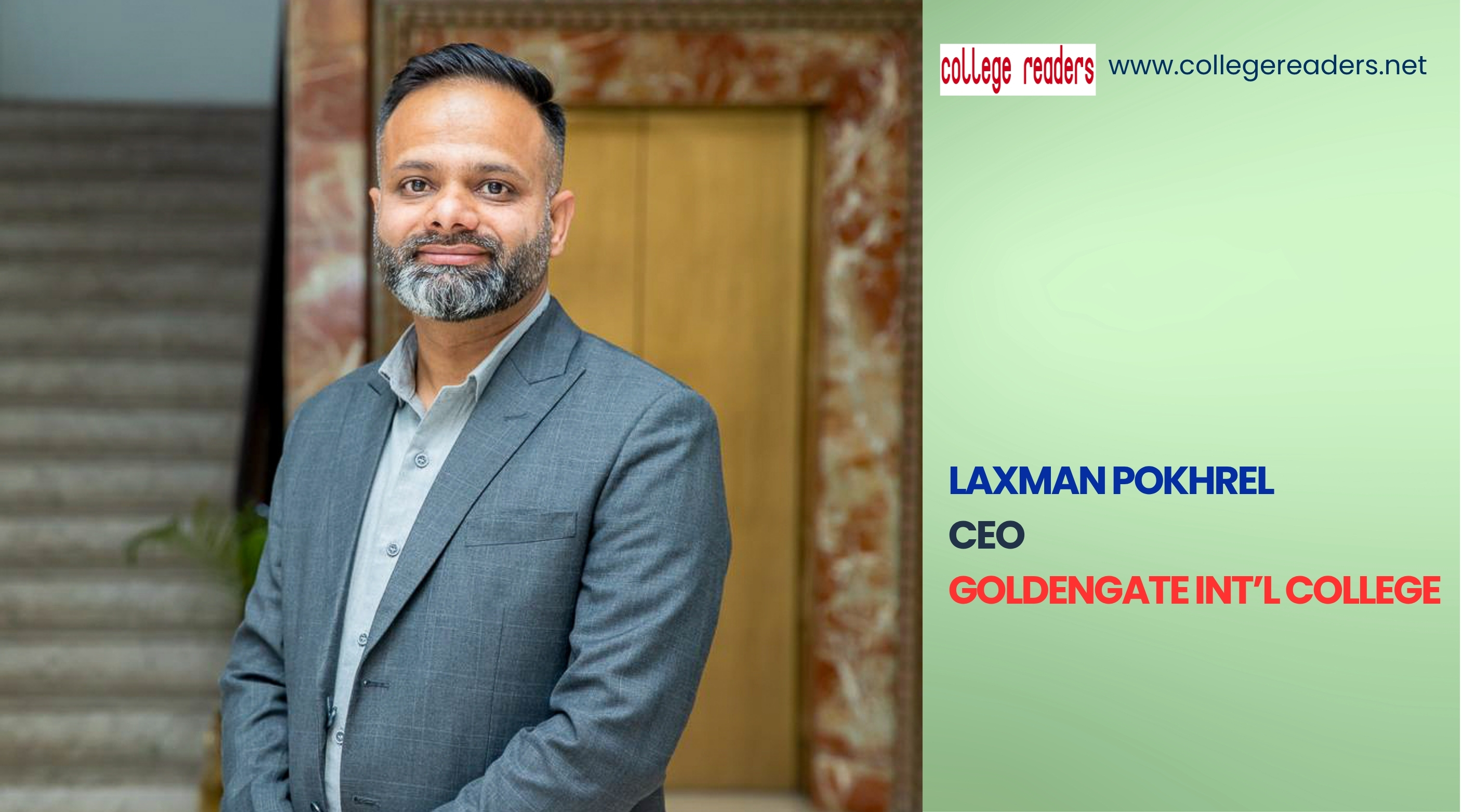
Leading the Shift: Laxman Pokharel’s Strategic Quest to Revolutionize GoldenGate
- College Readers
- 24 Jul 2026
- Views
- Op-ed
Pokharel spent nearly eight to ten years in school education before progressing to teaching at the Plus Two, bachelor’s and master’s levels. From approximately 2002 to 2010, his work remained largely connected with school education. He later moved into higher education, particularly management and MBA programmes, where his responsibilities expanded from classroom teaching to programme management.
Over time, he assumed leadership positions at different educational institutions, serving as principal and chief executive officer. These roles allowed him to move beyond the delivery of education and focus on building academic systems, improving student enrolment, strengthening institutional identity and transforming colleges facing operational or strategic challenges.
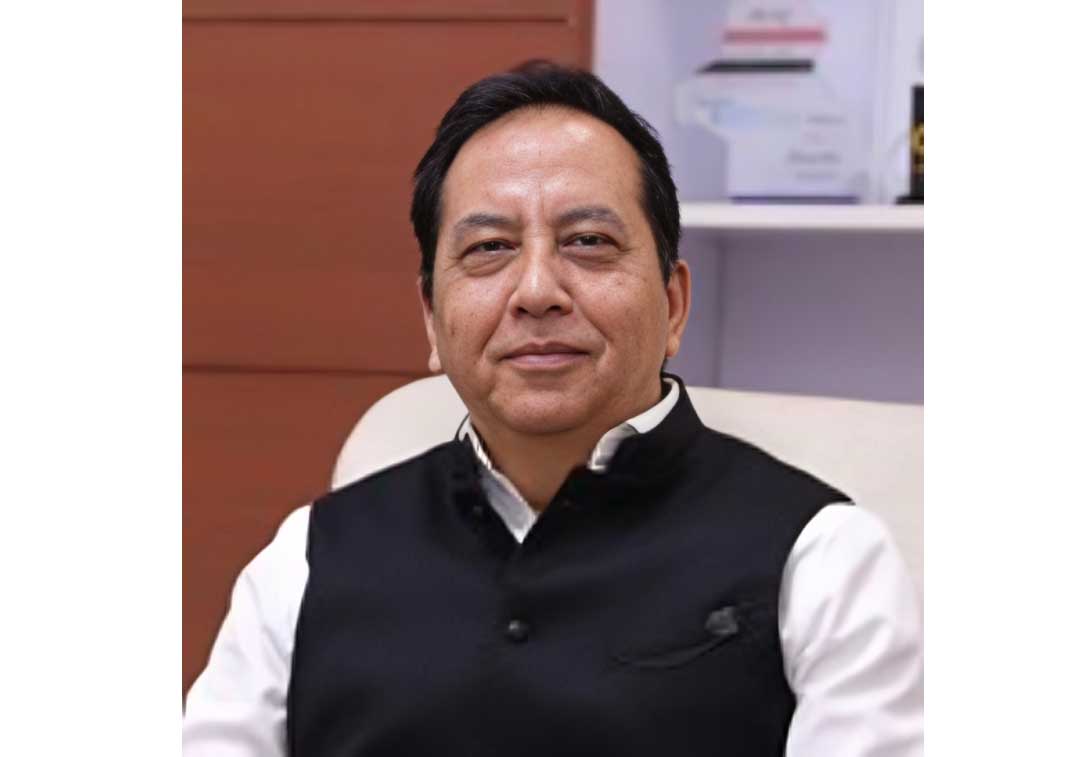
He is now serving as the Chief Executive Officer of GoldenGate International College, one of Nepal’s recognised higher education institutions. For Pokharel, this position is not merely another administrative appointment. It represents an opportunity to apply the lessons he has gathered from teaching, institutional leadership, market research, technology companies and corporate-sector engagement.
A Reform-Oriented Education Leader
Pokharel remains optimistic about Nepal’s higher education, but his optimism is not based on denying its weaknesses. He acknowledges that student migration, outdated curricula, limited employment opportunities and weak industry connections have placed the sector under serious pressure.
In his assessment, Nepal repeatedly discusses the departure of students without adequately examining why they are leaving. The central question, he argues, is whether universities and colleges have created programmes, learning environments and employment pathways that respond to the aspirations of the present generation.
His reform agenda begins with curriculum relevance. As artificial intelligence, digital technology and changing business practices reshape the global economy, academic programmes must also evolve. Universities cannot continue relying on courses designed around the knowledge professors acquired in the past. Education must instead anticipate future demand and prepare students for emerging professional realities.
Pokharel strongly advocates outcome-based education. Under this model, every academic programme should clearly define what students will know and be capable of doing after graduation. Knowledge should not remain confined to examinations and certificates; it must be transformed into practical competence, professional confidence and employability.
“Pokharel believes higher education must be designed around future skills and measurable outcomes—not merely around what institutions and teachers have traditionally offered”
He also identifies the absence of strong collaboration between universities and industries as a major weakness. Students invest three or four years in higher education, yet many graduate without sufficient workplace exposure. Meanwhile, employers struggle to find graduates who can immediately apply academic knowledge in real professional settings.
For Pokharel, theoretical education alone cannot address this problem. Colleges must connect classrooms with companies, markets, projects, internships and professional networks. Students should experience how knowledge is applied long before they receive their degrees.
Understanding the New Generation
One of Pokharel’s most distinctive leadership qualities is his emphasis on understanding students. He argues that the success of an educational institution depends on its ability to recognise what students expect from education, teachers, administrators and the overall campus environment.
Today’s students seek more than prescribed curricula. They expect extracurricular and co-curricular activities, practical exposure, responsive administration, modern infrastructure and opportunities to participate actively in institutional life.
Pokharel acknowledges that many education leaders belong to an older generation and may find it difficult to understand the behaviour and expectations of younger learners. His solution is not to blame students but to redesign educational processes from their perspective.
His previous leadership experience shows that he places considerable importance on market research and evidence-based planning. By studying where prospective students are located, what they want to study and what kind of learning experience they seek, institutions can improve both enrolment and academic relevance.
For him, institutional transformation begins with a simple principle: understand the student first and then adapt the institution accordingly.
Transforming GoldenGate
Pokharel has joined GoldenGate with the belief that the institution does not need to be built from the beginning. Established around two decades ago, the college has already developed a strong brand and produced more than 55,000 graduates. It also operates more than 16 or 17 programmes affiliated with Tribhuvan University, giving it a substantial presence in Nepal’s private higher education sector.
However, institutional reputation alone cannot guarantee future success.
Pokharel believes GoldenGate must now transform itself according to changing student expectations, industry needs and technological developments. His mission is to preserve the institution’s legacy while modernising its programmes, processes and learning culture.
The transformation he envisions includes integrating information technology, digital education and artificial intelligence across academic programmes. It also involves strengthening existing courses, introducing relevant new programmes and improving the way teaching and learning take place.
Rather than viewing GoldenGate only as a college that delivers university curricula, Pokharel wants it to become a learning excellence centre where academic knowledge, technology, professional skills and workplace experience are integrated.
“His vision is to transform GoldenGate from an established academic brand into a modern learning excellence centre where students graduate with knowledge, skills and real professional experience”
Learning, Earning and Growing
A central pillar of Pokharel’s vision is the concept of “learning, earning and growing.” His confidence in this approach comes from personal experience. He worked while pursuing his bachelor’s degree and gained experience with organisations ranging from small businesses to one of the world’s largest IT companies while remaining in Nepal.
He therefore rejects the assumption that students can study and work simultaneously only after going abroad. In his view, the same opportunity can be created in Nepal through institutional commitment and industry collaboration.
Pokharel wants students to begin gaining practical exposure from the second or third semester through volunteering, internships, part-time employment, unpaid assignments and real projects. Earning is not only about receiving money; it is also about developing skills, discipline, responsibility and an understanding of workplace expectations.
At GoldenGate, he plans to use the team’s connections with IT companies and corporate networks to create structured opportunities for students. His goal is for graduates to leave the college not only with academic certificates but also with two or three years of meaningful work experience.
Such a system could also allow some students to contribute to their own educational expenses. Pokharel believes that students who participate financially in their education often become more responsible and better understand its value.
A Persona of Practical Transformation
Laxman Pokharel’s leadership persona is that of a practitioner rather than a purely theoretical reformer. His ideas emerge from classroom teaching, programme management, institutional leadership, corporate engagement and personal experience as a working student.
He does not view Nepal’s higher education as a failed system, but he warns that it must change quickly. His priorities are clear: modern curricula, outcome-based education, student-centred institutions, experiential learning, industry partnerships, technological integration and employment-oriented academic programmes.
At GoldenGate International College, Pokharel’s challenge is to convert these ideas into visible institutional results. His ambition is not simply to increase enrolment or protect an established brand. It is to revive GoldenGate as a contemporary centre of learning where students are prepared not only to pass examinations, but also to work, innovate, compete and grow in a rapidly changing world.

Popular Categories
Trending This Month








 Established in 2065 BS, COLLEGE READERS is a premier national-level educational magazine dedicated to serving the academic and informational needs of school and university students, teachers, educators, and concerned ones in Nepal. The magazine provides current and comprehensive information on various educational opportunities worldwide, aiming to guide school and college-level students in their academic and career journeys. It also highlights essential support services and service providers that play a crucial role in shaping students' career paths in today's competitive world.

- Our Location Putalisadak, Kathmandu
- Send Us Email collegereaders123@gmail.com
- Call Us Now 977 01 4518759
