
Call now
977 01 4518759
Send Message
collegereaders123@gmail.com
Our Location
Putalisadak, Kathmandu
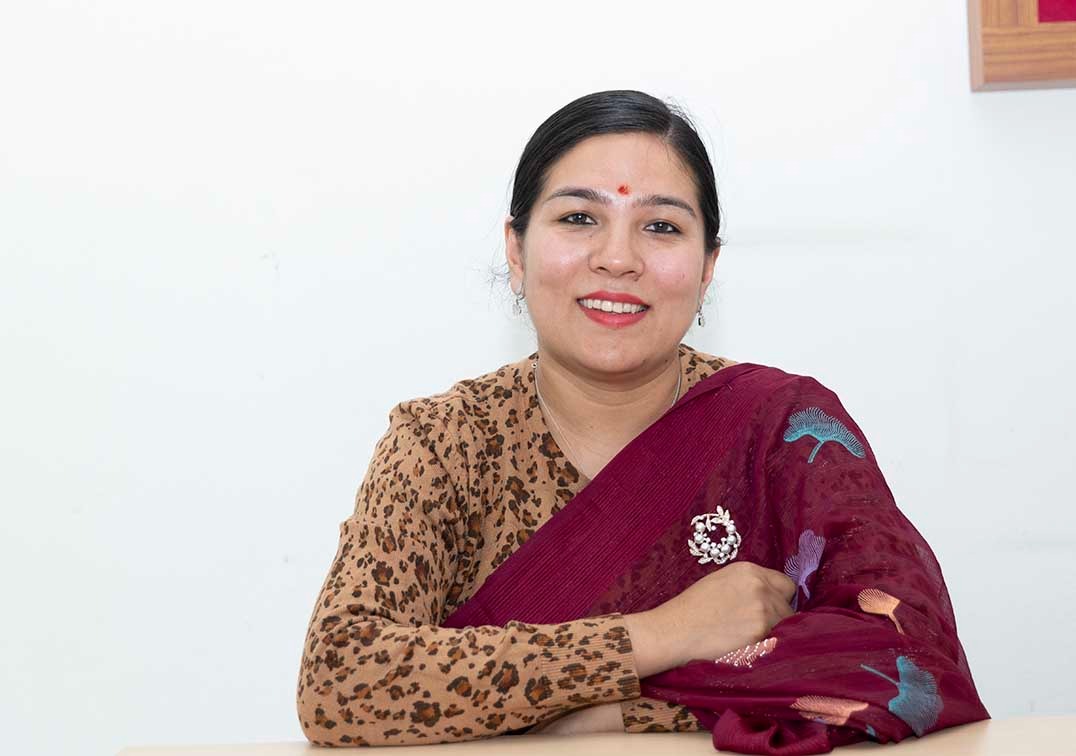
Nilam Baniya Badu
Principal and Director
Gyan Sanskar International School
Knowledge Alone isn’t Enough Children Need Skills, Values & Resilience
- College Readers
- 03 Apr 2026
- Views
- Interviews
Nilam Baniya Badu, Principal and Director of Gyan Sanskar International School, grew up in an environment where school life was not something distant—it was part of home itself. Her father, Basanta Baniya, founded Pragati School in Pokhara, and from early childhood she was surrounded by conversations about students, classrooms, and learning. Later, her experience abroad deepened her connection to education through teaching, research, and professional work in the field. Those experiences gradually shaped a dream: to help create in Nepal a kind of school education that would prepare children not only for academic success, but also for a meaningful, balanced, and fulfilling future. In this conversation with College Readers, she reflects on the challenges of progressive education, the tension between tradition and change, the role of parents and teachers, and the importance of building strong roots before expecting visible results.
When we talk about value-based education, we often say that schools must now provide knowledge, skills, technology, and behavioral development together. How do you integrate these at your school?
At our school, we often talk in terms of Knowledge, Skill, and Understanding. Knowledge is what children learn from content, books, and curriculum. Skill is what they are able to demonstrate through action. But understanding happens only when knowledge and skill come together meaningfully.
That is why we do not stop at teaching content. In every curriculum area, in every subject, we try to make children apply what they learn. For example, if children are learning addition and subtraction in mathematics, we may connect that to entrepreneurship through activities like a vegetable market. Our events are designed so that children can apply what they have studied in real situations.
We also organize Celebration of Learning, where children must present what they have understood to others. If a child truly understands something, they should be able to explain it to someone else. This is one way of moving from information to genuine understanding.
At the same time, through our Sanskar Curriculum, we incorporate value-based learning into lesson planning itself. We include qualities such as being respectful, adaptable, empathetic, resilient, and personally responsible. So for us, education is not divided into separate boxes. We try to integrate values, learning, and life skills together.
One of the biggest concerns today is that digital life and artificial intelligence are reducing children’s originality and creativity. How do you respond to that?
This is indeed a very serious issue. Children today are using artificial intelligence more and more, and often their own brains less and less. But the truth is that children are naturally creative. The problem is not that creativity has disappeared, but that it needs the right environment to flourish.
In the lower grades especially, the more meaningful exposure children receive, the more creative they become. So rather than simply pushing children further into screens, devices, and content consumption, we try to build brain-based pedagogy. That means helping children understand their own strengths and weaknesses—what we call metacognition. Children must learn to know themselves, improve themselves, and grow with awareness.
We also create spaces that support making and experimenting. For example, our SIM Lab, makers’ spaces, and practical rooms encourage children to build, break, reassemble, and discover. Sometimes children enjoy breaking things more than making them—and even that can lead to creativity. We also connect children with nature through field trips, hands-on projects, clay work, collecting natural materials, and nature-based assignments. In many ways, creativity is born from direct experience, observation, and play.
We therefore pay close attention to how children engage, what excites them, and what kind of assignments or assessments bring out their originality. A great deal of real learning happens through fun, exploration, and active involvement.
What role do parents, teachers, and schools play in producing a good learner?
I see this as a triangular relationship—parent, teacher, and learner. At the center is always the child. Everything else exists to support the child in becoming a good human being: capable, ethical, knowledgeable, strong, and compassionate.
If I had to roughly express it, I would say perhaps 40 percent lies with parents, 30 percent with the school, and 30 percent with the learner. But that ratio is never fixed. In some cases, a child may need much stronger support from parents. In other cases, the school may need to do more to uplift the child. It depends on the child’s personality, interests, needs, and environment.
What matters most is that everyone’s input must go toward strengthening the child. If parents provide the right support at home, if the school provides the right environment, and if the child is guided according to their individual strengths, then the learner grows into a better human being.
How do parents come to believe that the teaching-learning activities in your school are truly of quality?
The first and most visible sign is behavior and attitude. In many children, changes become visible within a relatively short time. We believe that first comes value, then attitude, and only after that comes deeper learning. If values are initiated properly, then knowledge can grow on a stronger base.
Parents often notice changes in discipline, speech, behavior, and how children carry themselves at home. Academic growth may be visible in books, notebooks, speaking, writing, or classroom performance, but many important changes also appear in skills—leadership skills, collaborative skills, confidence, and initiative.
We provide many opportunities for children to choose, present, and discover their strengths. Not every child will shine in the same way. One child may show strength in writing, another in speaking, another in performance, and another in organization. We believe in helping children slowly discover those strengths over time.
I often compare our approach to Chinese bamboo. For several years, it appears that nothing is happening above the ground. But underneath, the roots are growing deep and strong. Then, when it finally emerges, it rises rapidly. Our educational philosophy is very similar. Before we expect visible outcomes, we must strengthen the roots.
Teacher quality is central to all of this. How does your school support and develop teachers?
Teachers are truly the heart of the school. No matter how strong the administration or principal may be, at the end of the day it is the teacher who shapes the daily life of the child. Children reflect teachers—in the way they speak, write, behave, and engage.
That is why we invest a great deal in teacher training and development. We conduct workshops, spend serious time on planning, and give careful attention even at the hiring stage. Teachers are selected only after we have considered many factors very seriously.
But development does not stop there. We also pay attention to their working conditions, their difficulties, and the areas where change is needed. We regularly review our own systems and make adjustments if something is making it harder for teachers to thrive. Teachers are also included in decision-making, which helps them feel empowered. In today’s world, perhaps more than anything else, people need respect. So one of our biggest priorities is to ensure that teachers feel valued, heard, and supported.
Finally, what message would you like to give to parents and families?
First of all, I always say thank you—for the trust parents place in us. To hand over one’s child to a school is to hand over a piece of one’s heart.
For parents who are exploring new schools, my suggestion is simple: visit schools, observe carefully, and understand them deeply. No school is opened with the intention of harming children. Education is a profession that requires heart and soul, because every child carries enormous responsibility.
Parents should take time to understand the school’s philosophy and whether it matches their own hopes for their child. At our school, we describe our model as a blend of East and West. We want children to remain rooted in Eastern philosophy, values, and spirituality, while also receiving the benefits of modern education, technology, STEAM learning, coding, and global exposure.
Our hope is to help children become knowledgeable, virtuous, capable, successful, strong, and—most importantly—happy human beings. That is the direction in which we continue to work.

Popular Categories
Trending This Month








 Established in 2065 BS, COLLEGE READERS is a premier national-level educational magazine dedicated to serving the academic and informational needs of school and university students, teachers, educators, and concerned ones in Nepal. The magazine provides current and comprehensive information on various educational opportunities worldwide, aiming to guide school and college-level students in their academic and career journeys. It also highlights essential support services and service providers that play a crucial role in shaping students' career paths in today's competitive world.

- Our Location Putalisadak, Kathmandu
- Send Us Email collegereaders123@gmail.com
- Call Us Now 977 01 4518759
