
Call now
977 01 4518759
Send Message
collegereaders123@gmail.com
Our Location
Putalisadak, Kathmandu
IPAN Urges Fact-Based Debate on Educational Programs Affiliated with Foreign Universities
- College Readers
- 29 Sep 2026
- Views
- News
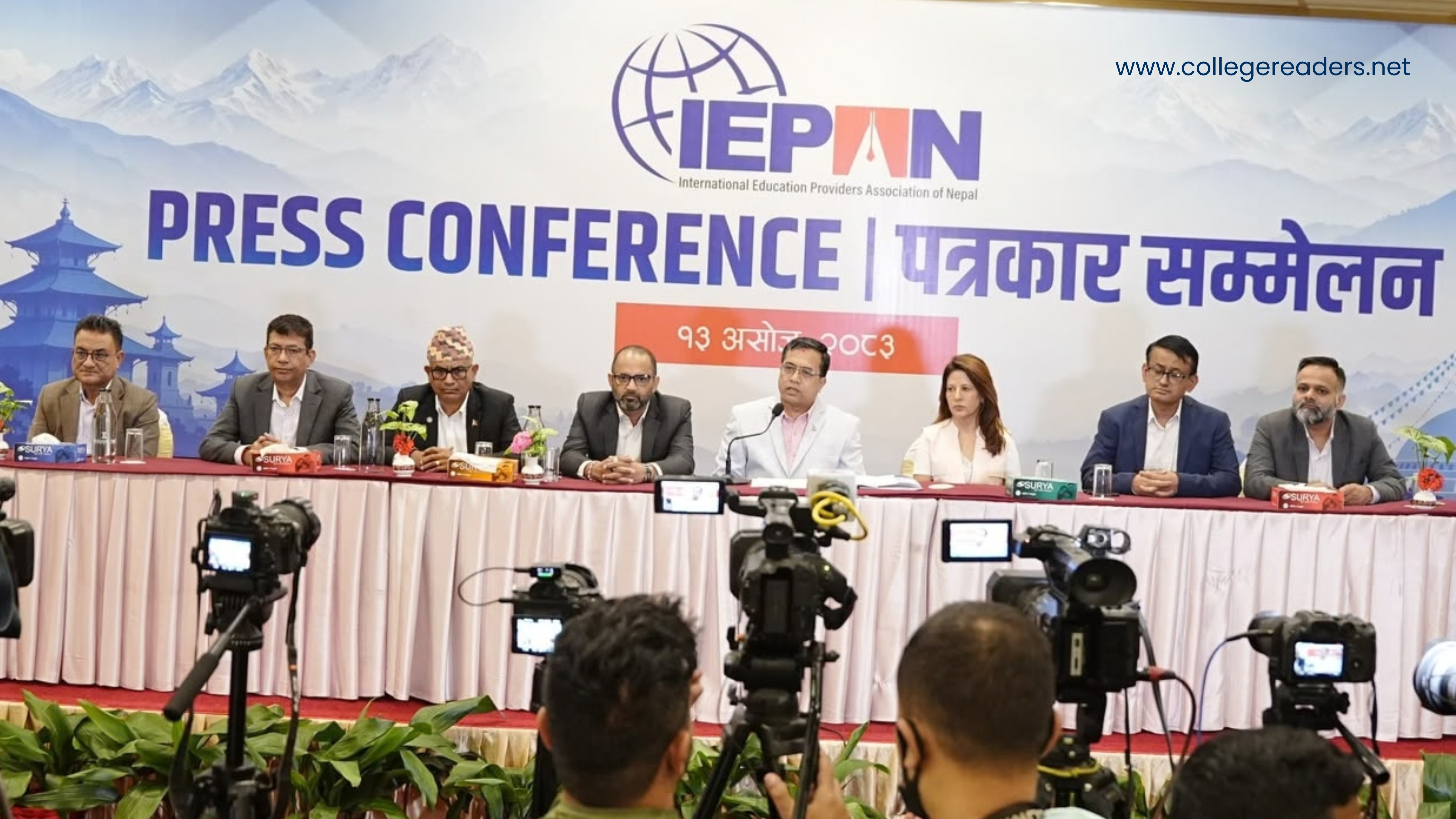
KATHMANDU. The International Education Providers Association of Nepal (IPAN) has stated that public debates regarding educational programs operated in Nepal through affiliation with foreign universities must be based on facts, law, and evidence. The association urged that any evaluation questioning an institution's legitimacy or the quality of education should draw conclusions based on existing legal provisions, institutional and program approvals, university accreditation, degree credibility, international recognition, academic reputation, and the opportunities and acceptance provided by the job market to graduates.
Demand for Evidence-Based Debate: IPAN insists that public discussion on foreign-affiliated educational programs must be rooted in law, accreditation, and employment outcomes rather than baseless claims.
Speaking at a press conference, IPAN President Laxman KC stated that claims suggesting programs operating with the approval of the Ministry of Education could be arbitrarily closed without a legal basis are incorrect. He informed that the "Foreign Educational Programs (Operation and Regulation) Directives, 2083," issued under Section 19 of the Education Act, 2028, provides for the operation and regulation of such programs.
According to KC, programs affiliated with 35 foreign universities across seven countries are currently operating in Nepal. A total of 37,208 students are enrolled across 58 institutions approved to run these programs. IPAN claims that the sector has generated approximately 5,000 direct and 15,000 indirect jobs, with an investment of around NPR 25 billion. Furthermore, IPAN noted that the sector contributes approximately NPR 500 million in direct taxes and over NPR 1 billion in indirect tax revenues annually, generating economic activity worth NPR 15 to 20 billion.
Significant Economic & Educational Impact: 58 approved institutions affiliated with 35 foreign universities across 7 countries educate 37,208 students, contributing ~NPR 25B in investment, generating 20,000 direct/indirect jobs, and keeping up to NPR 60B in foreign exchange within the country annually.
KC highlighted that pursuing an international degree within Nepal allows students to remain with their families, saving on overseas living and daily expenses. IPAN claims that the total cost of studying in Nepal can be up to 15 times less than pursuing the same degree abroad. The association estimates that this helps reduce potential foreign exchange outflows by roughly NPR 50 to 60 billion annually, though it clarified that this does not imply all students going abroad would have otherwise enrolled in domestic programs.
"Recently, we have played a major role in producing IT talent," KC stated. "Colleges in Nepal affiliated with foreign universities are the trendsetters in Nepal's IT education."
Citing a study by IIDS, KC noted that Nepal exported approximately USD 515 million (around NPR 68 billion) in IT services in 2022, a figure estimated to approach nearly USD 1 billion (around NPR 145 billion) by 2025. He attributed this growth to the initiatives of recent Nepali IT graduates, IT companies, freelancers, and the private sector.
KC added that colleges affiliated with foreign universities pioneered the teaching of AI-related courses such as AI & Machine Learning and Big Data Analytics, cybersecurity courses like Cybersecurity and Network Security, as well as fields such as Hotel & Hospitality Management, Interior Design, Entrepreneurship, and Multimedia & Animation within Nepal.
He explained that offering these subjects domestically has helped produce skilled human resources tailored to global market demands while gradually reducing the need for students to make large investments to study abroad. Highlighting the pull toward foreign education, KC informed that 112,593 students in FY 2080/81 and 123,589 students in FY 2081/82 acquired No Objection Certificates (NOCs) for abroad studies. According to IPAN's presentation, NPR 124.95 billion and NPR 138.48 billion flowed out of the country for educational purposes during those respective years. KC emphasized that to curb youth brain drain, the country must strengthen employment and entrepreneurial ecosystems while delivering quality, competitive, and world-class higher education locally.
The Nepal Education Institution Survey 2081, conducted by the National Statistics Office, also underscored the substantial contribution of non-governmental educational institutions. Covering FY 2080/81, the survey recorded 466,805 students pursuing higher education in these institutions, with a total gross value addition of approximately NPR 160 billion and a workforce of 311,516 people. (These figures reflect non-governmental educational institutions as a whole, rather than the isolated contribution of the 58 foreign-affiliated institutions).
Pioneers in IT & Emerging Sectors: Foreign-affiliated colleges pioneered programs in AI, Cybersecurity, Multimedia, and Hospitality in Nepal, directly driving the nation's rising $1B IT service export economy.
Addressing quality concerns, KC explained that affiliated colleges and branch campuses of foreign universities represent distinct models in terms of ownership and management. Emphasizing that neither model should automatically be deemed superior or inferior, he urged evaluating each program based on curriculum, faculty qualifications, infrastructure, assessment methods, and student learning outcomes. He added that affiliating universities set the curriculum and academic standards while continuously monitoring partner colleges.
KC also mentioned that the Ministry of Education conducts on-site inspections through expert teams. Under the new regulations, affiliated institutions are required to initiate Quality Assurance and Accreditation (QAA) processes within three years. Royalties and fees payable to foreign universities are remitted through banking channels following ministry approval and recommendation, with complete details submitted back to the ministry. IPAN welcomed regulatory oversight and investigation should there be evidence of irregularities in any institution.
KC advised against comparing short-term training courses in artificial intelligence or cybersecurity to full academic degrees, urging observers to form opinions only after reviewing program duration, credit hours, curriculum design, and evaluation methodologies. He noted that student assessments encompass research projects, presentations, and coursework alongside formal written examinations.
Finally, KC shared IPAN's vision of positioning Nepal as a destination for international students in the future. To achieve this, he urged the government to establish clear frameworks regarding institutional evaluation, student visas, and essential support services for international students. He also called for publishing an updated list of approved institutions and programs, clarifying quality assessment criteria, and ensuring an effective grievance redressal mechanism for students.

Popular Categories
Trending This Month












 Established in 2065 BS, COLLEGE READERS is a premier national-level educational magazine dedicated to serving the academic and informational needs of school and university students, teachers, educators, and concerned ones in Nepal. The magazine provides current and comprehensive information on various educational opportunities worldwide, aiming to guide school and college-level students in their academic and career journeys. It also highlights essential support services and service providers that play a crucial role in shaping students' career paths in today's competitive world.

- Our Location Putalisadak, Kathmandu
- Send Us Email collegereaders123@gmail.com
- Call Us Now 977 01 4518759
