
Call now
977 01 4518759
Send Message
collegereaders123@gmail.com
Our Location
Putalisadak, Kathmandu
Experts Call for Review of Hydropower Design and Safety Standards Amid Growing Himalayan Flood Risks
- College Readers
- 02 Sep 2026
- Views
- Events
Kathmandu, September 1, 2026 — Experts and stakeholders have called for a comprehensive review of the design and safety standards of hydropower projects in Nepal in response to emerging risks in the Himalayan region.
They have stressed the need for real-time monitoring of glaciers, glacial lakes and high-altitude areas, along with river-basin-level risk assessments and effective early warning systems.
Experts believe the recent flooding in the Bhotekoshi River may not have been caused by a glacial lake outburst flood (GLOF), but rather by a glacial flood triggered by the melting of a large mass of ice and snow that fell in a high Himalayan area.
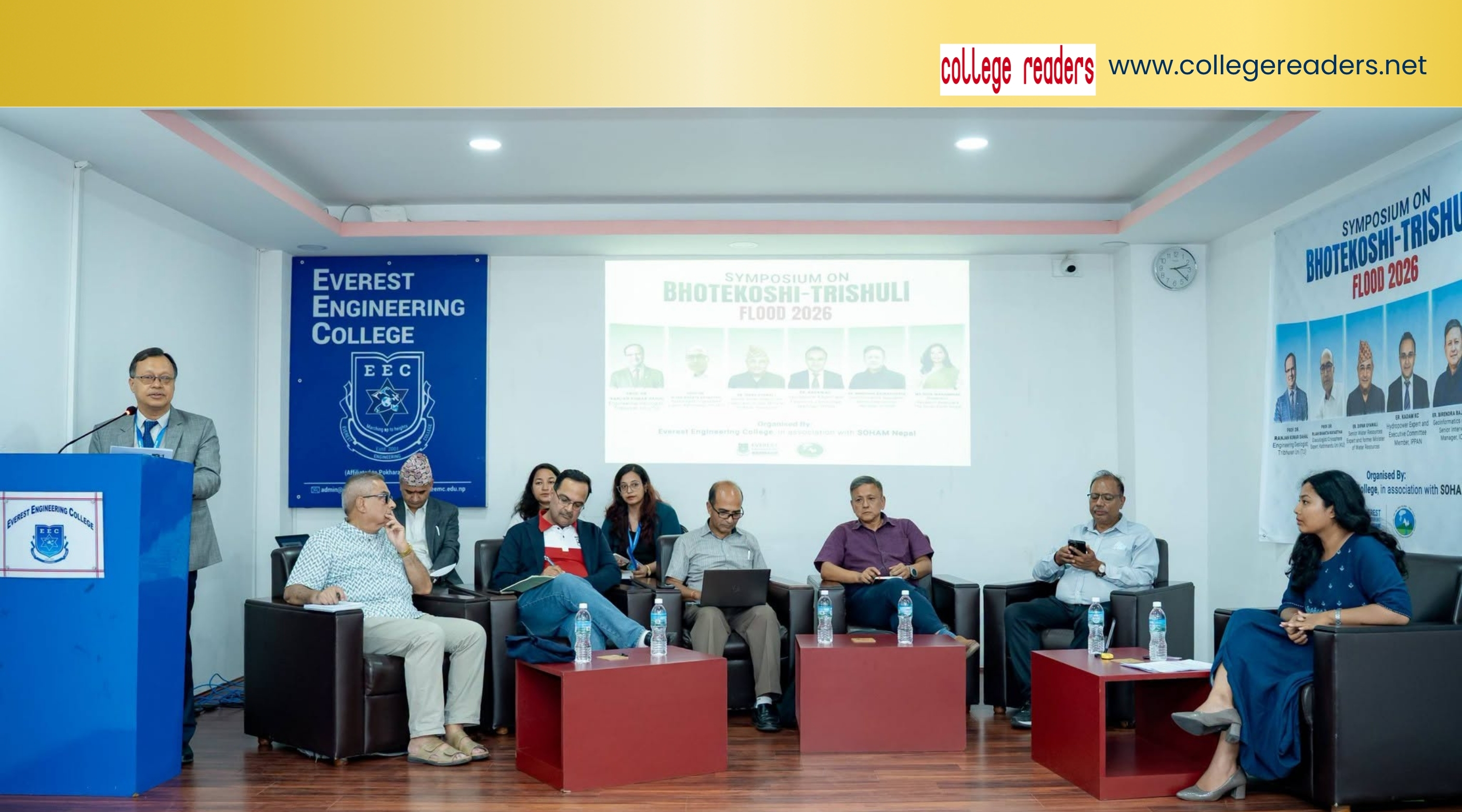
At a programme on the Bhotekoshi–Trishuli flood organized by the Society of Hydrologists and Meteorologists–Nepal at Everest Engineering College, participants discussed the nature and intensity of the flood and the extent of the damage. They emphasized that the incident demonstrated the need to strengthen continuous monitoring, early warning mechanisms and risk-sensitive infrastructure planning in Nepal's mountainous regions.
Need for Continuous Monitoring
Glaciologist Rijan Bhakta Kayastha of Kathmandu University said a large mass of ice reportedly fell from an elevation of around 5,200 metres and had melted by the time it reached approximately 3,800 metres. When the resulting water reached around 2,900 metres, it merged with the river, generating a massive flow that subsequently caused flooding at high speed in the Rasuwa area, located at around 1,700 metres elevation.
According to Kayastha, Nepal has approximately 2,354 glacial lakes and hundreds of glaciers, making effective early warning systems along river systems essential.
He said monitoring should not be limited to glacial lakes but should also cover glaciers and high-altitude areas where sudden ice- and snow-related events can occur.
“The tendency to settle in areas where rivers have demonstrated their flow path has still not disappeared,” Kayastha said.
He acknowledged that designing infrastructure capable of withstanding extremely large floods is challenging, but argued that design standards must nevertheless be revised by taking emerging risks into account.
Recalling a similar flood in Rasuwa last year, Kayastha said flooding had occurred then from an elevation of around 2,900 metres. Since glacier- and glacial-lake-related disasters are not necessarily confined to the monsoon season, he recommended beginning surveillance and preparedness activities in vulnerable areas before the onset of the monsoon.
.jpg.jpeg)
Real-Time Observation and Cross-Border Risk
Geologist Ranjan Kumar Dahal described the latest incident as an environmental catastrophic event. While acknowledging a connection with climate change, he cautioned against viewing such disasters solely through the lens of climate change.
Dahal said Nepal had begun considering risks originating from the Chinese side and the need for transboundary information-sharing following last year's incident. Although there are foundations for cooperation between Nepal and China, he said such cooperation has not yet been effectively translated into action at the diplomatic level.
He called for Nepal to move toward a real-time observation system and suggested establishing a dedicated mechanism or committee to coordinate monitoring, information-sharing and risk management.
He also urged Nepal to present evidence-based claims at international forums regarding the increasing risks associated with climate change.
“Instead of relying on traditional approaches, we need to clearly present our position with data and evidence,” he said, emphasizing the need to prepare scientific documentation and engage with the international community.
Dahal said that although databases of vulnerable glaciers and high-risk areas have been developed, Nepal's limited resources make it impossible to monitor every area equally. Therefore, high-risk locations should receive priority.
Hydropower Designs Must Reflect New Risks
Dahal also called for hydropower project designs to be modified in line with emerging risks.
He said hydropower projects are generally designed using relatively conservative assumptions while also taking construction costs into consideration. However, he argued that risk should receive much greater priority during the design process.
According to him, incorporating realistic disaster risks into project designs could significantly reduce potential damage.
Satellites Alone Cannot Solve the Problem
Birendra Bajracharya of the International Centre for Integrated Mountain Development (ICIMOD) said satellite technology could play an important role in monitoring disasters in the Himalayan region, but warned that investment in technology alone would not solve the problem.
He noted that direct satellite observation can be difficult during the monsoon because clouds often cover mountainous areas. Conducting field studies in high-altitude locations also presents major logistical challenges.
Rather than investing heavily in new satellites to continuously monitor Nepal's thousands of glaciers, Bajracharya suggested focusing on how to make more effective use of data already available from international satellite systems.
Risk-Sensitive Infrastructure Needed
Former Water Resources Minister Deepak Gyawali said Nepal cannot solve climate-related problems on its own while global carbon emissions continue to rise. However, because Nepal is already experiencing the impacts, he stressed the need to develop risk-sensitive infrastructure.
He called for a rethink of the practice of constructing settlements and roads immediately alongside rivers.
“Even if roads become more expensive, they should be constructed through relatively safer locations,” Gyawali said.
He emphasized that many such disasters are closely linked to natural processes and that Nepal should not focus only on relief and rescue after disasters occur.
“Instead of concentrating only on relief and rescue after a disaster, we need long-term planning and preparedness.”
Gyawali also raised concerns about the concentration of investment in hydropower and the associated risks to Nepal's insurance sector. He noted that more than 40 percent of the investment of Nepal's insurance companies is concentrated in the hydropower sector, meaning a major natural disaster could potentially create significant risks for the insurance industry itself.
.jpg.jpeg)
Shift Toward Storage and Pumped-Storage Projects
Gyawali argued that Nepal should move beyond an overreliance on run-of-river hydropower projects and increase investment in reservoir-based and pumped-storage hydropower projects.
He said Nepal's energy economy would not achieve its expected benefits if the country continued importing electricity from India at relatively high prices while selling domestically generated electricity at lower prices.
Emergency Evacuation Routes and Risk-Based Insurance
Civil engineer and hydropower expert Taranath Sapkota said the recent event demonstrated the need to reconsider the design and safety standards of hydropower projects.
He stressed the importance of constructing evacuation tunnels so workers can be safely evacuated during emergencies.
Even where powerhouses must be constructed above ground, Sapkota said project designs should include alternative routes through tunnels leading to safer locations.
He noted that many hydropower projects are still being developed according to conventional design standards, despite the emergence of new types of hazards in the Himalayan region.
Sapkota also pointed to limitations in existing insurance arrangements. Insurance policies may not cover every type of risk or damage, while exclusion clauses can leave certain risks uninsured. He therefore called for insurance provisions to be revised to reflect actual and emerging risks.
Traditionally, hydropower projects have often been designed using flood data based on an event expected to occur within a 100-year return period. However, Sapkota warned that increasingly unusual and extreme events in the Himalayan region could make such historical assumptions insufficient.
A New Approach to Himalayan Risk Management
The experts agreed that Nepal needs to move from a largely reactive disaster-management approach toward continuous monitoring, data-driven risk assessment, early warning systems, risk-sensitive infrastructure design, emergency preparedness and stronger transboundary cooperation.
With climate and high-altitude hazards becoming increasingly complex, they emphasized that Nepal's hydropower development must adapt to a new risk environment rather than relying solely on traditional engineering assumptions.

Popular Categories
Trending This Month











 Established in 2065 BS, COLLEGE READERS is a premier national-level educational magazine dedicated to serving the academic and informational needs of school and university students, teachers, educators, and concerned ones in Nepal. The magazine provides current and comprehensive information on various educational opportunities worldwide, aiming to guide school and college-level students in their academic and career journeys. It also highlights essential support services and service providers that play a crucial role in shaping students' career paths in today's competitive world.

- Our Location Putalisadak, Kathmandu
- Send Us Email collegereaders123@gmail.com
- Call Us Now 977 01 4518759
