
Call now
977 01 4518759
Send Message
collegereaders123@gmail.com
Our Location
Putalisadak, Kathmandu
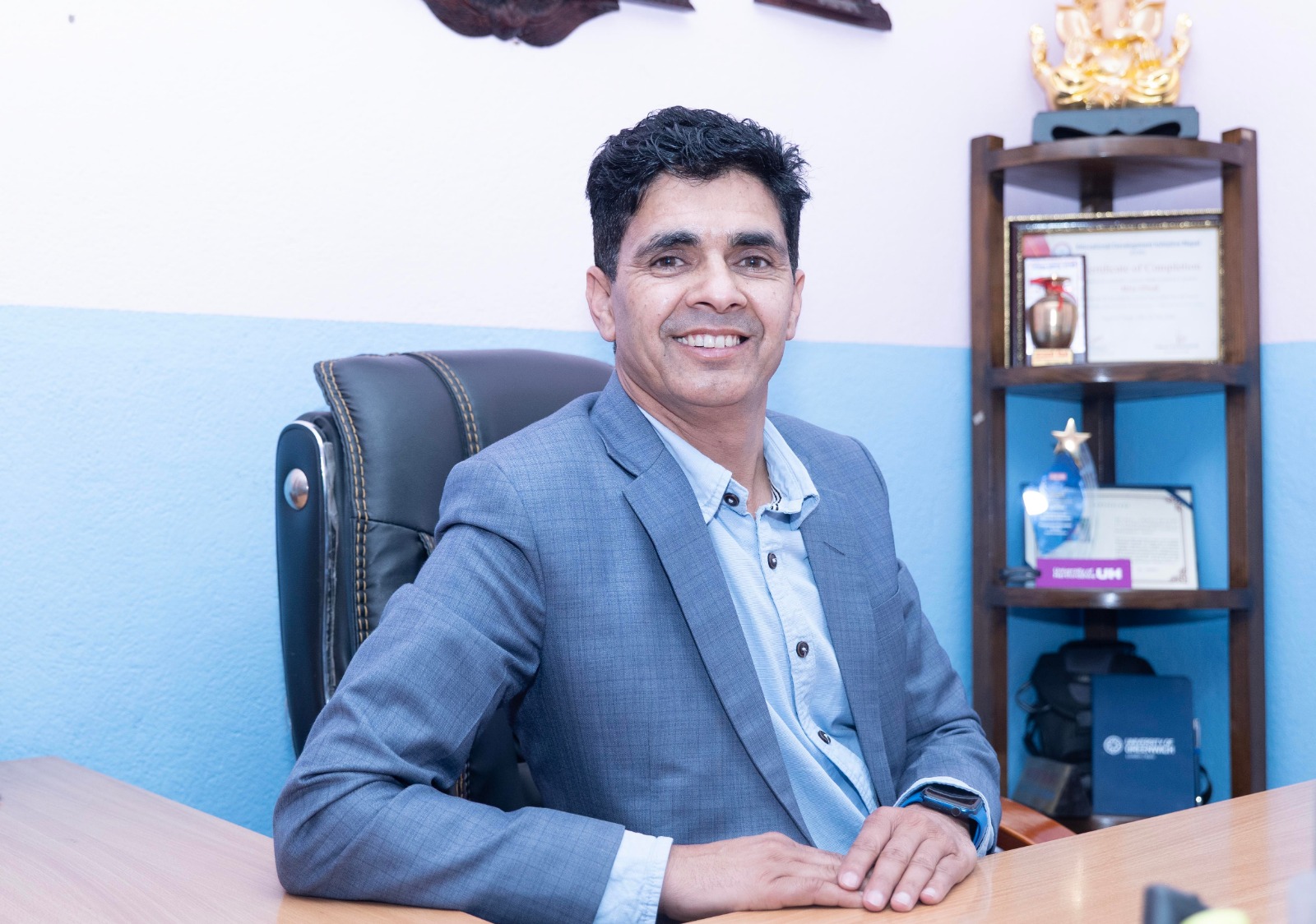
Bishnu Parajuli
Principal
Progressive Secondary School, BOD Vinayak Siddha College, Vice President N-PABSAN
Education Must Evolve with the Times, but Keep Its Heritages
- College Readers
- 30 Mar 2026
- Views
- News
Bishnu Parajuli has spent decades in Nepal’s education sector as a teacher, school leader, and educational stakeholder. He serves as the Principal of Progressive Secondary School, sits on the Board of Directors at Vinayak Siddha College, and is also the Vice President of N-PABSAN. With more than two decades of leadership at Progressive Secondary School, Parajuli has closely observed the changing realities of school education in Nepal. In this conversation with College Readers, he reflects on policy uncertainty, the need for time-relevant education, the role of private schools, the importance of parental partnership, and the urgent need to blend traditional values with modern skills.
As Vice President of N-PABSAN, how do you see the role of private schools, especially regarding scholarship and sustainability?
Private schools are businesses, and we should say that clearly. But unlike many other businesses, education carries a greater social responsibility. That is why scholarships matter. The state introduced the idea of ten percent scholarships so that children from poor, Dalit, Janajati, marginalized, and conflict-affected backgrounds could access private education. Most schools have provided that, and in some cases even more than the required percentage.
The issue now is not whether scholarships should be given, but how fairly and systematically they are monitored and continued. If a student receives support at school level, then there should also be a clear policy about whether that support continues at higher levels or not.
On the issue of sustainability, private schools have played a major role in Nepal’s educational transformation. They helped reduce the earlier trend of sending children to India and other places even for school education. They have also contributed to employment, tax revenue, and the broader economy. More importantly, they helped keep children within family and community structures during the school years. That contribution should not be forgotten.
At the same time, private schools must operate within state rules and policies. We believe in that. The state must create a policy environment where community schools improve and private schools also survive meaningfully. Education policy should be a win-win framework for the whole country.
Is quality now one of the central challenges for private schools? Are private and boarding schools delivering education suited to the present time?
Yes, quality is absolutely central. A school is connected not only to students but also to the family and the community. We believe that for a child to become capable, the parents are just as responsible as the school. The home is the first school. Values come from home; education is then structured by the school.
However, a growing problem is that some parents expect schools to do everything—teach values, behavior, eating habits, speaking habits, and academics all at once. That expectation is not realistic. Quality education means producing a good citizen—someone who can stand on their own feet, live responsibly, and contribute meaningfully to society.
Private schools are trying. Many are run by highly educated people with strong commitment. Many have invested in training and in improving standards. But there are also practical difficulties: shortage of skilled manpower, declining parental capacity to pay, and limits in implementing all the programs schools envision. So while many are striving to offer high-quality and even internationally oriented education, we have not yet reached the level we ideally should.
How does Progressive Secondary School ensure quality teaching and learning in the classroom?
At Progressive, we believe learning is lifelong and must be connected both to the modern world and to our own heritage. Nepal itself is a learning ground—our geography, our culture, our civilization, our environment, even nature itself teaches us. The challenge is how to bring these broader dimensions meaningfully into the classroom.
We try to blend traditional learning with modern education. We teach language, culture, and civilization in practical ways, while also bringing science, technology, research, and communication into classroom learning. We focus on helping children speak confidently, think critically, and research independently. Our aim is not only to make students academically successful, but also capable, self-assured, and adaptable wherever they go in the world.
Because of our long experience, I believe Progressive has been able to do this in a somewhat distinctive way.
Parents’ expectations, students’ expectations, and what teachers are able to deliver are often not the same. How do you balance these?
Today’s children are very smart. They have many sources of learning beyond the classroom. In comparison, teachers belong to an older system, and parents are often even further removed from the pace of change. Yet parental expectations are very high. They want their children to achieve a lot, but the guidance system around the child is not always strong enough.
So we try to include parents more closely in school activities, train teachers according to the changing world, and help students understand the demands of the present time, their own community, and their possible future. Balance comes when all three—school, parents, and students—work together. This is no longer the time for blame, punishment, or rigid traditional methods. Now it is a time for collaboration.
What initiatives is Progressive taking to make learning more enjoyable, effective, and student-centered?
The first thing is that teachers themselves must keep moving. If teachers move forward, students move forward. In today’s world, change is so fast that new realities emerge almost overnight. So teachers must receive regular, time-relevant training and engage in research-based practice.
We also believe that education should not be limited to certificates. If a student is talented in music, we should promote that. If a student is strong in sports, we should support that alongside academics. I personally feel that Nepal has many opportunities in agriculture, livestock, tourism, and practical fields that could be introduced much earlier in education. Urban children are often disconnected from real life. They may know packaged products, but not where things actually come from. That kind of learning gap must be addressed.
So our thinking is increasingly toward a broader, more practical, and more student-centered education—one that values both modern skills and real-life competence.
Finally, what message would you like to give to parents?
Parents must understand that their role is foundational. Children often carry the dreams, anxieties, and ambitions of their parents. Many students going abroad are not doing so only because they want to, but also because of parental pressures, social trends, and the lack of time-relevant opportunities here.
So my request to parents is this: teach values at home. Help children understand family, culture, and responsibility. Reduce the unhealthy obsession with going abroad as the only path to success. Support schools positively, not only critically. Cooperation between parents and schools is essential.
If parents become more conscious, more involved, and more supportive, then schools can do far more. In the end, building capable and responsible young people is a shared task—and our experience tells us that when parents and schools truly cooperate, children thrive.
Popular Categories
Trending This Month








 Established in 2065 BS, COLLEGE READERS is a premier national-level educational magazine dedicated to serving the academic and informational needs of school and university students, teachers, educators, and concerned ones in Nepal. The magazine provides current and comprehensive information on various educational opportunities worldwide, aiming to guide school and college-level students in their academic and career journeys. It also highlights essential support services and service providers that play a crucial role in shaping students' career paths in today's competitive world.

- Our Location Putalisadak, Kathmandu
- Send Us Email collegereaders123@gmail.com
- Call Us Now 977 01 4518759
