
Call now
977 01 4518759
Send Message
collegereaders123@gmail.com
Our Location
Putalisadak, Kathmandu
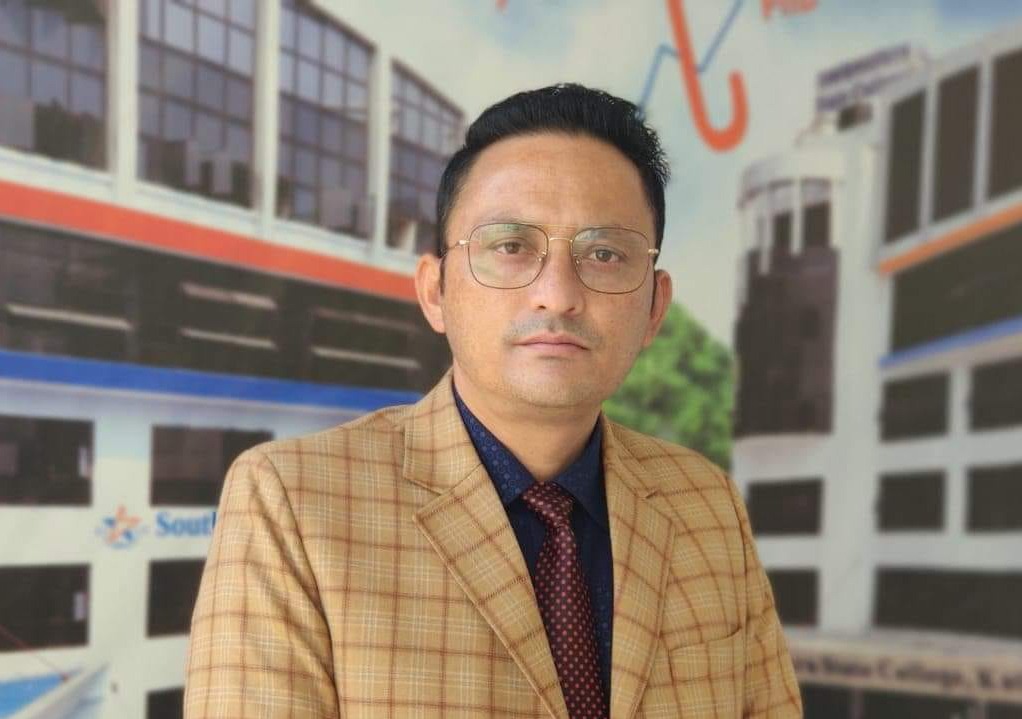
Dr. Ramesh Adhikari
Principal
Southwestern School
Digital Learning and Parents Power Whole-Child Education
- College Readers
- 30 Mar 2026
- Views
- Interviews
Dr. Ramesh Adhikari, Principal of Southwestern School, has spent more than twenty-six years in Nepal’s education sector. Originally from Dhading and currently based in Tarkeshwar, Kathmandu, he has long been engaged in educational leadership and school development. In this conversation with College Readers, he shares his views on the changing nature of education, the challenges facing children and schools today, the importance of curriculum and academic supervision, and the shared responsibility of parents, teachers, and school leaders in shaping the future of students.
As Principal of Southwestern School, how do you ensure quality and consistency in classroom teaching and learning?
Dr. Ramesh Adhikari:
At our school, we believe education should be progressive and holistic. Today, everyone talks about progressive education, but it must be reflected in actual practice. We study educational practices from both national and international contexts, conduct research, and apply what is useful for our students.
For example, Southwestern introduced “No Book Day” as early as 2076 B.S. The purpose was to encourage learning beyond textbooks. We believe children learn through play, exploration, outdoor activity, research, and presentation. Activities such as hiking, followed by student presentations, help children connect learning with experience.
Our focus is always on the psychology and interests of the child. If a school understands what interests a child and teaches in a way that matches child psychology, overall development becomes possible. Once the child develops in an all-round way, it creates positivity for parents, confidence for the school, and strength for the student. Quality in education is not only about classroom delivery; it is about how meaningfully learning connects with the child’s growth.
What role should a school leader play in curriculum planning and academic supervision?
Dr. Ramesh Adhikari:
Curriculum is one of the most important aspects of education. In Nepal today, we speak of both national and international curricula, but the real question is: which curriculum is suitable for our students, at our level, in our context? That requires deep study.
At Southwestern, we do not adopt books or curricular materials because of personal relationships with publishers, writers, or stakeholders. We follow a process. Subject heads first evaluate and recommend materials. Then the management team discusses them, and finally the top management team reviews them rigorously before anything is implemented.
The same principle applies to lesson planning and academic supervision. Some schools prepare yearly plans, some monthly, and some daily. What matters most is that planning should be meaningful, discussed seriously, and implemented consistently. A school leader must ensure that curriculum selection, lesson planning, and academic monitoring are all aligned. Strong academic results come from strong processes.
How do you manage coordination among parents, students, and staff, especially when conflict arises?
Dr. Ramesh Adhikari:
This is one of the most difficult and most important areas of school leadership today. The relationship among parents, students, and teachers must function like a triangle. If one side weakens, the whole structure becomes unstable.
Today, many children are not fully under the supervision of their parents. Many parents themselves say they cannot control their children’s mobile phone use and expect the school to do it. At the same time, schools are expected to provide discipline, values, emotional balance, and academic excellence. That is not realistic unless families remain actively involved.
A child’s values begin at home. That is why it is often said that the home is the first school and parents are the foremost teachers. When issues arise, we address them according to need. If the issue concerns the child, we sit with the child. If it concerns parents, we sit with parents. If it concerns teachers, we sit with teachers. This triangular relationship is essential, but I must say that managing it has become more challenging day by day.
In this age of digitalized education, how does Southwestern School define ideal learning?
Dr. Ramesh Adhikari:
Every school says it is good, but ideal learning must be demonstrated through practice. At Southwestern, we define ideal learning as a balance between academic excellence, innovation, skill development, and child-centered teaching.
We have consistently delivered strong SEE results, but we do not define success only through examination scores. We have introduced various digital and activity-based teaching-learning methods, including student presentations, project-based work, and classroom participation models such as “be a teacher in class.” We also seek regular feedback from parents and reflect on that seriously.
In addition, we are working to strengthen international dimensions in learning. We have introduced programs such as Cambridge Assessment English and the Early Genius curriculum at the junior level, and Cambridge curriculum components from Grades 1 to 7. These efforts reflect our belief that children in the twenty-first century need reading, writing, speaking, and listening skills, along with confidence and inner competency. Ideal learning is not only about passing exams. It is about preparing children for life.
Finally, what message would you like to give to parents?
Dr. Ramesh Adhikari:
My message to parents is simple but very important: paying fees is not enough. Parents are not just handing over a child to a school; they are handing over a future. A school can teach many things, but it cannot replace parental time, parental supervision, and parental values.
School years are a sensitive stage in life. Especially for children in the middle and secondary years, parents must remain attentive. Children need guidance, monitoring, emotional presence, and conversations about values and behavior. If parents give time to their children, supervise them with care, and support them at home, schools can do their part more effectively.
I would also encourage parents to choose schools carefully. Do not look only at reputation. Look at the curriculum, the teaching team, the school’s vision, and its management. Private education must offer something meaningful and different. At the same time, parents should remember that not every child will be the same. Some are naturally high achievers, and some are average. Even average children can go very far in life if they develop confidence, character, and the right skills.
Most importantly, parents must invest in the child—not only financially, but with time, attention, and determination. That is the real foundation of a child’s future.
Popular Categories
Trending This Month








 Established in 2065 BS, COLLEGE READERS is a premier national-level educational magazine dedicated to serving the academic and informational needs of school and university students, teachers, educators, and concerned ones in Nepal. The magazine provides current and comprehensive information on various educational opportunities worldwide, aiming to guide school and college-level students in their academic and career journeys. It also highlights essential support services and service providers that play a crucial role in shaping students' career paths in today's competitive world.

- Our Location Putalisadak, Kathmandu
- Send Us Email collegereaders123@gmail.com
- Call Us Now 977 01 4518759
