
Call now
977 01 4518759
Send Message
collegereaders123@gmail.com
Our Location
Putalisadak, Kathmandu
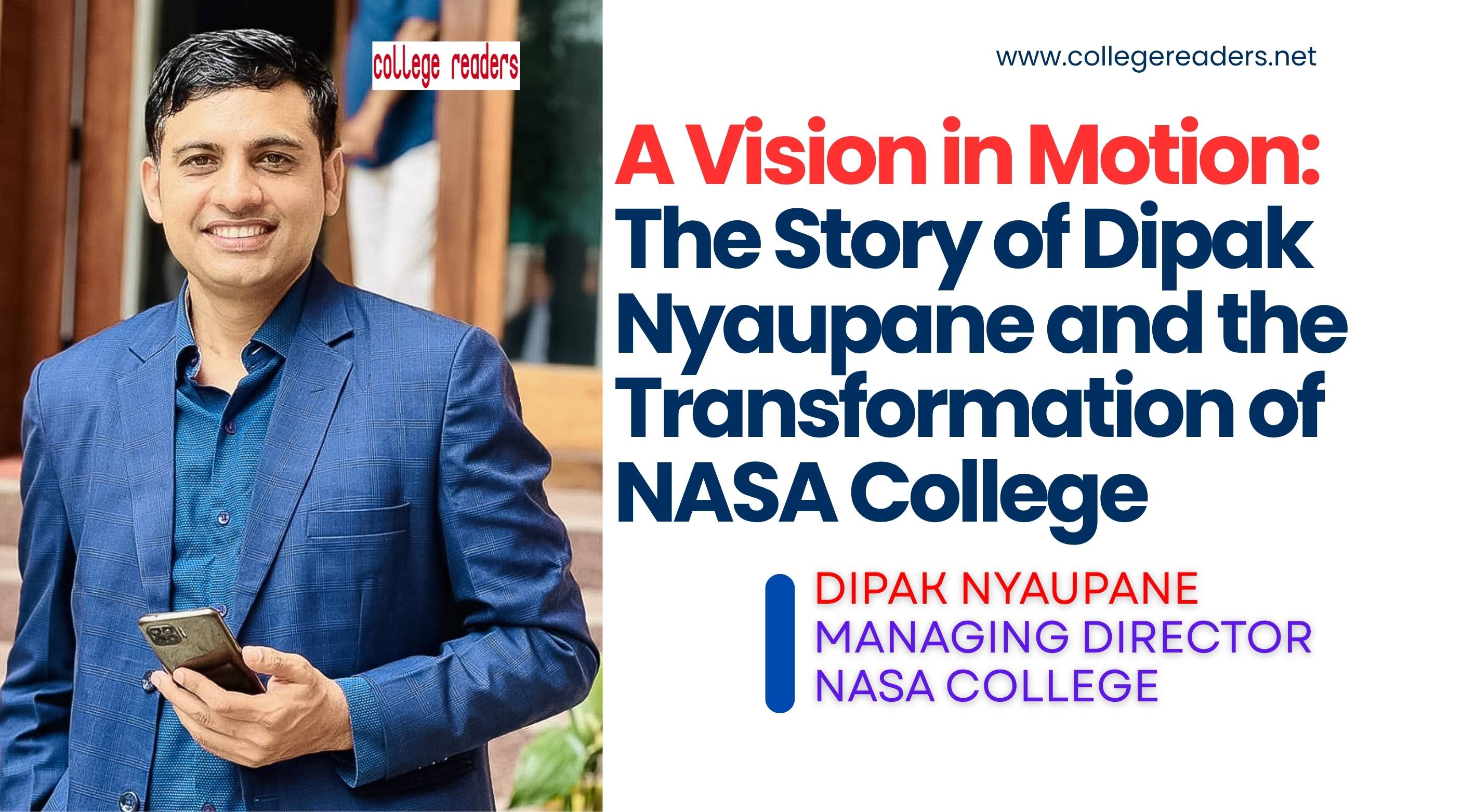
A Vision in Motion: The Story of Dipak Nyaupane and the Transformation of NASA College
- College Readers
- 17 May 2026
- Views
- Op-ed , Interviews
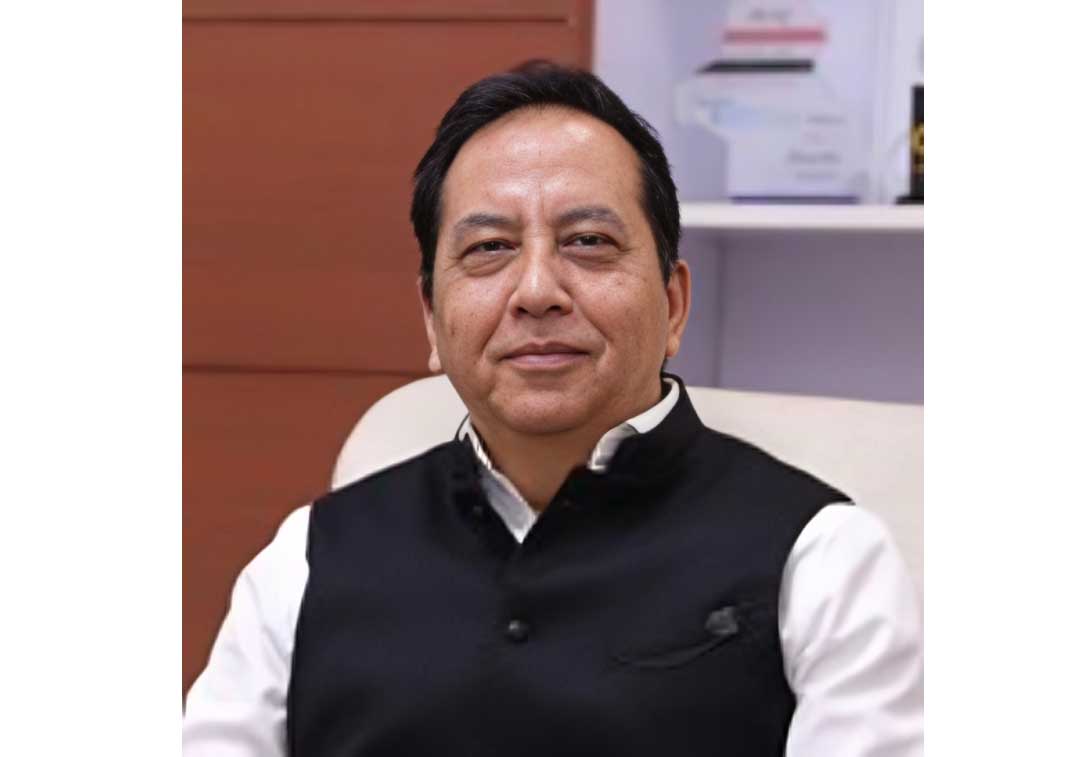
In the dynamic landscape of Nepal’s education sector, where many leaders come and go, a few individuals leave a lasting imprint through the depth of their vision and the conviction of their work. Dipak Nyaupane, the Managing Director of NASA College, stands among these distinctive personalities—energetic, forward-looking, and grounded in purpose. Born in the hills of Gulmi and now based in Dhapasi, Kathmandu, Nyaupane’s identity stretches well beyond that of a college administrator. He is at once a skilled manager, a passionate educationist, and a sensitive guardian of every student’s future entrusted to his institution.
Nyaupane’s commitment to education was never an accident of circumstance. From a young age, he carried a quiet but firm desire to contribute something innovative to the service sector—and within that, education called to him most strongly. Encouragement from a small circle of close friends combined with his own inner conviction to push him into the field. He began his professional journey as Managing Director at Platinum Management College and Times College, learning the realities of institutional management from the ground up. Those early roles gave him both confidence and a clear sense of direction.
A particularly meaningful chapter of his early journey was the privilege of working alongside his own teachers and mentors. When senior educators turned to him and said, “Dipak, let us work together, let us build an institution,” the proposal energised him in ways that no salary or title could. His emotional bond with western Nepal, particularly Gulmi, and his understanding of the educational needs of Kathmandu, gave him a dual perspective. He took the time to sharpen his managerial skills, treating them as his principal weapon, and entered the industry with both feet firmly on the ground.
The early years brought significant challenges, particularly because of his age. Established senior figures were hesitant to place their trust in someone they considered too young to lead. “In the beginning, because I was a little young, seniors didn’t seem to trust me; they acted as though they already knew everything,” he recalls candidly. Nyaupane refused to absorb that scepticism as discouragement. Instead, he extracted the most valuable lesson from those interactions—observing closely what to do and what not to do—and quietly built that learning into his own professional conduct.
In his view, every institution faces two kinds of obstacles—internal and external. Although external pressures often appear more visible, his early days demanded more energy on the internal side: coordinating with colleagues who held divergent ideas and competing interests. Known for being clear-headed and straightforward, Nyaupane learned to manage these tensions with patience and tact rather than confrontation. He gradually built the kind of professional credibility that no shortcut can produce. That credibility, earned slowly and protected carefully, eventually allowed him to step into the role of Managing Director at NASA College with confidence, full institutional backing, and a quiet sense of authority earned the right way.
What distinguishes Nyaupane’s approach at NASA is his refusal to claim authority without first earning understanding. He did not assume the helm directly. For nearly the first two years, he chose instead to immerse himself in the finance and administrative departments, observing how money flowed, how systems creaked, and how routine problems hid beneath polished surfaces. That bottom-to-top apprenticeship gave him a granular, almost forensic grasp of the institution. By the time he took the reins of leadership, he knew every micro-problem and the practical levers needed to address each one in granular detail.
For Nyaupane, the single most important ingredient of a successful educational institution is teamwork. Academic quality alone, he argues, is not enough. The real strength of a college lies in the seamless blend of its academic and non-academic teams—teachers and administrators working as one. “If an organisation is to move forward, these two teams must come together with excellent harmony,” he often says. It is a deceptively simple philosophy, but one that informs every appointment, every department restructure, and every cultural decision he has made at NASA since stepping into his role.
Today, Nyaupane’s full attention is focused on a clear two-year roadmap to transform NASA College into a model educational destination in Nepal. The first pillar is a progressive educational approach. Working in close consultation with expert professors from Kathmandu University, he is moving NASA away from traditional pedagogy toward a more modern, application-oriented system of teaching. The second pillar is a deliberately student-friendly culture. If a student approaches the college with a new or creative idea, the institution responds with appreciation and active support, not bureaucratic resistance—a posture rare in Nepali higher education.
Nyaupane has placed a firm commitment that no talented student will see their education halted because of financial difficulty; affordability is treated not as a marketing slogan but as a working principle. The third pillar is infrastructure. Smart boards now equip every classroom at NASA, but Nyaupane is clear that technology alone is not enough. He has carved out separate, quiet study spaces beyond the classroom—with WiFi and the resources students need to learn at their own pace. The combined effect is an environment carefully built for the way today’s students actually study and engage.
Underlying all of this is a deeply held conviction about leadership itself. “A leader must change with the times and operate within the laws of the country,” Nyaupane often reminds his team. But the most important question, he insists, remains the human one: what do the children want, and what kind of quality person do we want them to become? His commitment extends past graduation. Students who pass through NASA are promised continuing guidance and support long after they leave its gates. For every SEE graduate searching for a future, his message is direct: NASA offers quality education at affordable fees, and an environment designed for personal development. With his clear vision, honest effort, and unwavering responsibility toward students, Nyaupane’s journey proves a simple truth—willpower and teamwork can turn any challenge into opportunity.

Popular Categories
Trending This Month








 Established in 2065 BS, COLLEGE READERS is a premier national-level educational magazine dedicated to serving the academic and informational needs of school and university students, teachers, educators, and concerned ones in Nepal. The magazine provides current and comprehensive information on various educational opportunities worldwide, aiming to guide school and college-level students in their academic and career journeys. It also highlights essential support services and service providers that play a crucial role in shaping students' career paths in today's competitive world.

- Our Location Putalisadak, Kathmandu
- Send Us Email collegereaders123@gmail.com
- Call Us Now 977 01 4518759
