
Call now
977 01 4518759
Send Message
collegereaders123@gmail.com
Our Location
Putalisadak, Kathmandu

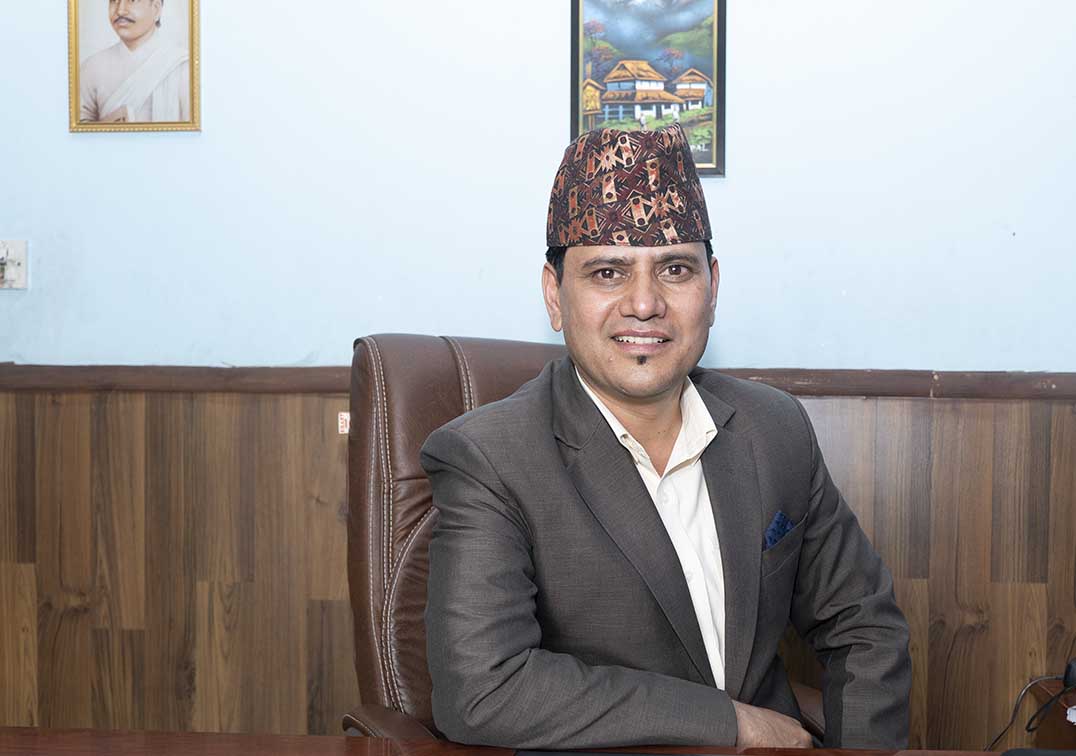
Dhan Bahadur Pun
Principal
Angel Heart Secondary School and Vice President of PABSON Kathmandu
A Child’s Growth is Rooted in the Home and Guided by the School
- College Readers
- 26 Mar 2026
- Views
- Interviews
Dhan Bahadur Pun, Principal of Angel Heart Secondary School and Vice President of PABSON Kathmandu District, has long been involved in Nepal’s institutional education sector. In this conversation with College Readers, he reflects on his journey into education, the challenges facing school leaders today, the need for Nepal-suited policies, the importance of balancing technology with reading culture, and the shared responsibility of schools and parents in shaping students’ futures.
College Readers: As a school leader, what major challenges do you see in today’s changing educational environment?
Dhan Bahadur Pun:
One of the biggest challenges is that Nepal still lacks the full implementation of an education policy truly suited to Nepal. Too often, policies are copied from other countries without enough research into our own social and national realities. Because of that, the results are not always healthy.
We are producing students who may be educated in the formal sense, but many do not develop respect for parents, teachers, the nation, or social responsibility. Many learn to demand rights, but not always to understand duties. Education should create respectful, responsible, and grounded human beings.
Another challenge is what happens after Grade 12. Many students do not see enough possibility in remaining in Nepal. So the question is not only how to educate them, but also how to create confidence that their future can be built here. That is a cultural and national challenge as much as it is an educational one.
College Readers: What role should a school leader play in curriculum planning and academic supervision to maintain quality?
Dhan Bahadur Pun:
The curriculum itself is not the main problem. In many ways, the present curriculum is good. The real issue is implementation. If institutional schools are contributing to the nation and paying taxes, then they should also receive stronger orientation and training from curriculum experts and state bodies such as the CDC.
Right now, the curriculum is on one side, the students are on another, and the teachers are somewhere else. Students are changing quickly; they are dynamic and curious. The curriculum is trying to become modern and inclusive, but the expected output has not fully appeared. One major reason is the lack of sufficient teacher preparation.
A school leader must therefore focus strongly on teacher development. Regular training, academic supervision, and professional support are essential. A curriculum succeeds only when teachers understand it deeply and can turn it into meaningful classroom practice.
College Readers: How does Angel Heart Secondary School ensure quality in classroom teaching and learning?
Dhan Bahadur Pun:
At Angel Heart, our motto is “Be Good, Do Good.” For us, quality education begins with understanding the child. I often say that a child is like a book; before we teach, we must first learn to read that child. Every student has different strengths, interests, and needs. So we first understand the child and then build lesson planning and support around that.
We also believe that while the curriculum provides a certificate, extra activities help shape life. That is why we place strong importance on ECA and CCA. When students are given platforms according to their abilities, they become happy, confident, and more engaged in learning.
We have introduced smart boards from Grades 1 to 12 while also keeping whiteboards for practical classroom work. We have introduced Cambridge Assessment English from Grade 1 and are also running classes in AI, coding, and robotics. Quality today means combining academics with relevant future skills.
College Readers: Many people worry that technology is weakening students’ creativity and reading habits. How do you address that concern?

Dhan Bahadur Pun:
That concern is real. Reading habits are declining, and many children are becoming too dependent on screens. So we have taken deliberate steps to strengthen reading culture. Apart from the regular curriculum, we run literature classes. In each class, students read two Nepali books and two English books over the year. They then do book reviews, discussions, exhibitions, and even publication activities.
The goal is to help students understand that knowledge does not exist only in textbooks or only inside the classroom. It exists in the wider world as well.
At the same time, we are not against technology. We give equal importance to IT and reading. The challenge is balance. If we focus only on digital exposure, reading will suffer. So we consciously build a culture where technology and literature support each other, and where creativity is developed through reading, discussion, reflection, and expression.
College Readers: What role do parents, students, and teachers play in maintaining educational quality?
Dhan Bahadur Pun:
Parents have a very large role—larger than many people realize. In my view, about seventy percent of a child’s development depends on parents, and thirty percent on the school. Parents who give time to their children, try to understand them, and stay involved in their growth usually have children who do very well.
If parents think that paying school fees means the school will do everything, that is not realistic. That is why we organize motivation and orientation sessions for parents and also train teachers on how to guide parents better.
Values, behavior, discipline, and honesty begin at home. If schools must teach everything that should have been taught at home, then the fuller development of the child becomes more difficult. Schools and families must work together.
College Readers: Finally, what message would you like to give to parents?
Dhan Bahadur Pun:
My humble request is this: if your child has a problem, do not immediately label the child as the problem. First understand why the issue has arisen. Then come to the school, discuss it, and work toward a solution together. If a child is not interested in studies, not participating in ECA or CCA, or not adjusting well, those are signs that need understanding, not blame.
Changing schools without understanding the root problem often makes things worse. A child’s future is shaped by the combined effort of parents, teachers, and the school. If parents and schools work together honestly, children can become confident, capable, and responsible human beings.
Popular Categories
Trending This Month








 Established in 2065 BS, COLLEGE READERS is a premier national-level educational magazine dedicated to serving the academic and informational needs of school and university students, teachers, educators, and concerned ones in Nepal. The magazine provides current and comprehensive information on various educational opportunities worldwide, aiming to guide school and college-level students in their academic and career journeys. It also highlights essential support services and service providers that play a crucial role in shaping students' career paths in today's competitive world.

- Our Location Putalisadak, Kathmandu
- Send Us Email collegereaders123@gmail.com
- Call Us Now 977 01 4518759
