
Call now
977 01 4518759
Send Message
collegereaders123@gmail.com
Our Location
Putalisadak, Kathmandu
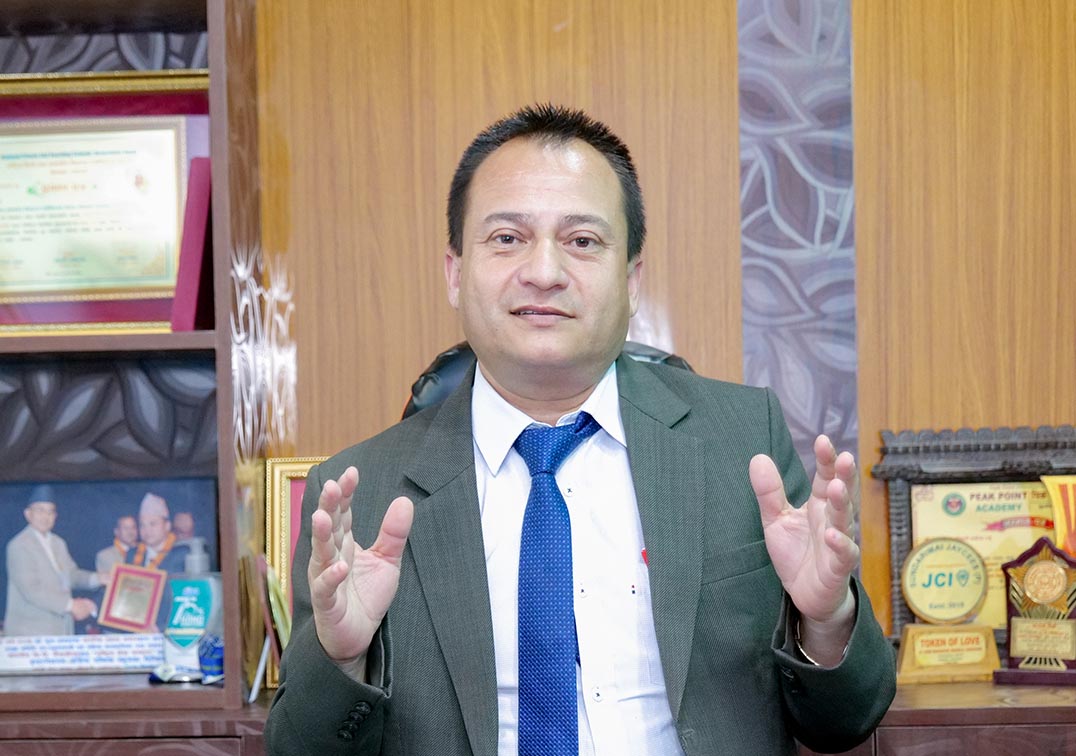
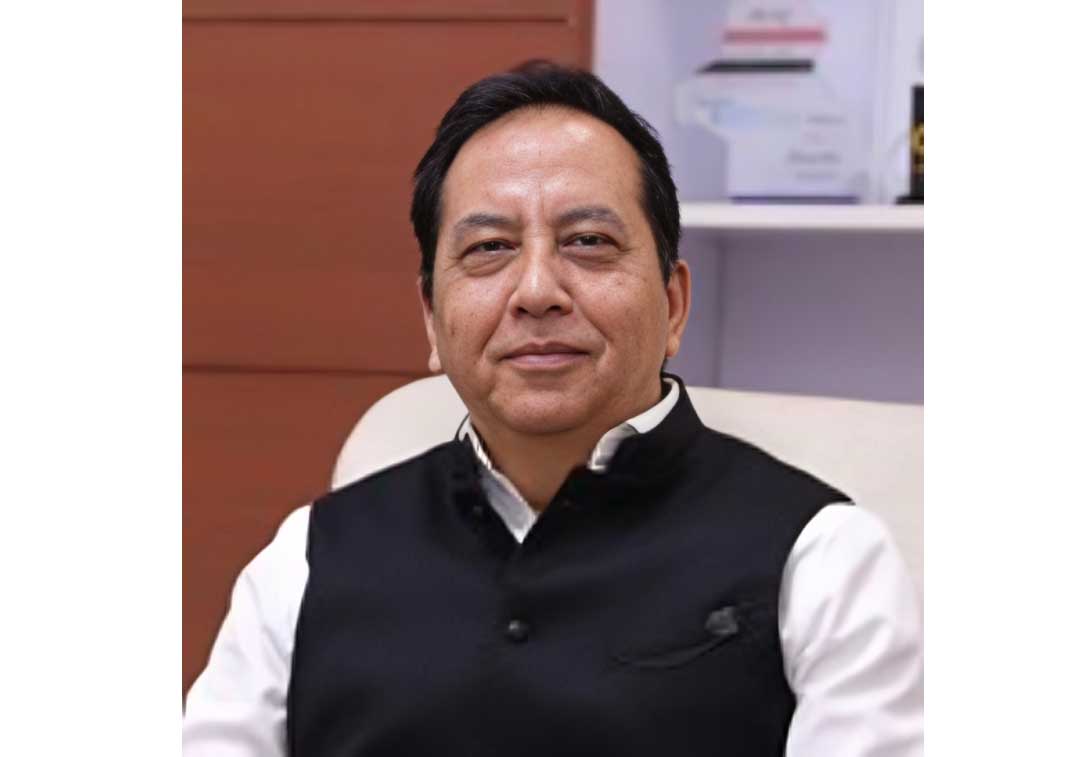
Hom Bahadur Adhikari
Principal
International Joseph Public School
Shift from Rote Classrooms to Hubs of Inquiry Redefine Student-Centred Learning
- College Readers
- 01 Apr 2026
- Views
- Interviews
In the dynamic sphere of Nepali education, few individuals attract comparable recognition for combining institutional leadership with active involvement in educational advocacy as Hom Bahadur Adhikari (Manoj). He currently serves as the President of National PABSAN Kathmandu District, alongside his responsibilities as Principal of International Joseph Public School and Vice Principal of Joseph Higher Secondary School/College.
Known for his assertive outlook and firm conviction in the transformative role of education, Adhikari has devoted many years to strengthening academic standards within his institutions while pushing for a more forward-looking national curriculum. Under his direction, the Joseph Educational Network has built a reputation for discipline and consistent academic performance, including repeated records of 100% success rates in national examinations.
In this exclusive interview for College Readers, he discusses his perspective on 21st-century education, the practical challenges of managing modern schools, and his outlook on the future prospects of Nepal’s younger generation.
As an experienced school leader and the President of National PABSAN Kathmandu, what do you identify as the most pressing challenges in today’s rapidly changing educational environment?
We are currently living through a paradigm shift in how knowledge is consumed and imparted. The most immediate challenge is the sheer pace of technological advancement. Integrating AI, digital literacy, and hybrid learning models isn’t just an "extra" anymore; it is a necessity that requires significant infrastructure and mindset shifts.
Beyond technology, we face the challenge of meeting increasingly diverse student needs. Today’s learners are global citizens; they have access to the world via their screens, which means our academic standards must remain world-class to keep them engaged. Furthermore, ensuring continuous professional development for our teachers is vital. A school is only as good as its faculty, and in a changing world, teachers must transition from being "lecturers" to "facilitators." Balancing these shifts while maintaining the core values of discipline and ethics is the tightrope every modern principal must walk.
Consistency is often the hallmark of a great institution. How do you ensure that the quality of teaching remains uniform across all classrooms in your schools?
Quality cannot be left to chance; it must be engineered through robust systems. At International Joseph Public School, we view teaching as an evolving craft. We ensure consistency through a multi-layered approach. First, we implement standardized lesson planning, where learning objectives are clearly defined and aligned across the board.
However, plans on paper are only effective if executed well. Therefore, I personally oversee regular classroom observations and peer-mentoring sessions. We don't use these as "inspections," but rather as opportunities for growth. This is supported by a rigorous feedback mechanism where data from student performance and parent interactions help us identify gaps. By providing continuous training workshops, we ensure that every teacher, whether a veteran or a newcomer, is equipped with the same high-level pedagogical tools.
You are deeply involved in the "engine room" of education. What specific role do you play in curriculum planning and academic supervision?
My role is to bridge the gap between the national curriculum requirements and the practical needs of the 21st-century job market. I actively participate in curriculum design, ensuring that while we meet the Government of Nepal’s standards, we also infuse our syllabus with "pragmatic education."
In terms of supervision, I act as the chief academic auditor. I oversee the effective implementation of the curriculum through constant monitoring and evaluation. It’s about asking: "Are the students merely memorizing, or are they mastering the concept?" I provide direct support to our department heads to ensure that the curriculum remains a living, breathing document that evolves with the students' interests and global trends.
Conflict resolution is an inevitable part of school leadership. How do you approach disagreements among students, parents, and staff?
Education is a human-centric "industry," and where there are people, there will be differing perspectives. My philosophy is rooted in fairness and transparency. Whether it is a grievance from a parent or a professional disagreement among staff, the first step is always active listening.
I believe in identifying the root cause rather than just treating the symptoms. By facilitating a constructive, face-to-face dialogue in a neutral environment, we find solutions that prioritize the student's well-being above all else. In my experience, most conflicts arise from a lack of communication. Once you open a transparent channel, reaching a "mutually acceptable solution" becomes a much smoother process.
In your view, what defines an "ideal learning environment" for a student in this century?
An ideal environment today must be student-centered and inclusive. It is a space where a child feels safe to fail, because failure is the first step toward innovation. In the 21st century, the physical classroom must be a "hub of inquiry" rather than a room for rote learning.
It must be technology-integrated, but more importantly, it must foster the "4 Cs": Critical thinking, Creativity, Collaboration, and Communication. We want to move away from the "cog in the machine" model. An ideal environment is one that nurtures the individual's unique talents—whether in science, management, or the arts—while instilling a sense of social responsibility and global citizenship.
Your school has earned a reputation for being quite progressive. What specific initiatives have you introduced to make learning more engaging?
We have moved aggressively toward Activity-Based Learning (ABL). We believe that a child remembers 10% of what they read but 90% of what they do. To that end, we have integrated project-based assignments that require students to solve real-world problems.
Our digital transformation is another highlight. We use various digital tools and e-labs to make abstract concepts in Science and Math more tangible. Additionally, we place immense value on co-curricular programs. From sports and martial arts to music and public speaking, these are not "extra" activities; they are core to our mission of holistic development. We want our students to leave our halls not just with a high GPA, but with the confidence to lead in any field they choose.
Popular Categories
Trending This Month








 Established in 2065 BS, COLLEGE READERS is a premier national-level educational magazine dedicated to serving the academic and informational needs of school and university students, teachers, educators, and concerned ones in Nepal. The magazine provides current and comprehensive information on various educational opportunities worldwide, aiming to guide school and college-level students in their academic and career journeys. It also highlights essential support services and service providers that play a crucial role in shaping students' career paths in today's competitive world.

- Our Location Putalisadak, Kathmandu
- Send Us Email collegereaders123@gmail.com
- Call Us Now 977 01 4518759
