
Call now
977 01 4518759
Send Message
collegereaders123@gmail.com
Our Location
Putalisadak, Kathmandu
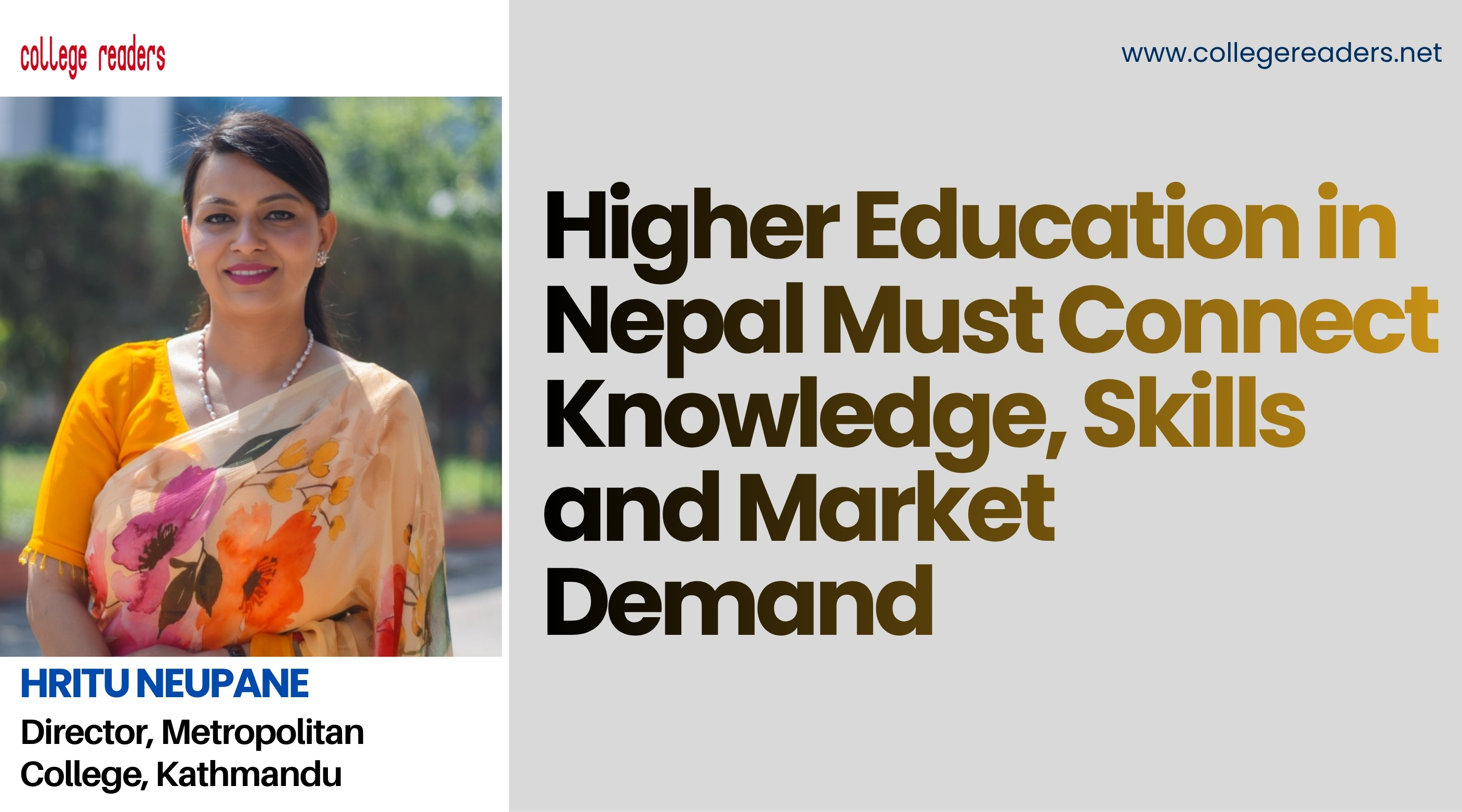
Higher Education in Nepal Must Connect Knowledge, Skills and Market Demand
- College Readers
- 08 Jul 2026
- Views
- Op-ed
One of the strongest debates today is whether students should complete at least their bachelor’s degree in Nepal before thinking of going abroad. I strongly believe this debate is necessary. Many young people leave the country after Plus Two not because they dislike Nepal, but because they see stronger returns abroad. When we spoke with students, many admitted that life abroad is difficult, but they felt that struggle there brings income, independence, and future security. In Nepal, they feared that even hard work might not produce the same outcome. This perception is painful, but it also tells us exactly where reform is needed.

Students do not migrate only for foreign degrees; they migrate for opportunity. If Nepal can create a system where students can study, gain skills, earn, and see a clear future, many of them will choose to stay. The idea of “learning while earning” must be understood seriously. Earning matters for today’s youth, but education must not be reduced to earning alone. A dangerous social narrative has grown around us: study only to get money. If that becomes the only purpose, then knowledge loses its meaning and education becomes merely a training course. Higher education must develop knowledge, skills, confidence, curiosity, and judgment together.
Our colleges and universities must become honest. For too long, many institutions have focused on degrees more than competence. Some students attend college without understanding why they are there. Some institutions run after enrolment numbers, promise job guarantees, and sometimes weaken academic seriousness through careless internal assessment. This harms both students and society. A degree without knowledge, and knowledge without skill, cannot build a meaningful future.
Students will remain in Nepal if higher education provides knowledge, skills, earning opportunities and future security.
The future of higher education lies in alignment: courses must be connected with industry, skills must be connected with knowledge, and students must be connected with real work experience. A student should not wait until graduation to understand the workplace. Internship, project-based learning, communication training, digital literacy, entrepreneurship exposure, and problem-solving practice should be part of the academic journey from the early semesters. If students gain such exposure, they will not have to depend only on job promises. The market itself will begin to recognize their value. Some will find employment, while others may become entrepreneurs and create opportunities.
Students also need to rethink subject selection. In Nepal, many young people still choose subjects by following trends rather than understanding their own interest and aptitude. After COVID, information technology became highly attractive, and many students began to believe that studying IT automatically means high income and a settled life. IT is important, but it is not the only future. We also need excellent teachers, counselors, economists, communicators, legal professionals, psychologists, researchers, and professionals in branches of health and management. The real question for every student should be: Where do my interest, ability, and future market demand meet?
The world is changing faster than our traditional academic habits. Artificial intelligence and advanced technologies are already reshaping the job market. Work once handled by many people can now be completed by a small team using technology. This does not mean students should fear AI; it means they must become more adaptable, analytical, and human-centered. Colleges should not simply say “IT is the future” or “management is the future.” They should ask what kind of IT, what kind of management, what kind of communication, and what kind of human skills will be needed in coming years.
Colleges must go beyond traditional syllabus and align academic programs with industry, technology and future market needs.
For example, a management graduate does not necessarily become a banker or business owner. A bank may need a communication officer who understands psychology and human behavior. A hospital may need administrators who understand technology and empathy. A company may need managers who can analyze data, lead people, and communicate with clarity. The future belongs not to narrow degrees but to blended competence. Therefore, colleges must go beyond the university-prescribed syllabus and add value through market-relevant skill modules.
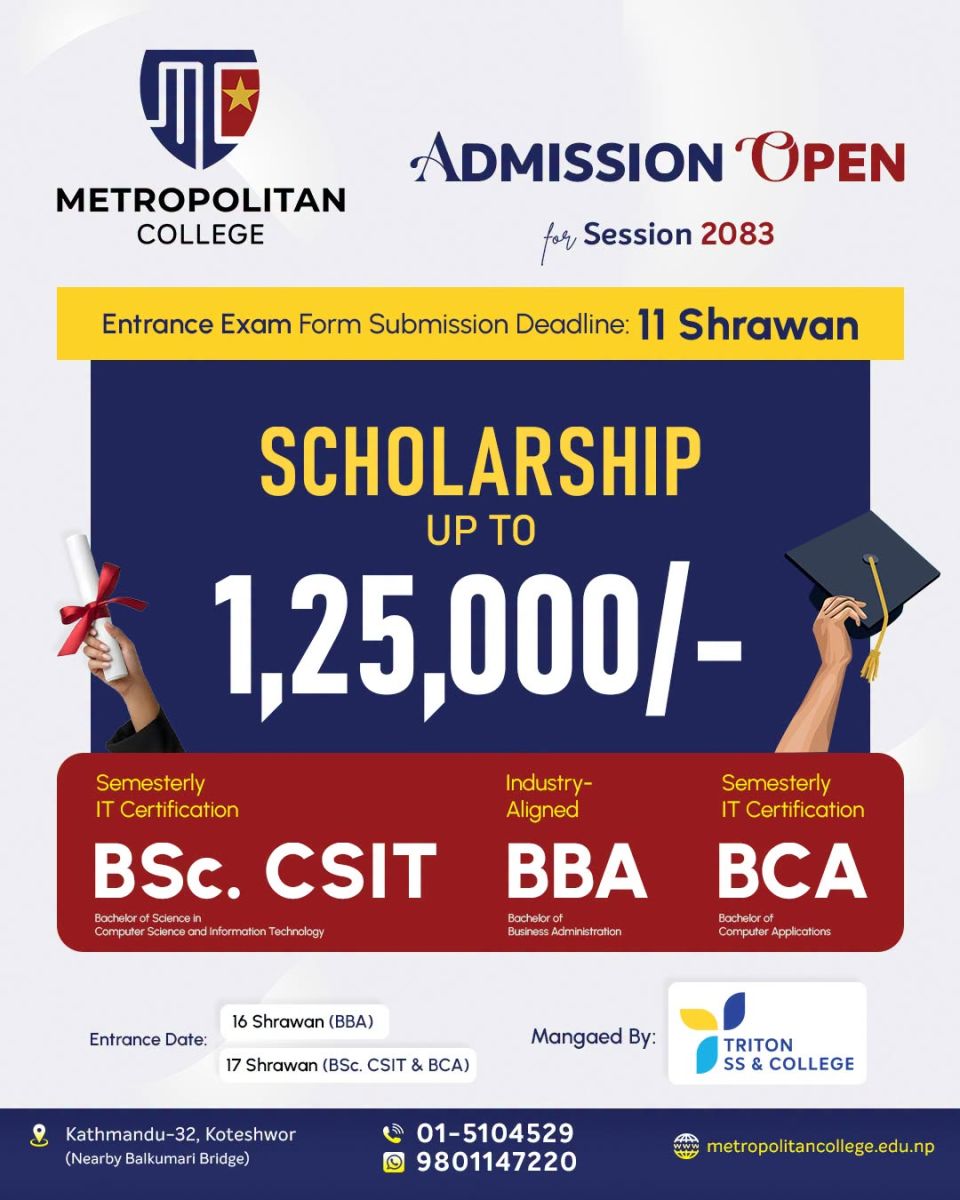
At Metropolitan College, our approach is built around this understanding. We offer BSc CSIT, BBA, BCA, and MBA programs, but we do not treat the syllabus as the entire education. We align our bachelor’s programs with industry needs and require students to learn eight different skills across eight semesters. Along with the regular curriculum, students complete additional courses of 30 to 70 hours, depending on the requirement. From the second semester, students who are ready can also be supported with internship or job placement opportunities. Before guiding them, we try to understand their interests and the field they want to enter.
We do not claim that we guarantee jobs. Instead, our belief is that if we prepare skilled, confident, knowledgeable, and adaptable graduates, the market will demand them. That requires investment, effort, and institutional commitment, but colleges should not hesitate to provide it. The responsibility of higher education is not merely to send students into the market; it is to prepare them so well that they can stand with dignity in any market.
I remain truly optimistic about Nepal’s higher education. The environment is becoming more positive, and there is hope among parents and students that meaningful change can happen in the coming years. But hope alone is not enough. Stability, honest reform, industry alignment, skilled manpower development, and student-centered academic culture must move together. If we sustain this positive momentum, Nepal can become a place where young people do not feel forced to leave after Plus Two, but feel confident to build their future at home.
Popular Categories
Trending This Month








 Established in 2065 BS, COLLEGE READERS is a premier national-level educational magazine dedicated to serving the academic and informational needs of school and university students, teachers, educators, and concerned ones in Nepal. The magazine provides current and comprehensive information on various educational opportunities worldwide, aiming to guide school and college-level students in their academic and career journeys. It also highlights essential support services and service providers that play a crucial role in shaping students' career paths in today's competitive world.

- Our Location Putalisadak, Kathmandu
- Send Us Email collegereaders123@gmail.com
- Call Us Now 977 01 4518759
