
Call now
977 01 4518759
Send Message
collegereaders123@gmail.com
Our Location
Putalisadak, Kathmandu
Education Bill Must Safeguard Both Public and Private Schools, Stakeholders Say
- College Readers
- 24 Aug 2026
- Views
- News
Kathmandu, August 23: Private-school operators and education stakeholders have called for the proposed Education Bill to ensure the long-term stability of both public and private schools while protecting educational investment and placing students’ interests at the centre of reform.
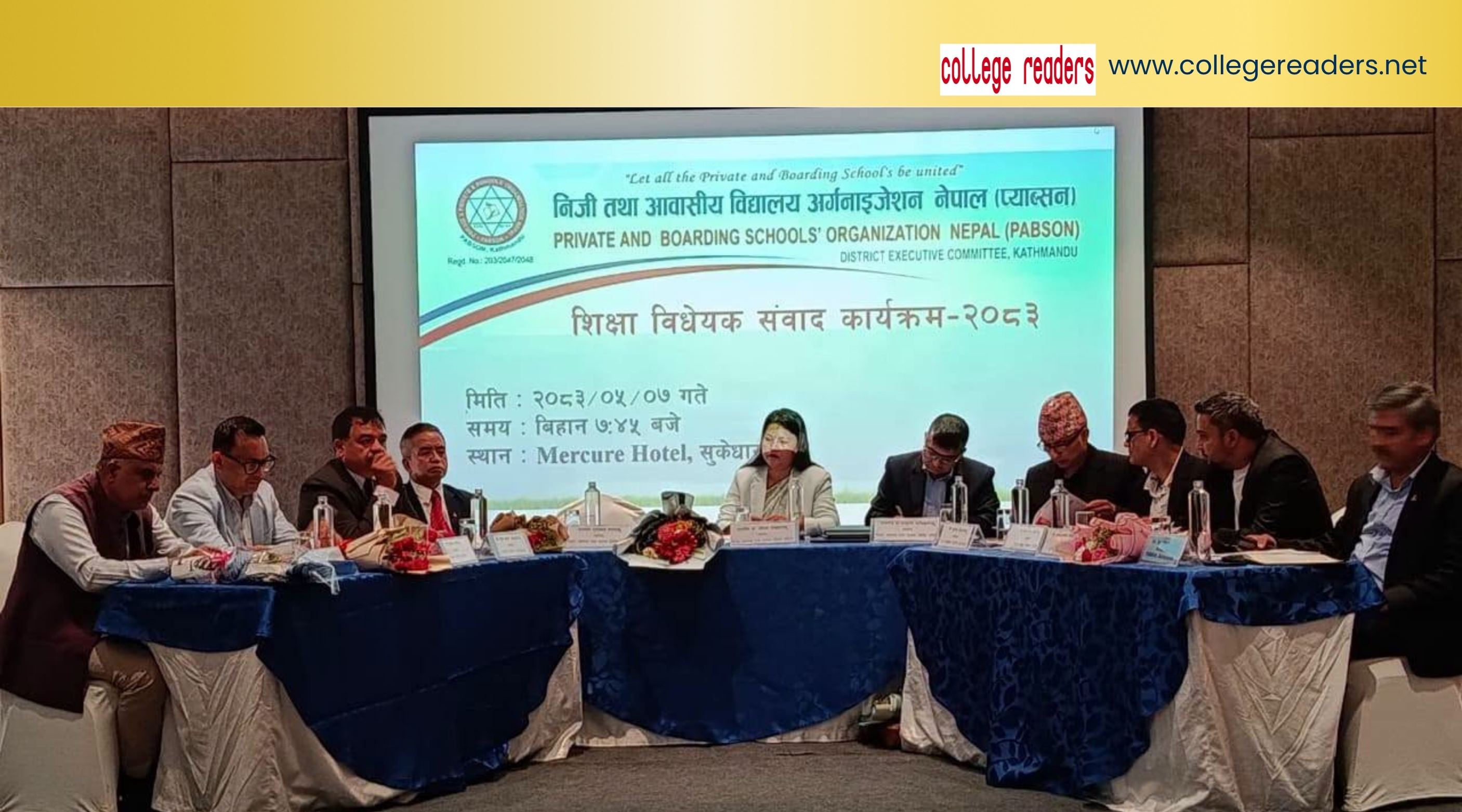
Speaking at the Education Bill Dialogue Programme–2083, organised by the Kathmandu District Committee of the Private and Boarding Schools’ Organization Nepal (PABSON), participants said the long-awaited legislation should address existing problems across Nepal’s education sector through clear, balanced and practical legal provisions.
The proposed Education Bill should protect investment, secure institutional stability and uphold the interests of students in both public and private schools.
PABSON Kathmandu President Nawaraj Bhatta said private schools account for approximately 25 percent of the country’s 35,991 schools. He added that around 38 per cent of students enrolled from Grades 1 to 12 study in private institutions.
Bhatta said private schools have contributed substantially to improving educational quality, generating employment and increasing government revenue. He urged the state to recognise and protect private investment in education.
According to him, private schools have helped reduce the outflow of capital by creating opportunities for students to receive quality education within Nepal instead of travelling abroad for their studies.
Welcoming the government’s reported preparations to pass the Education Bill in Bhadra, Bhatta said the legislation must incorporate the genuine concerns and practical difficulties of private schools. He stressed that the government should create a secure investment environment and adopt policies that encourage, rather than discourage, private participation in education.
PABSON Central President Krishna Prasad Adhikari said the bill should provide fair and dignified treatment to both public and private institutions.
He claimed that when one student studies at a private school, the government saves approximately Rs 57,000 in public expenditure. Similarly, the employment of one staff member in the private education sector could save the state resources amounting to as much as Rs 300,000.
“We are not merely placing demands before the government; we are seeking fair recognition,” Adhikari said. He added that the contribution of private schools to Nepal’s education system should be properly assessed and reflected in the new legislation.
Private schools educate a significant share of Nepal’s students, create employment and reduce the financial burden on the state.
Former Ministry of Education Joint Secretary and Spokesperson Deepak Sharma described private schools as major stakeholders in the national education system. He said the proposed bill must clearly define their responsibilities, rights and institutional status.
Sharma noted that uncertainty over whether private schools should operate as companies or be converted into trusts has created serious concern within the sector. He said the new legislation should settle the issue through an unambiguous legal provision.
He also pointed out that schools are currently affected by overlapping education laws and regulatory arrangements. Separate laws, regulations and operational guidelines concerning private schools should therefore be developed without delay, he added.
Higher Institutions and Secondary Schools’ Association Nepal (HISSAN) Central President Yubaraj Sharma said scholarships provided by private schools alone could not resolve the broader challenges facing Nepal’s education system.
He argued that the quality of public schools must also improve. At the same time, private investment in education should be treated with respect and protected through explicit provisions in the Education Bill.
Dr Achyutam Lamichhane, a member of the House of Representatives’ Education, Health and Information Technology Committee, said the bill would clearly address whether private schools should continue operating as companies or adopt a trust-based model.
He said committee members were holding discussions to formulate legislation capable of advancing the education sector in a fair and dignified manner.
Lamichhane also urged the government to avoid policies and programmes that discriminate between students attending public and private schools.
“The state should not act in a manner that creates discrimination in any area,” he said, emphasising the need for equal treatment of all students.
Stakeholders want the bill to clarify whether private schools will operate as companies or trusts and to guarantee equal treatment for every student.
House committee members Guru Prasad Bhandari and Dr Pramila Gachhadar attended the programme alongside PABSON Central President Krishna Prasad Adhikari, and HISSAN Central President Yubaraj Sharma.
Former PABSON adviser Bijay Sambamphe and Kathmandu District Education Coordination Chief Suresh Raj Joshi were also present. The programme brought together private-school operators, directors and principals from across Kathmandu.
PABSON Kathmandu Secretary Krishna Bhandari conducted the programme, while Senior Vice-President Sudarshan Thapa delivered the welcome address.
Thapa said Nepal has 10,421 institutional schools educating approximately 3.8 million students and employing more than 300,000 people. He added that investment in the private education sector exceeds Rs 600 billion, with a substantial amount spent regularly on teachers’ and employees’ salaries and benefits.
Given the scale of the sector’s investment, employment and educational responsibilities, Thapa said the government should introduce policies that support its responsible development.
Participants shared the view that the long-awaited Education Bill must clearly address the operational challenges facing private schools, protect educational investment, establish workable provisions for managing teachers and employees, and safeguard students’ interests. They concluded that lasting education reform would require a balanced legal framework that strengthens both public and private institutions.


Popular Categories
Trending This Month








 Established in 2065 BS, COLLEGE READERS is a premier national-level educational magazine dedicated to serving the academic and informational needs of school and university students, teachers, educators, and concerned ones in Nepal. The magazine provides current and comprehensive information on various educational opportunities worldwide, aiming to guide school and college-level students in their academic and career journeys. It also highlights essential support services and service providers that play a crucial role in shaping students' career paths in today's competitive world.

- Our Location Putalisadak, Kathmandu
- Send Us Email collegereaders123@gmail.com
- Call Us Now 977 01 4518759
