
Call now
977 01 4518759
Send Message
collegereaders123@gmail.com
Our Location
Putalisadak, Kathmandu
Dhangadhi’s School Revolution: The Mayor Who Refused to Compromise
- College Readers
- 17 Apr 2026
- Views
- News
Dhangadhi, Nepal — In 2022, the final results of the Grade 8 basic level examination exposed a deep crisis in public education in Dhangadhi Sub-Metropolitan City. Eighteen community schools recorded a zero pass rate. Not a single student from those schools passed.
The result shocked the entire city.
Schools had lost credibility, teachers were demoralized, parents were furious, and students even took to the streets demanding to be passed. Teachers surrounded the office of Mayor Gopal Hamal, pressuring the local government to add marks and push students through.
But Hamal refused.
“I neither checked the answer sheets nor set the questions,” he told teachers at the time. “All I said was that students should not be passed by artificially adding marks. This result shows the true state of teaching in our schools. It should not be covered up — it should be corrected.”
That decision, controversial at the time, became a turning point. What began as a public embarrassment has now evolved into what many are calling the “Dhangadhi Model” of educational reform.
A Crisis That Forced Accountability
Following the disastrous results, repeated meetings were held between the municipality and school teachers. The local government asked a difficult but necessary question: Why had the pass rate fallen to zero?
Teachers offered a range of explanations. Some blamed poverty and weak parental support, especially among Dalit and low-income families. Others pointed to teacher shortages, lack of classrooms, and inadequate furniture. Some cited flaws in government policy.
After listening to all sides, Mayor Hamal offered a challenge.
He told them that if the municipality addressed these structural problems, the teachers too would have to commit to improving classroom performance.
That mutual commitment laid the foundation for a formal reform process. Dhangadhi declared the year 2080 B.S. (2023/24) as the Year of Educational Reform, and from there, the city began restructuring its public education system with unusual urgency and focus.
Learning From Delhi, Building a Local Model
As reform discussions intensified, Hamal studied the school improvement agenda implemented in New Delhi under Arvind Kejriwal. Dhangadhi then sent a team to observe government school practices in Delhi and assess which strategies could be adapted locally.
The municipality later combined those findings with local needs and realities to shape what became the Dhangadhi Model — a homegrown framework for public school reform informed by outside learning but rooted in local conditions.
School Mergers and Better Resource Use
One of the first bold steps under the reform agenda was school consolidation.
In Shrawan 2080 B.S. (mid-2023), nine schools were merged. Schools with low enrollment, weak results, and close geographic proximity were integrated into larger institutions. For example, Shaileshwari Secondary School in Ward No. 2 was merged into Sharada Secondary School, while Navjyoti Secondary School in Ward No. 7 was merged into Shiva Secondary School.
The move helped ease the shortage of teachers and resources while improving the efficiency of public investment.
Fixing School Finances
According to Mayor Hamal, the municipality also introduced a new system to improve the financial condition of schools.
In the past, schools struggled to collect revenue from shutter rentals and advertising spaces. Hamal said that in some cases, school properties generated only Rs 2.5 to 3 million annually, but after the municipality stepped in to manage contracts transparently, the same assets began generating close to Rs 10 million.
Importantly, he said, the municipality does not keep any portion of that income; it goes directly into school accounts.
To improve transparency and reduce the risk of non-payment, Dhangadhi introduced a contract system backed by bank guarantees, helping schools increase revenue while reducing financial leakages.
Five Model Schools and Digital Learning
Dhangadhi has now selected five model schools, mainly in rural areas:
- Chandrodya Secondary School
- Behdadbaba Secondary School
- Siddhanath Secondary School
- Thekeraj Secondary School
- Bhawani Secondary School
These schools have undergone major upgrades. Traditional blackboards and whiteboards have been replaced by smart boards, and digital teaching methods are being introduced.
According to officials from the municipality’s education branch, schools are now using audio, video, and animation materials available through the Education and Human Resource Development Center portal. Work is also underway to install play stations and interactive learning tools for students.
From the next academic year, these model schools are expected to shift fully to English-medium instruction, in coordination with organizations such as Teach For Nepal and Kathmandu University.
Ending Ghost Attendance, Reforming Teacher Management
To ensure that teachers are physically present in classrooms, the municipality has made e-attendance mandatory. The system is monitored directly by the local government.
Officials say the days when teachers could draw salaries without regularly attending school are over. Attendance is now tracked centrally, and salary payments are tied to that attendance record.
The municipality has also removed teachers who were teaching without licenses, carried out staff realignment, and recruited new teachers through public advertisement to address shortages.
Experienced teachers have been appointed as mentor teachers to coach new recruits inside classrooms, while headteachers have received capacity-building training to strengthen school management and leadership.
The Mayor’s Personal Intervention
In a rare personal gesture, Mayor Hamal said he spent Rs 1 million from his own government salary and service benefits to distribute educational materials to students in schools that had produced zero results.
He said he realized that a lack of basic learning materials was one reason students were underperforming.
The municipality also moved to reduce visible forms of economic inequality within schools. Hamal recalled that some children were too poor to buy even a bowl and had to receive midday meals in their hands, creating a sense of humiliation and psychological division among students.
To address this, the city invested Rs 50,000 to distribute lunch containers so that all students could receive meals with dignity.
He added that around Rs 2 million in additional financial support had also been mobilized from various organizations for schools.
Results Begin to Show
The impact of these reforms is now becoming visible in exam data.
In the 2079 B.S. academic session, a total of 4,475 students appeared in the exam, but only 1,467 passed, resulting in an overall pass rate of 32.78 percent.
In 2080 B.S., the first year of the reform campaign, 5,891 students appeared and 3,028 passed, raising the pass rate to 51.40 percent.
In 2081 B.S., improvement continued. Out of 5,442 students, 3,351 passed, taking the pass rate to 61.58 percent.
By 2082 B.S., the municipality has set a target of achieving a 70.03 percent pass rate, with 3,801 passes out of 5,428 students. Some individual schools, officials say, have already leapt from around 30 percent to as high as 87 percent.
Public Recognition and Renewed Confidence
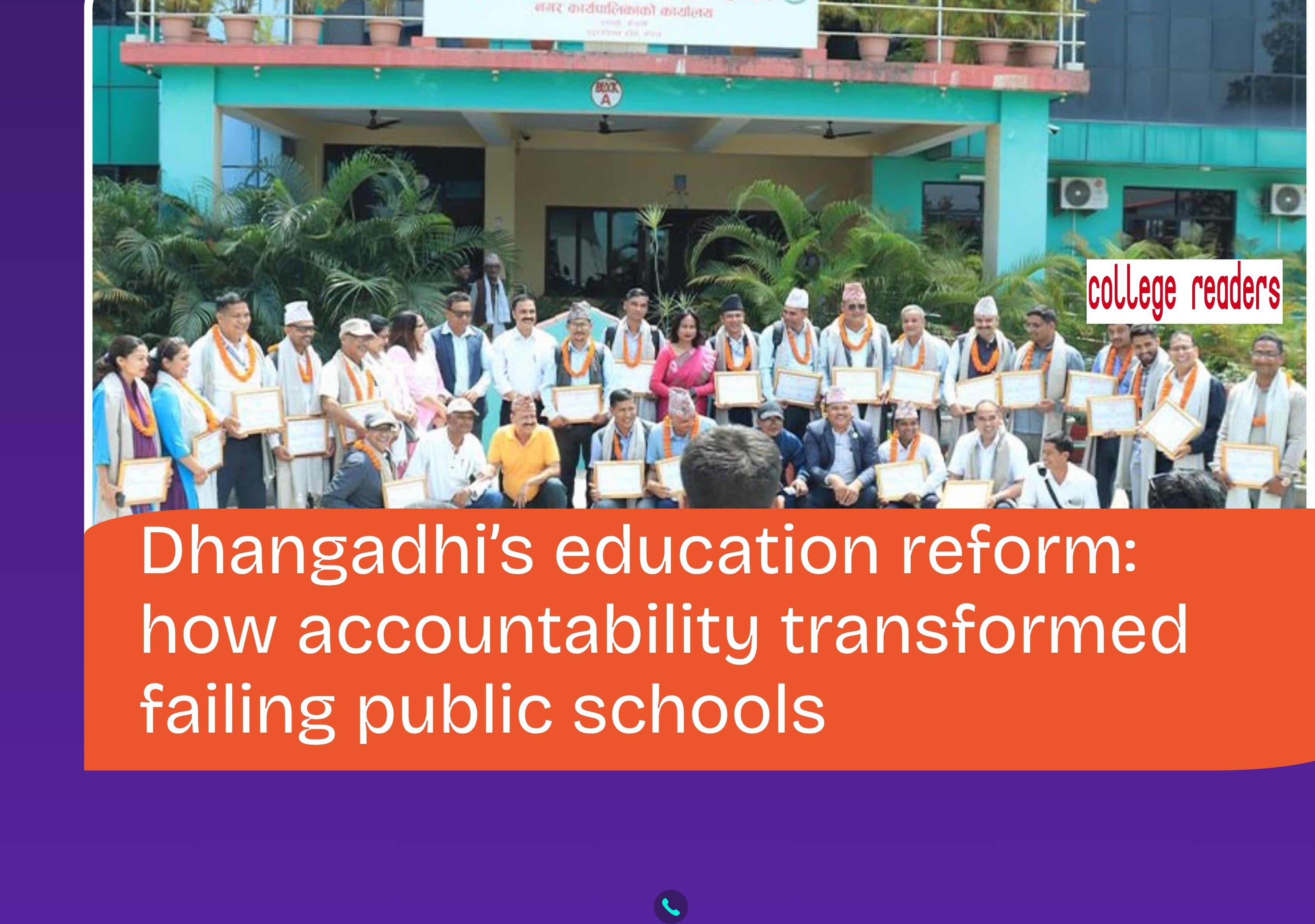
To celebrate improvement, the municipality honored 25 schools that performed strongly in the Grade 8 basic level examination. Unlike conventional award ceremonies, the recognition was held with band music and public celebration, creating excitement among teachers, students, and schools.
Among the 10 community schools recognized were:
- Behdababa Secondary School
- Sharada Secondary School
- Siddhartha Secondary School
- Sarbodaya Secondary School
- Indrodaya Secondary School
- Panchodaya Secondary School
- Sharada Secondary School, Devariya
- Janapriya Secondary School
- Thekeraj Secondary School
- Chandrodya Secondary School
According to Mayor Hamal, the festive style of recognition has encouraged healthy competition and strengthened the educational environment.
Education as a Development Priority
Dhangadhi Sub-Metropolitan City is now spending more than Rs 40 million annually from internal resources alone on education, in addition to the federal budget.
Hamal says the municipality’s total investment in education has risen sharply — from around Rs 20 million in the past to nearly Rs 100 million now.
“Building roads alone is not development,” he said. “If we do not invest in children, the future will remain dark. That is why we have made education a matter of pride.”
That message appears to be resonating. Public confidence in government schools is returning, and the number of students leaving private schools to enroll in public institutions is rising.
For Dhangadhi, what began as a humiliating zero-result crisis has now become a case study in how political will, accountability, and targeted reform can begin to restore faith in public education.
Popular Categories
Trending This Month








 Established in 2065 BS, COLLEGE READERS is a premier national-level educational magazine dedicated to serving the academic and informational needs of school and university students, teachers, educators, and concerned ones in Nepal. The magazine provides current and comprehensive information on various educational opportunities worldwide, aiming to guide school and college-level students in their academic and career journeys. It also highlights essential support services and service providers that play a crucial role in shaping students' career paths in today's competitive world.

- Our Location Putalisadak, Kathmandu
- Send Us Email collegereaders123@gmail.com
- Call Us Now 977 01 4518759
