
Call now
977 01 4518759
Send Message
collegereaders123@gmail.com
Our Location
Putalisadak, Kathmandu
Beyond the Classroom: How Bagiswori College is Redefining Higher Education in Nepal
- College Readers
- 03 Aug 2026
- Views
- Op-ed
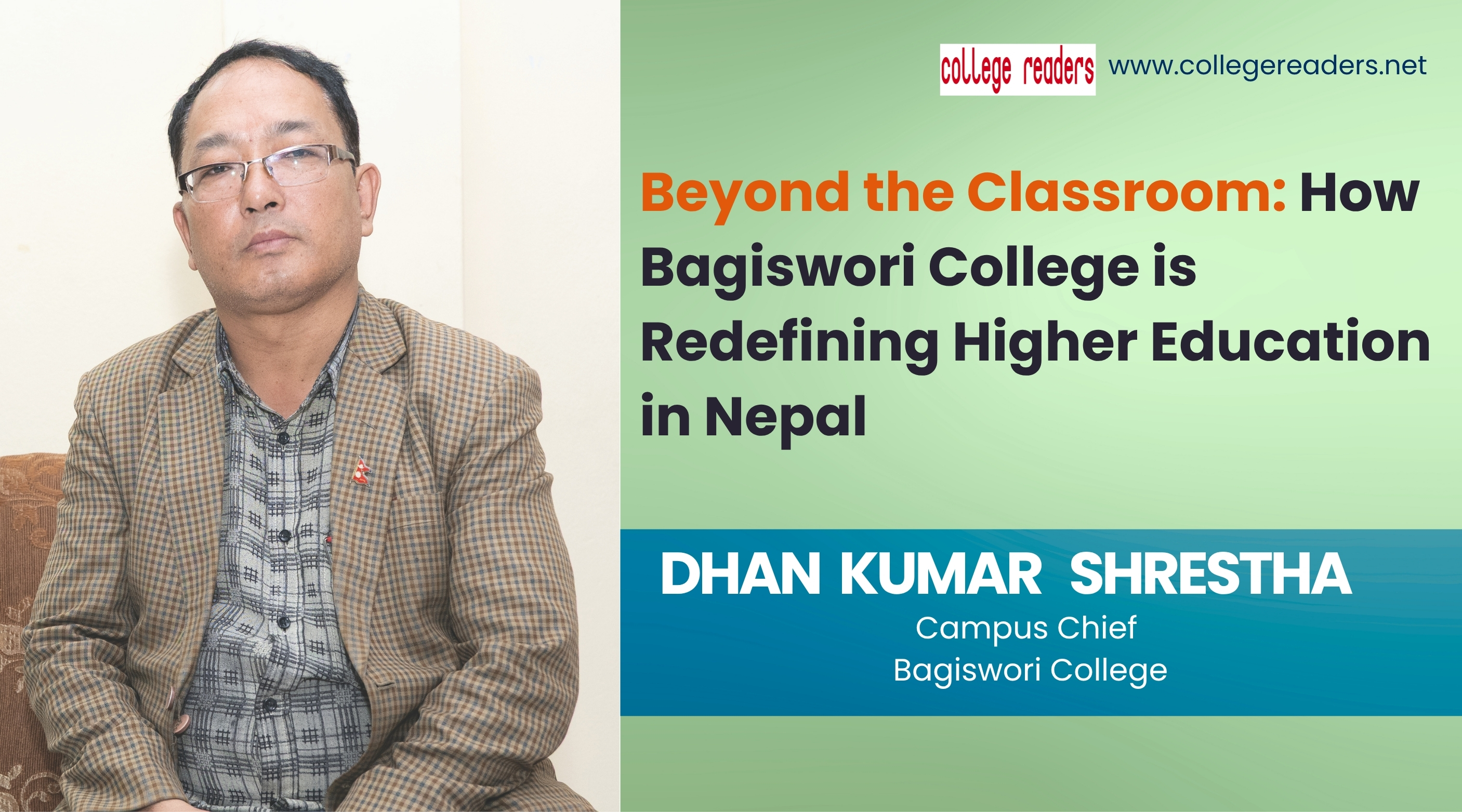
Established in 2007 (2064 B.S.), Bagiswori College has achieved remarkable milestones over the years. As the first community college in Bhaktapur District to receive Quality Assurance and Accreditation (QAA) certification, the institution has continuously sought to redefine the purpose of higher education. Today, Bagiswori College stands not merely as an academic institution but as a center for innovation, social responsibility, and human resource development.
One of the college's most significant achievements is its commitment to bridging the gap between classroom education and practical skills. Recognizing that academic degrees alone are insufficient in today's competitive world, the college introduced its innovative "Four Skills in Four Years" initiative. Through this program, students receive training in information technology, taxation, accounting, digital marketing, public speaking, artificial intelligence, and advanced computer applications.
Bagiswori College believes that every graduate should leave the institution with two valuable assets: an academic degree in one hand and practical skills in the other. This philosophy has become the foundation of the college's educational model.
The college offers fifty-hour non-credit courses designed to provide students with practical knowledge without disrupting their regular academic schedule. These courses include hands-on projects, assessments, workshops, and real-world applications that enable students to become competent professionals and entrepreneurs.
Another distinctive feature of Bagiswori College is its emphasis on community engagement. The institution strongly believes that education must extend beyond the boundaries of the classroom. Students are encouraged to participate in community-based projects, collaborate with local organizations, and identify solutions to real social problems. Before entering the field, students receive proper training, counseling, and preparation through workshops and seminars.
This approach has transformed the learning experience. Students not only apply their theoretical knowledge in practical settings but also develop leadership, communication, and problem-solving skills. By connecting classroom lessons with community needs, Bagiswori College has established a unique model of experiential learning.
Entrepreneurship development is another pillar of the college's success. In a country where unemployment and foreign migration have become pressing concerns, Bagiswori College has adopted an entrepreneurial approach to education. The institution encourages students to think creatively, develop innovative ideas, and transform those ideas into sustainable businesses.
The support provided by the University Grants Commission (UGC) has further strengthened this vision. Student entrepreneur Nista Kayastha received seed funding of NPR 3.15 million to establish Handmade Wonders, while Kripa Prajapati secured NPR 2.41 million for her innovative handmade jewelry business. These achievements demonstrate that when students are given opportunities and mentorship, they can create meaningful enterprises and contribute to the national economy.
The college's Business Festival, organized last year, serves as another inspiring example. During the two-day event, students presented nearly sixty-three innovative business ideas. The festival proved that Nepal's youth possess immense creative potential and that educational institutions must provide platforms to nurture and showcase their talents.
The future of higher education lies not in producing job seekers alone but in creating innovators, researchers, and entrepreneurs capable of generating employment opportunities for others.
Research has also become a defining strength of Bagiswori College. The institution promotes research culture among both faculty members and students by encouraging participation in national and international seminars, workshops, and academic conferences. Undergraduate project work and master's theses are increasingly linked to community issues, enabling students to conduct meaningful research that addresses real societal challenges.
The college actively supports young researchers by funding local projects and encouraging students to publish research articles. This commitment to research has significantly enhanced academic excellence and has helped students develop critical thinking and analytical skills.
Bagiswori College's achievements are reflected not only in its innovative practices but also in the success of its graduates. Since its establishment, the institution has produced nearly 1,600 graduates, with students securing top positions at the national level on multiple occasions. Annual tracer studies reveal that approximately eighty percent of graduates pursue higher education, while many others have successfully entered government service, private-sector organizations, and entrepreneurial ventures. Several alumni are currently pursuing MPhil and PhD degrees in universities both within Nepal and abroad.
One of the most pressing challenges facing Nepal today is the increasing trend of students leaving the country immediately after completing higher secondary education. While financial motivations remain a significant factor, the lack of skill-oriented education has also contributed to this phenomenon. Bagiswori College has addressed this issue by introducing an "earning and learning" model that allows students to balance employment and education.
Under this system, employed students can continue their studies while working part-time. The college provides job cards and flexible schedules, ensuring that students can gain professional experience without compromising their academic performance. Furthermore, soft-skills training programs and industry-oriented courses in accounting, taxation, and finance have significantly improved students' employability.
The success of these initiatives became evident when three leading organizations in Kathmandu recruited Bagiswori students directly after the completion of an accounting technician course. In collaboration with Bhaktapur Municipality and other local institutions, the college also facilitates internships, placements, and professional training opportunities.
The experience of Bagiswori College offers an important lesson for Nepal's higher education sector. The country does not suffer from a shortage of opportunities; rather, it faces a shortage of skilled manpower capable of meeting market demands. Universities and colleges must redesign their curricula to include practical skills, entrepreneurship, and experiential learning.
For students who have recently completed their higher secondary education, the message is clear: Nepal's universities offer valuable academic programs that can serve as a strong foundation for future success. Rather than rushing abroad without adequate preparation, students should first acquire knowledge, skills, and maturity within their own country. By doing so, they can better navigate global opportunities while remaining connected to Nepal's development.
Bagiswori College's journey demonstrates that the future of education lies in innovation, community engagement, research, and entrepreneurship. It is a model that not only prepares students for employment but also empowers them to become agents of change in society.

Popular Categories
Trending This Month








 Established in 2065 BS, COLLEGE READERS is a premier national-level educational magazine dedicated to serving the academic and informational needs of school and university students, teachers, educators, and concerned ones in Nepal. The magazine provides current and comprehensive information on various educational opportunities worldwide, aiming to guide school and college-level students in their academic and career journeys. It also highlights essential support services and service providers that play a crucial role in shaping students' career paths in today's competitive world.

- Our Location Putalisadak, Kathmandu
- Send Us Email collegereaders123@gmail.com
- Call Us Now 977 01 4518759
