
Call now
977 01 4518759
Send Message
collegereaders123@gmail.com
Our Location
Putalisadak, Kathmandu
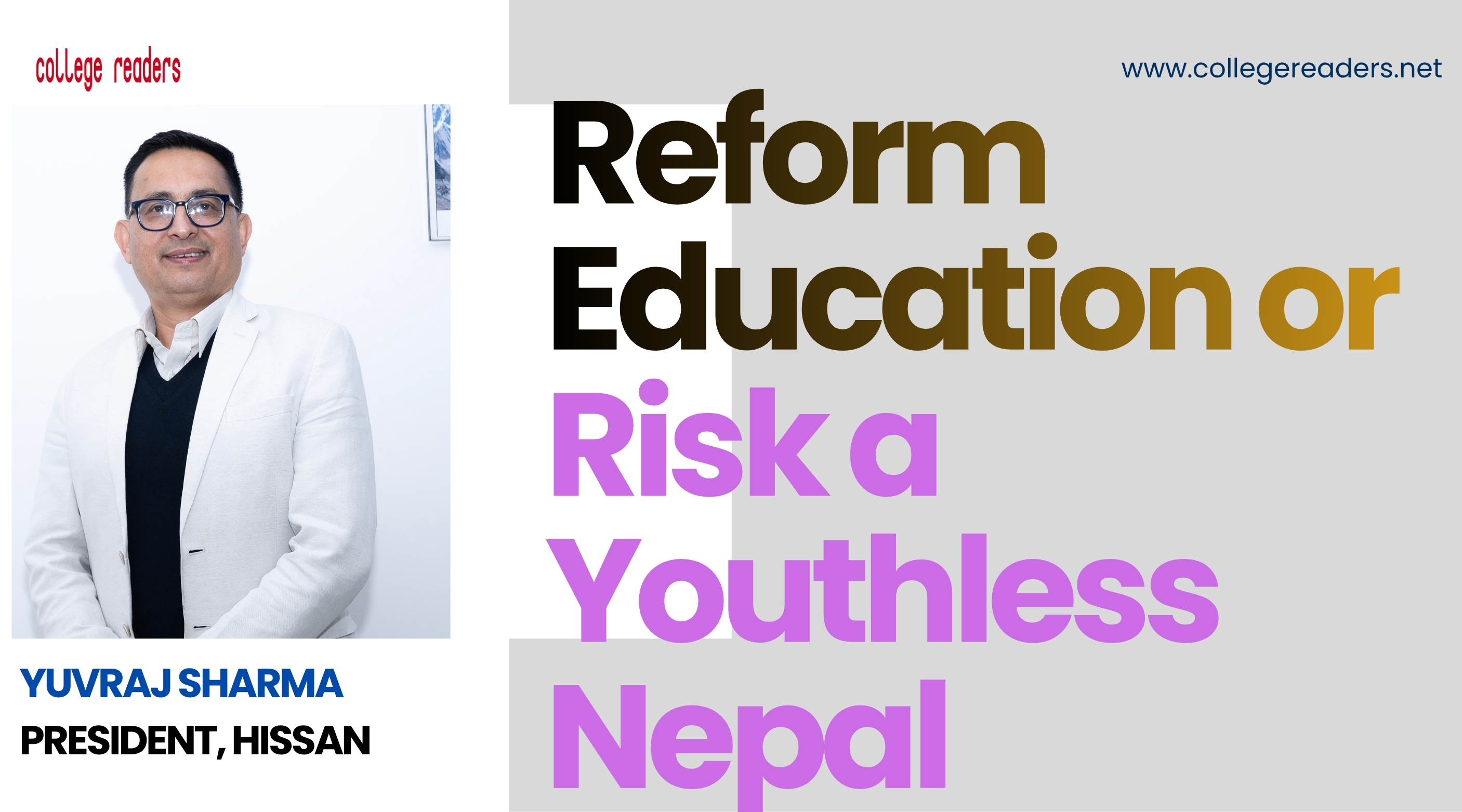
Reform Education or Risk a Youthless Nepal
- College Readers
- 19 Jul 2026
- Views
- Interviews
College Readers: Nepal’s education sector, both private and government, seems to be passing through uncertainty and fluctuation. Many schools and colleges also appear confused about the future. What is HISSAN doing in this situation?
Yuvraj Sharma: This is a very important issue. I have been saying that we must first understand the historical contribution of private educational institutions in Nepal. Private schools, Plus Two colleges, higher education colleges and even university-level institutions began growing significantly from the decade of the 2050s B.S. When Tribhuvan University phased out some of its earlier programmes, private institutions started expanding rapidly. From the mid-2050s to the 2060s, new universities opened, and Plus Two-based institutions began running university programmes in large numbers.
In the 2060s and 2070s, Nepal witnessed major investment in education. Medical colleges, engineering colleges, school infrastructure, Plus Two colleges and university colleges developed strongly. During that period, higher education took a major leap, and investment of more than around five kharba rupees is believed to have entered the sector. Along with that, nearly 55 to 60 foreign university programmes also came to Nepal.
However, from the 2070s to the 2080s, political instability, weak implementation of federalism and failure to internalize change created frustration among students and parents. That frustration opened another path: students began migrating abroad in large numbers. Today, the key challenge is how to protect the achievements made between the 2050s and 2070s and move forward from there. HISSAN must stand firmly in this challenge, identify solutions and raise these issues seriously.
College Readers: What, in your view, created this uncertainty in private education?
Yuvraj Sharma: Private educational institutions grew because government schools and colleges had become weak. Our presence expanded in the 2050s, 2060s and 2070s. But later, debates began on how private institutions should operate. Some argued that private institutions should be converted into trusts or non-profit models. Despite these debates, private investment did not immediately decline. But now the situation has become more serious.
Even the new government, including forces that came from an alternative political stream, has not been able to provide clarity in education. Decisions made at the Ministry of Education and Cabinet levels have often been contradictory. As a result, the entire private sector is shaken and worried. Further investment in education has become questionable.
The main problem is that we still do not have clear laws. We do not have a School Education Act, a Higher Education Act or a Technical Education Act. Rules, regulations and regulatory frameworks have failed to provide guidance and clarity. When uncertainty grows, consultancies grow. Students who once moved from government institutions to private institutions are now moving from private institutions to foreign education. Especially after COVID, this trend has grown rapidly.
College Readers: Students’ first choice now seems to be abroad. Their second choice appears to be foreign university-affiliated colleges in Nepal rather than Nepali university programmes. Why is this happening?
Yuvraj Sharma: Yes, this is a major concern. There is now a group of students who do not want to study in government colleges, do not want to study in private colleges affiliated with Nepali universities, but want to study foreign university programmes inside Nepal. Around 50 to 60 such institutions have emerged. Some are genuinely offering quality, employment-oriented education, but some are simply providing degrees. This is a matter the Ministry of Education must examine seriously.
There is also an issue of unequal regulation. Colleges affiliated with Nepali universities face quota systems, limited admission windows and many procedural barriers. Admission generally happens once a year, around Bhadau–Ashoj. If students are not admitted then, colleges must run the whole year, and often the whole four-year cycle, with the same batch.
But foreign university-affiliated colleges in Nepal can admit students throughout the year and often without strict quotas. For example, in Nepali BIT programmes, students usually need a science background with subjects like Physics, Chemistry, Mathematics or Computer. But some foreign university-affiliated IT programmes accept students from Commerce or any discipline. So, even for similar degrees, entry requirements differ. This has badly affected Nepali university-affiliated private colleges, constituent campuses and community campuses.
College Readers: What immediate reforms are needed to protect Nepal’s education system?
Yuvraj Sharma: We immediately need three major Acts: the School Education Act, the University or Higher Education Act and the Technical Education Act. The Technical Education Act should not be limited only to CTEVT; it should come in the form of a Technical University Act as well. Today, we talk about employment and skills. Academic qualification alone is not enough. We need a strong technical and skill-based stream along with the general academic stream from school to university.
At present, because clear Acts, laws and regulations are absent, education policy is being shaped by influence rather than a national vision. Universities have their own Acts, rules and bylaws. Their systems are rigid. They cannot update curricula on time. Approval processes are slow and complicated. This has prevented Nepali universities from growing fast.
Nepal urgently needs School Education, Higher Education and Technical Education Acts to end policy uncertainty and build a modern, skill-oriented education system.
College Readers: The current government says it wants to make processes faster. Do you see progress?
Yuvraj Sharma: There is an attempt, but the structure itself is slow. Universities often need approval from the Ministry of Education, and since the Prime Minister is the Chancellor, many matters go up to that level. This makes the process lengthy.
Foreign universities are more flexible. They can change curricula quickly through their academic councils, study boards, deans and internal systems. In many cases, they also give colleges autonomy to design or adapt curricula. That is why their programmes become more market-responsive.
Our higher education has two major problems: funding and autonomy. Nepali colleges teach curricula prepared by Nepali universities and Nepali professors, but those colleges do not have the authority to adapt curricula for students. They cannot award degrees. They cannot conduct convocations. Foreign university-affiliated colleges in Nepal can teach, award degrees and hold convocations under their systems, but Nepali affiliated colleges are tightly bound by old university regulations.
Until colleges receive flexibility and autonomy, quality cannot improve as expected.
College Readers: What kind of autonomy should be given to colleges?
Yuvraj Sharma: The upcoming Higher Education Act must make autonomy for colleges a central issue. The University Grants Commission can develop standards for this. It already conducts Quality Assurance and Accreditation, or QAA. Colleges that receive QAA, whether private, community or constituent campuses, should be considered for greater autonomy.
We have three types of institutions: private affiliated colleges, community campuses and constituent campuses. If these institutions meet QAA standards, they should be given authority up to degree awarding. This could start with 25, 50 or even 100 colleges. If we can create autonomous colleges, we can retain students in Nepal for four-year bachelor’s programmes, just as we retained students in Grades 11 and 12 over the past 20 to 25 years.
This is not a strange idea. It is practised in other countries. If autonomous colleges are allowed to design relevant programmes, they can attract Nepali students and even foreign students.
QAA-certified colleges should receive greater autonomy to design curricula, conduct examinations and award degrees according to national quality standards.
College Readers: How can curriculum reform help Nepal attract students?
Yuvraj Sharma: Curriculum is at the centre of the issue. If colleges get autonomy to design new curricula, they can create programmes relevant to Nepal and attractive to international students. For example, Nepal can become a strong place to study International Relations and diplomacy because we are located between two major powers, India and China. Students from China, India, Japan, Thailand and other countries could come here for study and research if we create strong programmes.
Similarly, some colleges may focus on tourism, some on technology, some on diplomacy and some on entrepreneurship. But without autonomy, our intellectual capacity is not being used. One body prepares the curriculum, another campus teaches, another evaluates and the university awards the degree, while the market demands something else. This mismatch must end.
College Readers: How actively is HISSAN lobbying for autonomous colleges and policy reform?
Yuvraj Sharma: HISSAN is clear on this issue. We have been raising it from the beginning. After the new leadership came, we divided responsibilities and formed councils. Now HISSAN will be more active in the drafting and discussion of the Higher Education Act and School Education Act.
We will organize seminars, create national-level debates and bring international practices into discussion. We have already started discussions with the Parliamentary Education Committee and will continue engaging with them. If we do not find a bold departure now, the educational achievements of the past 30 to 40 years may collapse.
We must convince students that studying in Nepal can create opportunities. If we fail, students will continue going abroad. If this trend continues for another 10 years, Nepal may become a youthless country. Schools and universities will struggle to operate, and the impact will go beyond education. It can affect the country’s independence, integrity and sovereignty. So, this is not a small issue.
If student migration continues at the present rate for another decade, Nepal risks becoming a youthless country with weakened educational, economic and national institutions.
College Readers: HISSAN has also advocated for private universities. What model do you propose?
Yuvraj Sharma: In the context of the Higher Education Act, we have imagined five levels of universities or higher education institutions. First, central universities such as Tribhuvan University. Second, provincial universities, some of which are already opening. Third, deemed universities, which may come from the private sector, community sector or trust model. Fourth, autonomous colleges—especially strong QAA-certified colleges with 2,000 to 4,000 students, long academic experience, qualified professors, infrastructure and the capacity to design curricula and conduct examinations. Fifth, specialized universities that focus only on areas like medicine, engineering or health sciences, such as NAMS, BPKIHS or Patan Health Sciences.
This layered model can create flexibility, quality and diversity in Nepal’s higher education.
College Readers: Finally, what is your message to policymakers, educators and parents?
Yuvraj Sharma: We must stop looking at student migration as only an individual student’s choice. It is a national issue. We need strong laws, autonomous institutions, skill-based education, modern curricula and trust in Nepali education. We must show young people opportunities inside Nepal. If education is reformed with vision, Nepal can retain its youth, attract foreign students and build a stronger future.

Popular Categories
Trending This Month








 Established in 2065 BS, COLLEGE READERS is a premier national-level educational magazine dedicated to serving the academic and informational needs of school and university students, teachers, educators, and concerned ones in Nepal. The magazine provides current and comprehensive information on various educational opportunities worldwide, aiming to guide school and college-level students in their academic and career journeys. It also highlights essential support services and service providers that play a crucial role in shaping students' career paths in today's competitive world.

- Our Location Putalisadak, Kathmandu
- Send Us Email collegereaders123@gmail.com
- Call Us Now 977 01 4518759
