
Call now
977 01 4518759
Send Message
collegereaders123@gmail.com
Our Location
Putalisadak, Kathmandu
Private Education Bodies Demand Immediate Abolition of 3% Equity Education Tax
- College Readers
- 12 Jul 2026
- Views
- News
KATHMANDU, Asar 28 — Four organisations representing Nepal’s private education sector have demanded the immediate abolition of the three percent Equity Education Service Fee introduced through the government’s budget for fiscal year 2083/84, arguing that the levy places an unjustified financial burden on families and contradicts the national objective of making education accessible.
Four leading private education organisations have jointly demanded the immediate withdrawal of the three percent Equity Education Service Fee.
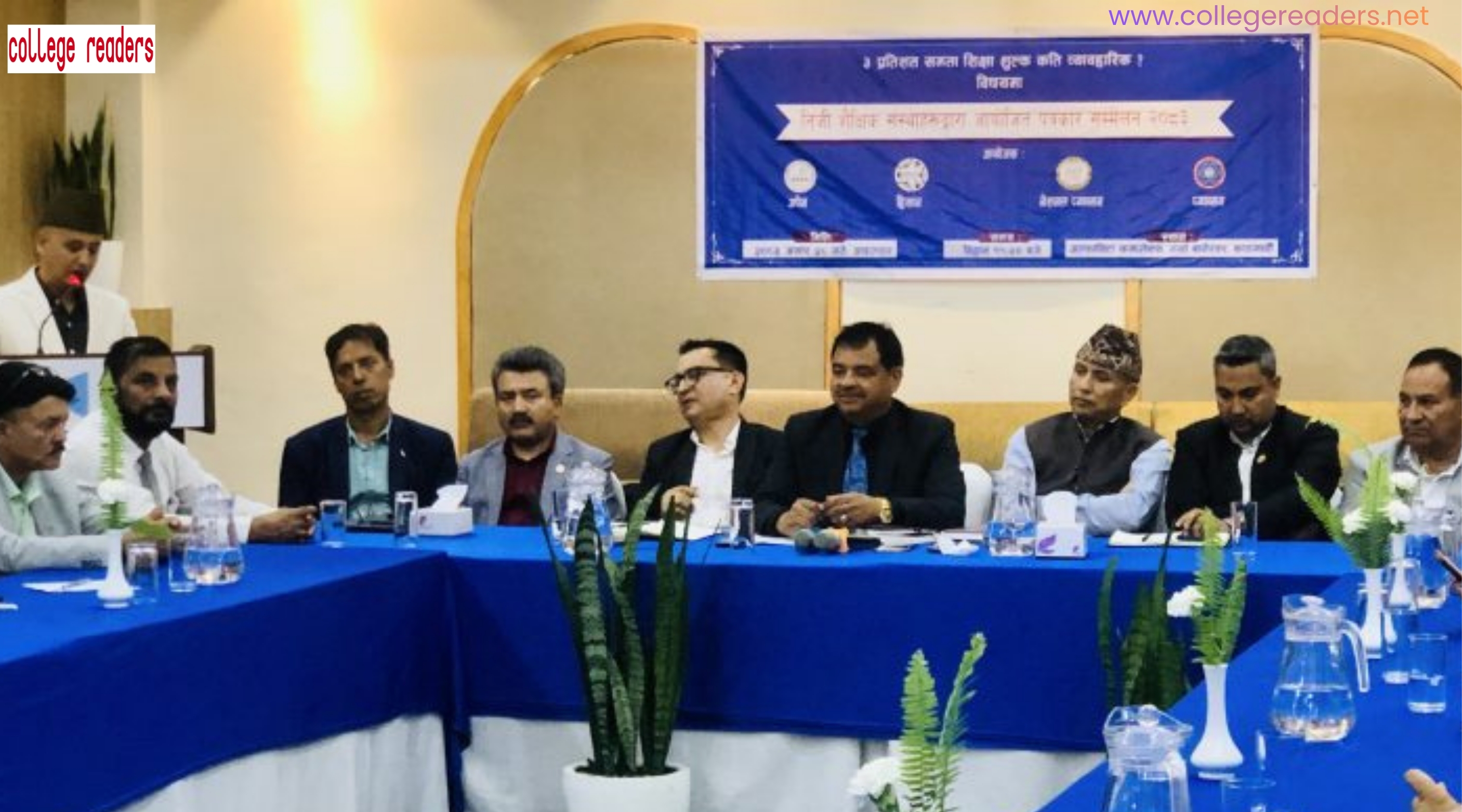
Private and Boarding Schools’ Organisation Nepal (PABSON), National Private and Boarding Schools’ Association Nepal (N-PABSAN), Higher Institutions and Secondary Schools’ Association Nepal (HISSAN), and Association of Private Educational Institutions of Nepal (APEN) presented a joint position at a press conference in Kathmandu. They called on the government to reconsider the tax and several recently proposed or amended education policies that, they said, had been developed without adequate consultation with institutions responsible for implementing them.
Although the organisations raised a broader set of policy concerns, their principal demand was the withdrawal of the three percent fee applied to educational charges collected from students or their parents. They maintained that education is recognised as a fundamental right under Nepal’s Constitution and that adding a tax to school fees is inconsistent with the state’s responsibility to expand educational access and promote equal opportunity.
The organisations argue that taxing educational fees places an unfair burden on parents and contradicts the constitutional commitment to accessible education.
PABSON President Krishna Adhikari said the provision was neither practical nor equitable and could not be considered appropriate as a sustainable education-financing measure. He urged the government to correct the decision after assessing its likely consequences for students, parents and educational institutions. According to Adhikari, a policy intended to support educational equity should not begin by increasing the cost borne by families already financing their children’s education.
N-PABSAN President Subas Neupane argued that the levy conflicted with the spirit of the Constitution. He said policies that fail to respect constitutional principles may be subjected to judicial review and insisted that the government should repeal the fee rather than transfer an additional obligation to parents. The organisations collectively maintained that families choosing private schools should not be treated as though they had committed an offence by assuming responsibility for their children’s education.
HISSAN President Yubaraj Sharma said the measure appeared designed to weaken the private education sector instead of recognising it as a national partner. He argued that discouraging institutions serving a substantial share of Nepal’s learners would ultimately affect students and parents. Sharma also criticised what he described as inconsistent treatment of families, saying they should not be shifted between competing policies without a stable and predictable educational framework.
Former PABSON President Tika Ram Puri said parents should not be penalised for enrolling their children in private schools. He warned that private education organisations would continue to oppose the arrangement unless the government revised it. Immediate past PABSON President D.K. Dhungana similarly said the decision was not in the interest of the education sector and called for its prompt correction. He urged authorities to recognise private institutions as partners and avoid policies that increase educational costs.
In their joint statement, the organisations said private schools have invested their own resources in buildings, technology, qualified personnel and academic quality while providing families with alternatives within the national education system. They argued that a special charge attached to private education could deepen negative perceptions of those institutions and undervalue parents who pay education expenses from their own income. Instead of penalising such families, the government should introduce measures that acknowledge and support their contribution, they said.
The organisations say Nepal’s 10,471 private schools educate approximately 3.741 million students and make a substantial contribution to employment and the national economy.
Citing figures attributed to the latest survey of the Central Bureau of Statistics, the organisations said Nepal has 10,471 private schools educating approximately 3.741 million students. They claimed that the sector generates around Rs 195 billion in annual output, Rs 160 billion in value addition, Rs 75 billion in salaries, wages and employee benefits, and represents Rs 309 billion in fixed-capital investment. These figures, they said, demonstrate its role in employment, skilled-human-resource development, infrastructure and the wider economy.
The representatives said the figures should be considered before any measure affecting private institutions is adopted. In their view, the state benefits from private investment because it reduces pressure on public expenditure while creating educational capacity. They therefore asked officials to evaluate not only potential tax revenue but also the indirect effect of higher costs on enrolment, family choices, employment and future institutional investment.
Alongside abolition of the tax, the private education bodies asked the government to review proposed scholarship requirements. They called for the existing 10 percent scholarship provision to be continued uniformly across the country instead of applying differing requirements of 10, 12 or 15 percent. A consistent national standard, they argued, would make compliance clearer, reduce disputes and ensure that scholarship policies are implemented fairly.
The organisations also demanded expanded access to higher education through collateral-free educational loans of up to Rs 1 million at concessional interest rates. They proposed that the “earn while learning” programme be broadened through partnerships with private institutions and employers, enabling students to gain skills and employment experience while continuing their studies. Such measures, they said, would address affordability more constructively than taxing education fees.
Another concern involved public holidays and the academic calendar. The organisations said decisions affecting school opening days should be taken only after examining their academic, social, economic and practical implications. Frequent or poorly timed changes can disrupt curriculum delivery, assessment schedules and the continuity of learning. They therefore requested structured consultation with schools and other implementing stakeholders before decisions on holidays or weekly closures are announced.
Private education representatives have called for collateral-free educational loans of up to Rs 1 million and an expanded “earn while learning” programme.
They also sought a review of provisions in the tenth amendment to the Education Regulations. While acknowledging that some measures aim to protect student rights, the organisations said certain clauses could create practical difficulties in school management, discipline, parent-school cooperation, institutional accountability and matters connected with Nepal’s cultural and social context. They called for a balanced framework recognising student rights and responsibilities, teachers’ professional rights, discipline and institutional obligations.
On changes to academic sessions, curricula, examinations or school operations, the organisations demanded a minimum six-month notice period. Schools, students, parents, teachers, publishers and service providers require sufficient time to prepare for major changes, they said. Policy stability and advance communication were described as essential to maintaining public confidence and ensuring that reforms can be implemented without avoidable disruption.
The groups further demanded meaningful institutional participation in education policymaking. They said representative private-sector organisations should be included in regular dialogue and formal consultation when the government drafts, amends or implements the School Education Act, education regulations, national curricula, financial provisions and other policies. Participation by those directly affected, they argued, would make policies more practical, sustainable and enforceable.
They have demanded a uniform 10 percent scholarship provision, six months’ advance notice of policy changes and formal participation in education policymaking.
They also urged the government to prepare necessary procedures, directives and implementation mechanisms before enforcing new regulations. Announcing rules without operational clarity can create uncertainty among schools and lead to inconsistent interpretation by different authorities, they said. Their appeal was directed particularly to the finance and education ministries, to which they said a memorandum outlining their concerns had already been submitted.
The organisations stressed that their campaign was not intended to create confrontation with the government. They described the private education sector as a strategic partner in improving quality, expanding access and strengthening Nepal’s education system. Their stated preference was for dialogue, cooperation, mutual trust and shared accountability rather than prolonged conflict.
However, they made clear that the three percent fee had become an immediate point of contention because its cost would ultimately be connected to household education expenditure. They called on the government to study its legal, policy and practical implications, consult parents and education providers, and remove the provision without delay.
The joint appeal places pressure on the government to explain how the revenue would advance educational equity and whether imposing it on fee-paying families is the most appropriate mechanism. For the four organisations, the answer is unequivocal: education should be made more affordable through scholarships, credit, planning and partnership, not burdened by an additional tax.
Popular Categories
Trending This Month








 Established in 2065 BS, COLLEGE READERS is a premier national-level educational magazine dedicated to serving the academic and informational needs of school and university students, teachers, educators, and concerned ones in Nepal. The magazine provides current and comprehensive information on various educational opportunities worldwide, aiming to guide school and college-level students in their academic and career journeys. It also highlights essential support services and service providers that play a crucial role in shaping students' career paths in today's competitive world.

- Our Location Putalisadak, Kathmandu
- Send Us Email collegereaders123@gmail.com
- Call Us Now 977 01 4518759
